 뒤로
Chapter 4: Introduction to Probability – Study Notes for Business Statistics
스터디 가이드 - 스마트 노트
 자료에 맞춘 맞춤형 노트, 핵심 정의, 예시, 맥락을 확장해 제공합니다.
Introduction to Probability
Overview
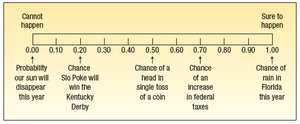
Probability is a fundamental concept in statistics that quantifies the likelihood of events occurring. In business, probability is used to assess risk, make predictions, and inform decision-making. The probability of any event ranges from 0 (impossible) to 1 (certain).
Probability: The chance that a particular event will occur, expressed as a value between 0 and 1.
Experiment: A process that produces a single outcome whose result cannot be predicted with certainty.
Sample Space: The collection of all possible outcomes of an experiment.
Types of Events
Mutually Exclusive, Independent, and Dependent Events
Understanding the relationships between events is crucial for applying probability rules correctly.
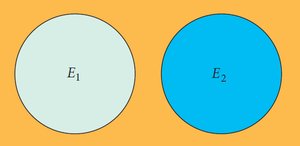
Mutually Exclusive Events: Two events are mutually exclusive if the occurrence of one event precludes the occurrence of the other. For example, an oil well either produces oil or does not; both cannot happen simultaneously.
Independent Events: Two events are independent if the occurrence of one does not affect the probability of the other. For example, the success of a business in Maryland does not influence the success of a business in Oregon.
Dependent Events: Two events are dependent if the occurrence of one event affects the probability of the other. For example, selecting two employees from a group without replacement makes the events dependent.

Approaches to Assigning Probability
Classical, Relative Frequency, and Subjective Probability
There are three main approaches to assigning probabilities to events:
Classical Probability: Used when all outcomes are equally likely. The probability of an event is the ratio of the number of favorable outcomes to the total number of possible outcomes.
Formula:

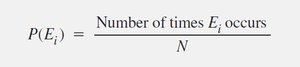
Relative Frequency Probability: Based on historical data; the probability is the proportion of times the event has occurred in the past.
Formula:
Subjective Probability: Based on personal judgment or experience rather than precise calculation. Common in situations with little or no historical data.
Rules of Probability
Basic Probability Rules
There are fundamental rules that all probabilities must follow:
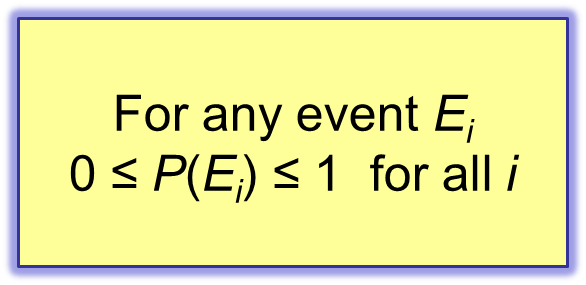
Rule 1: For any event , for all .
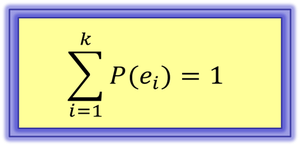
Rule 2: The sum of the probabilities of all possible outcomes in the sample space is 1: .
Addition Rule
Probability of Union of Events
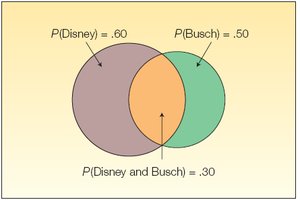
The addition rule is used to find the probability that at least one of several events occurs.
For mutually exclusive events:
For non-mutually exclusive events:
Complement Rule
Probability of the Complement of an Event
The complement rule is used to determine the probability that an event does not occur.
Formula: , where is the complement of event A.
Multiplication Rule
Joint Probability of Events
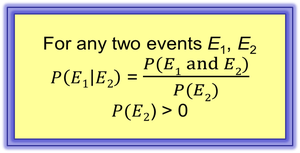
The multiplication rule is used to find the probability that two events both occur.
For independent events:
For dependent events (conditional probability):
Bayes’ Theorem
Revising Probabilities with New Information
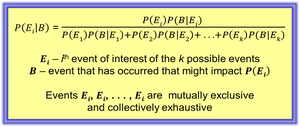
Bayes’ Theorem allows us to update the probability of an event based on new evidence or information.
Formula:
Where is the event of interest, is the new evidence, and is the prior probability.
Tables and Examples
Probability Distributions and Event Tables
Tables are often used to summarize the probabilities of different outcomes or events.
x = number sold | P(x) |
|---|---|
0 | 0.2 |
1 | 0.3 |
2 | 0.4 |
3 | 0.1 |
Table: Probability distribution for number of products sold.
x = defects | P(x) |
|---|---|
0 | 0.03 |
1 | 0.12 |
2 | 0.23 |
3 | 0.27 |
4 | 0.20 |
5 | 0.10 |
6 | 0.04 |
7 | 0.01 |
Table: Probability distribution for number of defects found in a sample.
Summary
Probability quantifies uncertainty and is foundational for business decision-making.
There are three main approaches to probability: classical, relative frequency, and subjective.
Key rules include the addition rule, complement rule, and multiplication rule (for both independent and dependent events).
Bayes’ Theorem is essential for updating probabilities as new information becomes available.
