 뒤로
Calculus I: Derivatives, Trigonometric Functions, and the Unit Circle
스터디 가이드 - 스마트 노트
 자료에 맞춘 맞춤형 노트, 핵심 정의, 예시, 맥락을 확장해 제공합니다.
Motion and Derivatives
Position, Velocity, Acceleration, and Jerk
In calculus, the motion of an object is described using functions of time. The position function s(t) gives the location of an object at time t. Derivatives of this function provide important physical quantities:
Displacement: The change in position over a time interval is .
Average Velocity: The average rate of change of position is .
Instantaneous Velocity: The derivative of position, , gives the velocity at time t.
Speed: The magnitude of velocity, , represents how fast the object is moving.
Acceleration: The derivative of velocity, , measures how velocity changes over time.
Jerk: The derivative of acceleration, , describes the rate of change of acceleration.
Example: If , then , , and .
Differentiation Rules
Basic Rules for Derivatives
Several fundamental rules are used to compute derivatives of functions:
Product Rule:
Quotient Rule:
Chain Rule:
These rules allow for the differentiation of composite, product, and quotient functions.
Trigonometric and Inverse Trigonometric Functions
Derivatives of Trigonometric Functions
The derivatives of the six basic trigonometric functions are:
Derivatives of Inverse Trigonometric Functions
Inverse trigonometric functions have the following derivatives:
For functions of the form , the chain rule applies:
,
,
,
,
Exponential and Logarithmic Functions
Derivatives of Exponential and Logarithmic Functions
Exponential and logarithmic functions are fundamental in calculus:
Derivative Rule for Inverse Functions
Theorem: Derivative of an Inverse Function
If f is a differentiable function with a nonzero derivative on an interval I, then its inverse f-1 is differentiable at every point in its domain. The derivative of the inverse at b is:
Or,
Example: If , then and .
The Unit Circle
Coordinates and Angles on the Unit Circle
The unit circle is a fundamental tool in trigonometry, representing all angles from 0 to 360 degrees (or 0 to radians) and their corresponding sine and cosine values. Each point on the circle is given by for a given angle .
0° or 0 radians:
30° or radians:
45° or radians:
60° or radians:
90° or radians:
120° or radians:
135° or radians:
150° or radians:
180° or radians:
210° or radians:
225° or radians:
240° or radians:
270° or radians:
300° or radians:
315° or radians:
330° or radians:
The unit circle is divided into four quadrants:
Quadrant I: 0 to 90° ($0\frac{\pi}{2}$ radians)
Quadrant II: 90 to 180° ( to radians)
Quadrant III: 180 to 270° ( to radians)
Quadrant IV: 270 to 360° ( to radians)
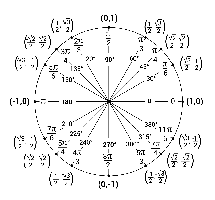
Example: To find , locate on the unit circle: .
Inverse Trigonometric Functions and the Unit Circle
Quadrants for Inverse Functions
Inverse trigonometric functions are defined on restricted domains to ensure they are functions. Their values correspond to specific quadrants:
For , , and : values are in Quadrants I and II.
For , , and : values are in Quadrants I and IV.
This restriction ensures that each inverse function returns a unique value for each input.
Summary Table: Derivatives of Common Functions
Function | Derivative |
|---|---|
Additional info: The notes above cover key topics from Calculus I, including derivatives, trigonometric functions, inverse functions, and the unit circle, which are essential for understanding differentiation and its applications.
