 뒤로
뒤로Differentiation: Rules, Proofs, and Applications
스터디 가이드 - 스마트 노트
 자료에 맞춘 맞춤형 노트, 핵심 정의, 예시, 맥락을 확장해 제공합니다.
Derivatives and Differentiability
Definition and Notation
The derivative of a function at a point measures the instantaneous rate of change of the function with respect to its variable. It is denoted as or .
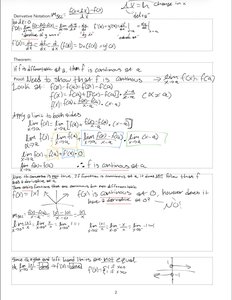
Derivative Notation:
Alternate Notation:
Interpretation: represents the change in .
Example: For , the derivative is .
Continuity and Differentiability
A function is differentiable at a point if the derivative exists at $a$. Differentiability implies continuity, but continuity does not necessarily imply differentiability.
If is differentiable at , then $f$ is continuous at $a$.
To show is continuous at , check if .
To show is differentiable at , check if exists.
Example: A function with a sharp corner (like at ) is continuous but not differentiable at that point.
Rules of Differentiation
The Constant Rule
If is a real number, then the derivative of a constant function is zero.
Proof:
The Power Rule
The power rule is used to differentiate functions of the form .
Proof:
Example:
The Constant Multiple Rule
If is a constant and is differentiable, then:
Proof:
The Sum Rule
The derivative of a sum is the sum of the derivatives.
Proof:
The Difference Rule
The derivative of a difference is the difference of the derivatives.
Generalized Sum Rule and Applications
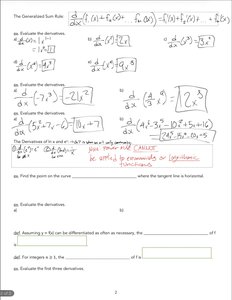
Generalized Sum Rule
The derivative of a sum of multiple functions is the sum of their derivatives.
Example:
Evaluating Derivatives
To evaluate derivatives, apply the rules above to each term in the function.
For , use the constant multiple and power rules:
For , use the power rule:
Limitations of Rules
The sum and difference rules cannot be applied to products or quotients of functions. For those, use the product and quotient rules.
Product Rule:
Quotient Rule:
Example: requires the product rule, not the sum rule.
Finding Tangent Lines and Higher Derivatives
Tangent Lines
The tangent line to a curve at a point is given by:
Point:
Slope:
Equation:
Higher Order Derivatives
If a function can be differentiated multiple times, the second derivative is , the third derivative is , and so on.
For , , ,
Example: For , , ,
Summary Table: Basic Differentiation Rules
Rule | Formula | Example |
|---|---|---|
Constant Rule | ||
Power Rule | ||
Constant Multiple Rule | ||
Sum Rule | ||
Difference Rule |
Additional info: The notes also briefly mention the graphical interpretation of differentiability and continuity, and the limitations of sum/difference rules for products and quotients.
