Ch. 5 - Integration
Briggs - Calculus: Early Transcendentals 3rd Edition
Briggs3rd EditionCalculus: Early TranscendentalsISBN: 9780136847243당신이 사용하는 게 아니라요?교과서 변경
5장, 문제 5.3.68

Areas of regions Find the area of the region bounded by the graph of ƒ and the 𝓍-axis on the given interval.


ƒ(𝓍) = 𝓍³ ― 1 on [―1, 2]

검증된 단계별 안내
1
Step 1: Understand the problem. You are tasked with finding the area of the region bounded by the graph of ƒ(𝓍) = 𝓍³ - 1 and the 𝓍-axis over the interval [―1, 2]. This involves integrating the function over the given interval and accounting for areas above and below the 𝓍-axis.
Step 2: Identify where the function crosses the 𝓍-axis. Set ƒ(𝓍) = 𝓍³ - 1 equal to 0 and solve for 𝓍. This gives the points where the function changes sign, which are important for splitting the integral into subintervals. Solve: x3-1=0. The solution is x=1.
Step 3: Split the integral into subintervals based on the root found in Step 2. The function changes sign at 𝓍 = 1, so divide the interval [―1, 2] into [―1, 1] and [1, 2]. On [―1, 1], the function is below the 𝓍-axis, and on [1, 2], the function is above the 𝓍-axis.
Step 4: Set up the integrals for each subinterval. For the area below the 𝓍-axis on [―1, 1], take the absolute value of the integral: -∫-11x3-1dx. For the area above the 𝓍-axis on [1, 2], compute: ∫12x3-1dx.
Step 5: Combine the results. Add the absolute value of the integral on [―1, 1] to the integral on [1, 2] to find the total area. This ensures that areas below the 𝓍-axis are treated as positive contributions to the total area.

비슷한 문제에 대한 검증된 영상 답변:

이 영상 해법은 위 문제에 도움이 된다고 튜터들이 추천한 것입니다.
영상 길이:
3m

주요 개념

질문에 올바르게 답하기 위해 반드시 이해해야 하는 핵심 개념들은 다음과 같습니다.

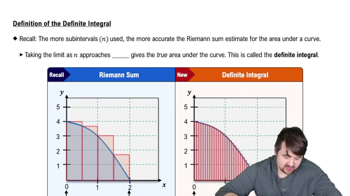
Definite Integral

The definite integral of a function over a specific interval represents the net area between the graph of the function and the x-axis. It is calculated using the Fundamental Theorem of Calculus, which connects differentiation and integration. In this context, the definite integral will help determine the area bounded by the curve ƒ(x) = x³ - 1 and the x-axis from x = -1 to x = 2.
추천 영상:
가이드 코스
05:43
Definition of the Definite Integral

Area Under the Curve

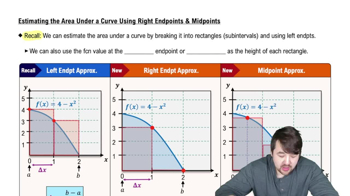
The area under the curve refers to the total area between the graph of a function and the x-axis over a given interval. If the function is above the x-axis, the area is positive, while if it is below, the area is considered negative. To find the total area, one must account for both positive and negative areas, which may involve taking the absolute value of areas where the function is below the x-axis.
추천 영상:
가이드 코스
05:59
Estimating the Area Under a Curve with Right Endpoints & Midpoint

Critical Points and Sign Analysis

Critical points are values of x where the derivative of the function is zero or undefined, indicating potential local maxima, minima, or points of inflection. Analyzing the sign of the function at these points helps determine where the function is above or below the x-axis. For the function ƒ(x) = x³ - 1, finding critical points will assist in understanding the behavior of the graph and identifying the intervals contributing to the area calculation.
추천 영상:
04:50
Critical Points
관련 실천
교과서 질문

Indefinite integrals Use a change of variables or Table 5.6 to evaluate the following indefinite integrals. Check your work by differentiating.                                                                                  


 ∫ 𝓍eˣ² d𝓍

71
views
교과서 질문

Indefinite integrals Use a change of variables or Table 5.6 to evaluate the following indefinite integrals. Check your work by differentiating.                                                                                  


 ∫ 𝓍³ (𝓍⁴ + 16)⁶ d𝓍

56
views
교과서 질문

Average height of a wave The surface of a water wave is described by y = 5 (1 + cos 𝓍) , for ― π ≤ 𝓍 ≤ π, where y = 0 corresponds to a trough of the wave (see figure). Find the average height of the wave above the trough on [ ―π , π] .

65
views
교과서 질문

Approximating displacement The velocity of an object is given by the following functions on a specified interval. Approximate the displacement of the object on this interval by subdividing the interval into n subintervals. Use the left endpoint of each subinterval to compute the height of the rectangles.

{Use of Tech} v = 4 √(t +1) (mi/hr) . for 0 ≤ t ≤ 15 ; n = 5     

47
views
교과서 질문

Derivatives of integrals Simplify the following expressions.


d/dz ∫¹⁰ₛᵢₙ ₂ dt /(t⁴ + 1)

94
views
교과서 질문

The composite function ƒ(g(𝓍)) consists of an inner function g and an outer function ƒ. If an integrand includes ƒ(g(𝓍)), which function is often a likely choice for a new variable u?

58
views