Ch. 5 - Integration
5์žฅ, ๋ฌธ์ œ 5.5.11

Use a substitution of the form u = a๐“ + b to evaluate the following indefinite integrals.
โˆซ(๐“ + 1)ยนยฒ d๐“

๊ฒ€์ฆ๋œ ๋‹จ๊ณ„๋ณ„ ์•ˆ๋‚ด
1
Step 1: Identify the substitution. Let u = ๐“ + 1. This substitution simplifies the expression inside the integral.
Step 2: Compute the derivative of u with respect to ๐“. Since u = ๐“ + 1, we have du/d๐“ = 1, or equivalently, du = d๐“.
Step 3: Rewrite the integral in terms of u. Substituting u = ๐“ + 1 and du = d๐“, the integral becomes โˆซuยนยฒ du.
Step 4: Apply the power rule for integration. The integral of uโฟ with respect to u is (uโฟโบยน)/(n+1) + C, where C is the constant of integration.
Step 5: Substitute back u = ๐“ + 1 into the result to express the solution in terms of ๐“. This completes the evaluation of the indefinite integral.

๋น„์Šทํ•œ ๋ฌธ์ œ์— ๋Œ€ํ•œ ๊ฒ€์ฆ๋œ ์˜์ƒ ๋‹ต๋ณ€:

์ด ์˜์ƒ ํ•ด๋ฒ•์€ ์œ„ ๋ฌธ์ œ์— ๋„์›€์ด ๋œ๋‹ค๊ณ  ํŠœํ„ฐ๋“ค์ด ์ถ”์ฒœํ•œ ๊ฒƒ์ž…๋‹ˆ๋‹ค.
์˜์ƒ ๊ธธ์ด:
2m

์ฃผ์š” ๊ฐœ๋…

์งˆ๋ฌธ์— ์˜ฌ๋ฐ”๋ฅด๊ฒŒ ๋‹ตํ•˜๊ธฐ ์œ„ํ•ด ๋ฐ˜๋“œ์‹œ ์ดํ•ดํ•ด์•ผ ํ•˜๋Š” ํ•ต์‹ฌ ๊ฐœ๋…๋“ค์€ ๋‹ค์Œ๊ณผ ๊ฐ™์Šต๋‹ˆ๋‹ค.

Substitution Method

The substitution method is a technique used in integration to simplify the process by changing the variable of integration. By substituting a new variable, often denoted as 'u', for a function of 'x', the integral can be transformed into a more manageable form. This method is particularly useful when dealing with composite functions or when the integrand can be expressed in terms of a simpler variable.
์ถ”์ฒœ ์˜์ƒ:
07:33
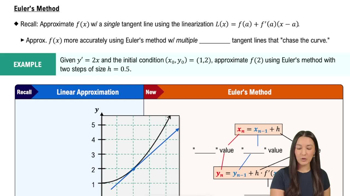
Euler's Method

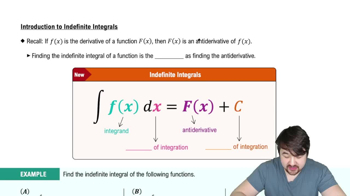
Indefinite Integrals

Indefinite integrals represent a family of functions whose derivative gives the integrand. They are expressed without limits of integration and include a constant of integration, typically denoted as 'C'. The process of finding an indefinite integral involves determining the antiderivative of the function, which can often be achieved through various techniques, including substitution.
์ถ”์ฒœ ์˜์ƒ:
๊ฐ€์ด๋“œ ์ฝ”์Šค
05:04
Introduction to Indefinite Integrals

Polynomial Functions

Polynomial functions are expressions that consist of variables raised to non-negative integer powers, combined using addition, subtraction, and multiplication. In the context of integration, recognizing polynomial forms is crucial, as they can be integrated using straightforward rules. For example, the integral of x^n is (x^(n+1))/(n+1) + C, which simplifies the evaluation of integrals involving polynomials.
์ถ”์ฒœ ์˜์ƒ:
07:00
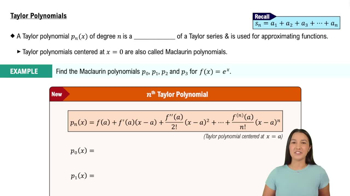
Taylor Polynomials
๊ด€๋ จ ์‹ค์ฒœ
๊ต๊ณผ์„œ ์งˆ๋ฌธ

Use the given substitution to evaluate the following indefinite integrals. Check your answer by differentiating.                                                                                              


 โˆซ (6๐“ + 1) โˆš(3๐“ยฒ + ๐“) d๐“ , u = 3๐“ยฒ + ๐“

52
views
๊ต๊ณผ์„œ ์งˆ๋ฌธ

Definite integrals Evaluate the following integrals using the Fundamental Theorem of Calculus


โˆซฯ€/โ‚„^ยณฯ€/โด (cotยฒ ๐“ + 1) d๐“

68
views
๊ต๊ณผ์„œ ์งˆ๋ฌธ

Areas of regions Find the area of the region bounded by the graph of ฦ’ and the ๐“-axis on the given interval.


ฦ’(๐“) = ๐“ยณ โ€• 1 on [โ€•1, 2]

102
views
๊ต๊ณผ์„œ ์งˆ๋ฌธ

Approximating displacement The velocity of an object is given by the following functions on a specified interval. Approximate the displacement of the object on this interval by subdividing the interval into n subintervals. Use the left endpoint of each subinterval to compute the height of the rectangles.

{Use of Tech} v = 4 โˆš(t +1) (mi/hr) . for 0 โ‰ค t โ‰ค 15 ; n = 5     

47
views
๊ต๊ณผ์„œ ์งˆ๋ฌธ

Derivatives of integrals Simplify the following expressions.


d/dz โˆซยนโฐโ‚›แตขโ‚™ โ‚‚ dt /(tโด + 1)

94
views
๊ต๊ณผ์„œ ์งˆ๋ฌธ

The composite function ฦ’(g(๐“)) consists of an inner function g and an outer function ฦ’. If an integrand includes ฦ’(g(๐“)), which function is often a likely choice for a new variable u?

58
views