 뒤로
뒤로Membrane Transport Mechanisms in Cell Biology
스터디 가이드 - 스마트 노트
 자료에 맞춘 맞춤형 노트, 핵심 정의, 예시, 맥락을 확장해 제공합니다.
Membrane Transport: Principles and Applications
Surface Area to Volume Ratio and Cellular Exchange
Cells rely on their surface area to volume (SA/V) ratio to efficiently exchange materials with their environment. The SA/V ratio determines how easily a cell can absorb nutrients and expel waste products.
Calculation: For a cube, surface area = 6a2, volume = a3. For a rectangular prism, surface area = 2(wl + wh + lh), volume = lwh.
Implication: Cells with a lower SA/V ratio (larger cells) have more difficulty exchanging materials efficiently.
Adaptation: Cells may develop folds or projections to increase surface area or evolve specialized transport mechanisms.
Types of Membrane Transport
Transport across the plasma membrane is essential for maintaining cellular homeostasis. There are several mechanisms by which molecules move across membranes:
Passive Transport: Movement along the concentration or electrochemical gradient, requiring no energy input.
Simple Diffusion: Direct, unaided movement of small, non-polar molecules (e.g., O2, CO2) across the lipid bilayer.
Facilitated Diffusion: Movement of molecules across membranes with the help of transport proteins (e.g., glucose transporter, aquaporins).
Active Transport: Movement against the concentration or electrochemical gradient, requiring energy (usually ATP).
Indirect Active Transport: Uses the gradient of one molecule to drive the transport of another (e.g., symport, antiport).
Red Blood Cell Transport Systems
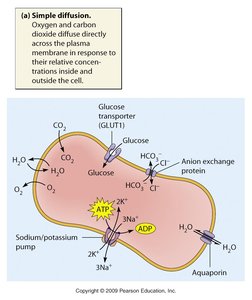
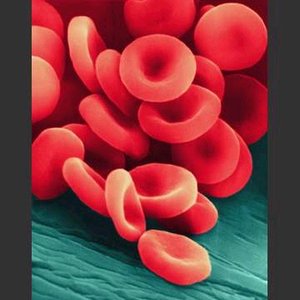
Red blood cells (RBCs) utilize various transport systems to maintain ion balance and facilitate gas exchange.
Simple Diffusion: O2 and CO2 diffuse directly across the membrane.
Facilitated Diffusion: Bicarbonate (HCO3-) and glucose are transported via specific proteins.
Active Transport: The sodium-potassium pump (Na+/K+ ATPase) maintains ion gradients essential for cell function.
Key Definitions in Membrane Transport
Passive Transport: Movement along the concentration or electrochemical gradient without energy input.
Simple Diffusion: Direct movement of molecules through the lipid bilayer.
Facilitated Diffusion: Protein-assisted movement across the membrane.
Active Transport: Energy-dependent movement against a gradient.
Symport: Two substances move in the same direction via a transport protein.
Antiport: Two substances move in opposite directions via a transport protein.
Factors Affecting Diffusion Across Membranes
The rate of diffusion across lipid bilayers depends on several factors:
Size: Smaller molecules diffuse more rapidly.
Polarity: Nonpolar molecules diffuse more easily than polar ones.
Charge: Charged molecules (ions) have low permeability.
Factor | More Permeable | Less Permeable | Permeability Ratio* |
|---|---|---|---|
Size | H2O (Water) | Urea | 102:1 |
Polarity | Propanol | Glycerol | 104:1 |
Charge | O2 (Oxygen) | OH- (Hydroxide ion) | 107:1 |
*Ratio of diffusion rate for the more permeable solute to the less permeable solute.

Osmosis and Tonicity
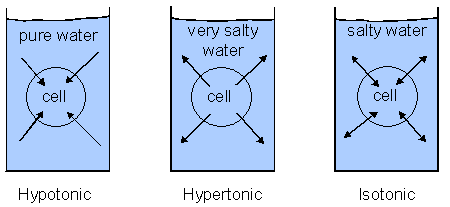
Osmosis is the diffusion of water across a selectively permeable membrane. Tonicity describes the relative concentration of solutes outside versus inside the cell, affecting water movement.
Hypotonic Solution: Lower solute concentration outside; water enters the cell, causing swelling or lysis.
Hypertonic Solution: Higher solute concentration outside; water leaves the cell, causing shrinkage or plasmolysis.
Isotonic Solution: Equal solute concentration; no net water movement.

Microscopy of Osmosis in Plant Cells
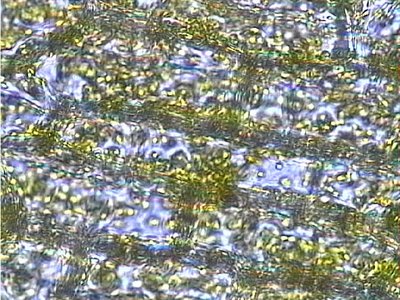
Plant cells in different solutions demonstrate the effects of osmosis:
Isotonic: No net water movement; cells remain flaccid.
Hypertonic: Water leaves the cell; plasmolysis occurs.
Hypotonic: Water enters the cell; cells become turgid.

Transport Proteins: Channels and Carriers
Transport proteins facilitate the movement of specific molecules across the membrane:
Channels: Provide hydrophilic pathways for ions and water (e.g., ion channels, aquaporins).
Carriers (Transporters): Bind and transport specific molecules (e.g., glucose transporter, Na+/K+ pump).


Ion Channels and Gated Channels
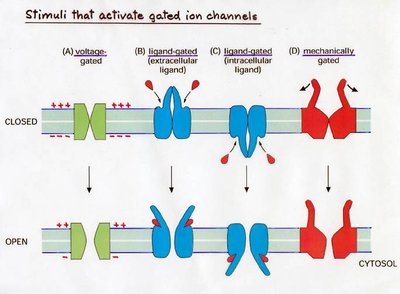
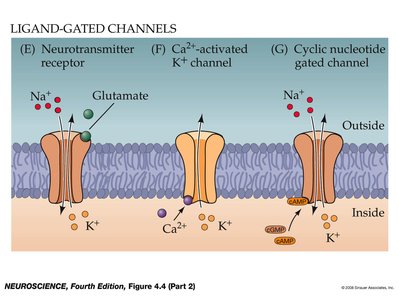
Ion channels are selective for specific ions and can be regulated (gated) by various stimuli:
Voltage-Gated Channels: Open in response to changes in membrane potential.
Ligand-Gated Channels: Open when a specific molecule (ligand) binds.
Mechanically Gated Channels: Open in response to mechanical forces.

Active Transport and ATPases
Active transport uses energy to move substances against their gradients. ATPases are enzymes that hydrolyze ATP to drive transport:
Na+/K+ ATPase: Maintains sodium and potassium gradients across the plasma membrane.
V-type ATPase: Pumps protons into organelles like lysosomes and vacuoles.
ABC Transporters: Use ATP to transport a variety of molecules across membranes.
Clinical Application: Cystic Fibrosis Transmembrane Conductance Regulator (CFTR)
CFTR is an ABC transporter that functions as a chloride channel. Mutations in CFTR cause cystic fibrosis, affecting ion and water transport in epithelial cells.
Normal Function: Regulates chloride and water movement in airways.
CF Mutation: Impaired chloride transport leads to thick mucus and respiratory issues.
Gene Therapy: Introduction of functional CFTR can restore normal ion transport.
Summary Table: Types of Membrane Transport
Type | Energy Requirement | Direction | Example |
|---|---|---|---|
Simple Diffusion | No | Down gradient | O2, CO2 |
Facilitated Diffusion | No | Down gradient | Glucose, HCO3- |
Active Transport | Yes (ATP) | Against gradient | Na+/K+ ATPase |
Indirect Active Transport | Yes (ion gradient) | Against gradient | Na+/glucose symporter |
Key Equations
Fick's Law of Diffusion:
Where J is the flux, D is the diffusion coefficient, and \frac{dC}{dx} is the concentration gradient.
Osmotic Pressure (van 't Hoff equation):
Where \Pi is osmotic pressure, i is the van 't Hoff factor, M is molarity, R is the gas constant, and T is temperature in Kelvin.
Additional info: This guide integrates foundational concepts from Chapter 8 (Transport Across Membranes) and related topics in cell biology, providing a comprehensive overview suitable for exam preparation.
