 뒤로
뒤로The Endomembrane System and Protein Sorting: Structure, Function, and Techniques
스터디 가이드 - 스마트 노트
 자료에 맞춘 맞춤형 노트, 핵심 정의, 예시, 맥락을 확장해 제공합니다.
The Endomembrane System
Overview of the Endomembrane System
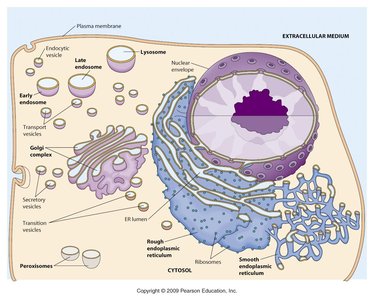
The endomembrane system is a collection of membranous organelles within eukaryotic cells that work together to modify, package, and transport lipids and proteins. It includes the endoplasmic reticulum (ER), Golgi apparatus, endosomes, lysosomes, and transport vesicles. Mitochondria, chloroplasts, and peroxisomes are not considered part of this system because they do not fuse with the ER.
Key Components: ER (rough and smooth), Golgi complex, endosomes, lysosomes, transport vesicles
Function: Protein and lipid synthesis, modification, sorting, and transport
Exclusion: Mitochondria, chloroplasts, and peroxisomes are not part of the endomembrane system
Endoplasmic Reticulum (ER)
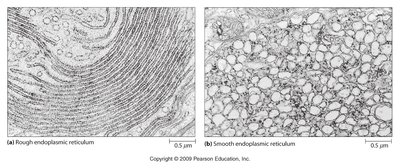
The ER is a network of membranes involved in protein and lipid synthesis. It is divided into rough ER (RER), which is studded with ribosomes, and smooth ER (SER), which lacks ribosomes.
Rough ER: Site of protein synthesis, co-translational insertion, protein maturation (glycosylation, S-S bond formation, assembly of multimers), and removal of misfolded proteins for degradation
Smooth ER: Involved in lipid metabolism, membrane biosynthesis, steroid biosynthesis, carbohydrate metabolism, calcium storage, and drug detoxification
Golgi Apparatus
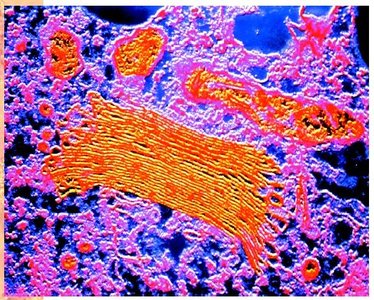
The Golgi apparatus is responsible for modifying, sorting, and packaging proteins and lipids for secretion or delivery to other organelles. It consists of a series of flattened membrane sacs called cisternae.
Protein Glycosylation: Addition and modification of carbohydrate groups on proteins
Protein Targeting Signals: Direct proteins to their correct destinations
Trafficking: Anterograde (forward) and retrograde (backward) transport between ER and Golgi


Vesicular Trafficking
Vesicular trafficking involves the movement of proteins and lipids between organelles via membrane-bound vesicles.
Anterograde Transport: Movement from ER to Golgi to plasma membrane or lysosomes
Retrograde Transport: Movement from Golgi back to ER
Secretion Types: Regulated (in response to stimulus) and constitutive (continuous)

Studying Organelles: Subcellular Fractionation and Centrifugation
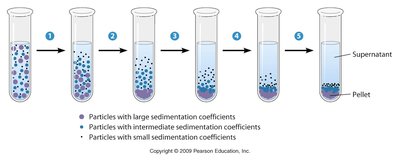
Differential Centrifugation
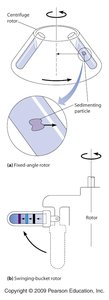
Differential centrifugation is a technique used to separate cellular components based on their size and density.
Principle: Larger particles sediment faster and form pellets at lower centrifugal forces
Svedberg Unit (S): ; larger S indicates faster sedimentation
Density Gradient Centrifugation
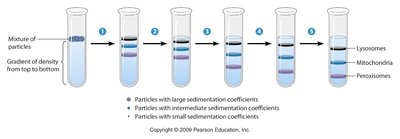
Density gradient centrifugation separates organelles based on their buoyant density in a gradient medium.
Gradient Formation: Layers of increasing density allow particles to settle at their respective equilibrium positions
Application: Used to isolate lysosomes, mitochondria, and peroxisomes


Lysosomes and Autophagy
Lysosomes
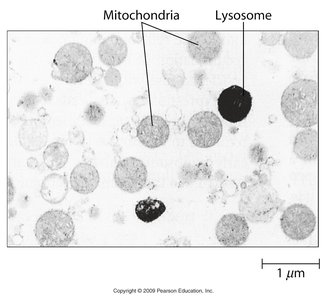
Lysosomes are membrane-bound organelles containing digestive enzymes (acid hydrolases) that break down macromolecules.
Internal pH: 4-5, maintained by proton pumps
Functions: Defense, nutrition, autophagy, extracellular digestion
Membrane: Heavily glycosylated on the inside to protect from enzyme activity
Autophagy
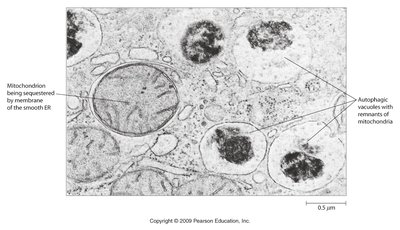
Autophagy is the process by which cells degrade and recycle their own components, often involving the sequestration of organelles by the ER and subsequent digestion by lysosomes.
Role: Cellular maintenance, response to starvation, removal of damaged organelles
Peroxisomes
Structure and Function
Peroxisomes are small, membrane-bound organelles involved in hydrogen peroxide metabolism, detoxification, and oxidation of fatty acids.
Enzymes: Contain catalase and other enzymes for breaking down H2O2
Metabolic Roles: Nitrogen compound metabolism, detoxification, fatty acid oxidation
Endocytosis and Exocytosis
Exocytosis
Exocytosis is the process by which cells release substances to the extracellular environment via vesicle fusion with the plasma membrane.
Regulated Secretion: Occurs in response to specific signals
Constitutive Secretion: Continuous release of substances
Endocytosis
Endocytosis is the uptake of external substances by the cell through vesicle formation.
Pinocytosis: Uptake of liquids
Phagocytosis: Uptake of large particles (>0.5 μm) via pseudopodia extension
Receptor-Mediated Endocytosis: Specific uptake of molecules via receptor binding, clathrin-coated vesicles, and dynamin-mediated vesicle scission
Clathrin-Mediated Endocytosis
Clathrin is a protein that forms a lattice structure around vesicles, facilitating their formation and internalization.
Structure: Clathrin triskelion assembles into a polyhedral lattice
Function: Drives vesicle budding and internalization
Summary Table: Major Organelles of the Endomembrane System
Organelle | Main Function | Key Features |
|---|---|---|
Rough ER | Protein synthesis, maturation | Ribosomes, glycosylation, S-S bonds |
Smooth ER | Lipid metabolism, detoxification | No ribosomes, steroid synthesis, calcium storage |
Golgi Apparatus | Protein modification, sorting | Cisternae, glycosylation, trafficking |
Lysosome | Digestion, autophagy | Acid hydrolases, low pH, glycosylated membrane |
Peroxisome | Detoxification, fatty acid oxidation | H2O2 metabolism, catalase |
Additional info:
Subcellular fractionation and centrifugation are essential techniques for isolating and studying organelles.
Protein sorting and vesicular trafficking are
tightly regulated processes critical for cell function and homeostasis.
Molecular mechanisms of exocytosis during
neurotransmitter release
from calcium channel come in
voltage gated channel is caluicium
if the neuron is active voltage gated will open
ca will come in they will come together.
- you need to know the sequence events.
Synaptic vesicle: dont need to know all these proteins
SNARE proteins are specialized molecular machines that drive the fusion of synaptic vesicles with the presynaptic cell membrane to release neurotransmitters
to maintain these synaptic you need to have proteins, ate etc to train something it will come at the expense of the synaptic you're not training (neuroplasticity)
🔄 The Biological Trade-Off
Your brain cannot infinitely expand its synaptic network due to physical space and metabolic limits. Therefore, training a specific skill or memory comes at the expense of other pathways. Your brain actively cleans up underutilized synapses to free up the amino acids, lipids, and ATP needed to solidify the new network you are training.
it's gonna affect visceral release.
diseases:#1 Diseases That Affect the Presynaptic Terminal (can't control you muscles) ( it affects snares complex)
Question : you are a good bacteria you enter the cell why would it be beneficial to have toxins : what will happen too your guts if you have these toxins?
TeTX
# relisten to min 8 - 19
The tetanus toxin light chain (TeTxLC) abolishes neurotransmitter release specifically in inhibitory interneurons by acting as a zinc-dependent endopeptidase that cleaves the vesicle-associated membrane protein (VAMP/synaptobrevin
sphincter of Oddi dysfunction (SOD), which can cause an agonizing "pancreas breaking" type of pain or trigger attacks of recurrent acute pancreatitis (inflammation of the pancreas. botox and .. prevent vesicle diffusion .
Injecting botulinum toxin (Botox) into the sphincter of Oddi relaxes this tight muscular valve, preventing the fluid backups that cause severe abdominal pain and recurrent acute pancreatitis
relisten to min 31- 30-29 .
