 뒤로
Transport Across Cell Membranes: Principles and Mechanisms
스터디 가이드 - 스마트 노트
 자료에 맞춘 맞춤형 노트, 핵심 정의, 예시, 맥락을 확장해 제공합니다.
Transport Across Cell Membranes
Principles of Transmembrane Transport
Cell membranes are selectively permeable barriers that regulate the movement of substances into and out of the cell. The ability of a molecule to cross the lipid bilayer depends on its size, polarity, and charge.
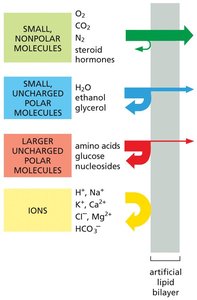
Small, nonpolar molecules (e.g., O2, CO2, N2, steroid hormones) can diffuse freely across the lipid bilayer.
Small, uncharged polar molecules (e.g., H2O, ethanol, glycerol) can cross, but less efficiently.
Larger uncharged polar molecules (e.g., amino acids, glucose, nucleosides) and ions (e.g., H+, Na+, K+, Ca2+, Cl-, Mg2+, HCO3-) require specialized transport proteins.
Role of Membrane Proteins in Transport
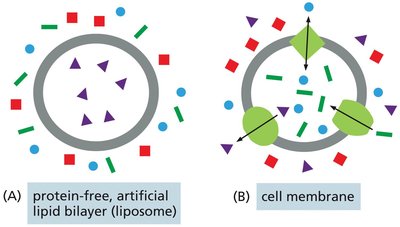
While artificial lipid bilayers allow only certain molecules to pass, biological membranes contain transport proteins that facilitate the movement of specific solutes.
Transport proteins increase the selectivity and rate of solute movement across the membrane.
Different cell types express distinct sets of transporters, reflecting their physiological roles.
Types of Membrane Transport Proteins
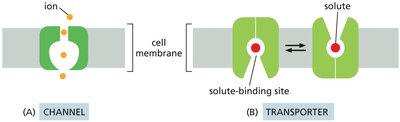
There are two main classes of membrane transport proteins: channels and transporters.
Channels form hydrophilic pores that allow specific ions or water molecules to pass through by diffusion. They discriminate mainly by size and charge and can be gated.
Transporters bind specific solutes and undergo conformational changes to transfer the solute across the membrane. They are highly selective for their substrates.
Mechanisms of Membrane Transport
Passive vs. Active Transport
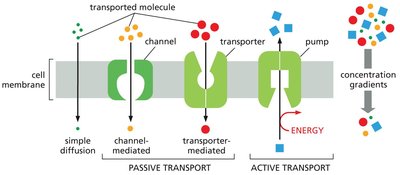
Solutes cross membranes by either passive or active transport:
Passive transport does not require energy and moves substances down their concentration or electrochemical gradients. Includes simple diffusion, channel-mediated, and transporter-mediated diffusion.
Active transport requires energy (often from ATP hydrolysis or ion gradients) to move substances against their gradients. Carried out by pumps.
Facilitated Diffusion
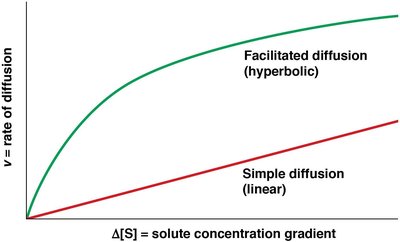
Facilitated diffusion is a type of passive transport where specific molecules cross the membrane via transport proteins. The rate of facilitated diffusion shows a hyperbolic relationship to solute concentration, similar to enzyme kinetics, due to transporter saturation.
At low solute concentrations, the rate increases rapidly; at high concentrations, it plateaus as all transporters are occupied.
Example: Glucose Transport
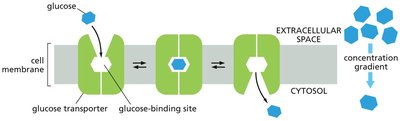
The glucose transporter (GluT) mediates the passive transport of glucose across the cell membrane. It binds glucose on one side, undergoes a conformational change, and releases it on the other side, following the concentration gradient.
Water Transport: Aquaporins and Osmosis
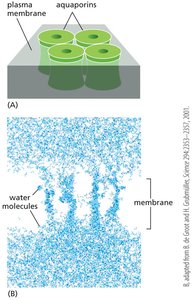
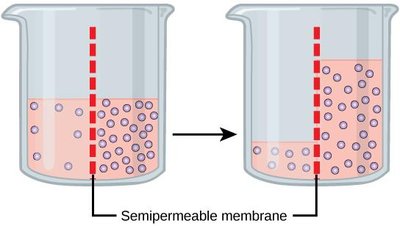
Water molecules diffuse rapidly through specialized channels called aquaporins. The movement of water across a membrane is called osmosis, typically from areas of low solute concentration to high solute concentration.
Ion Concentrations and Membrane Potential
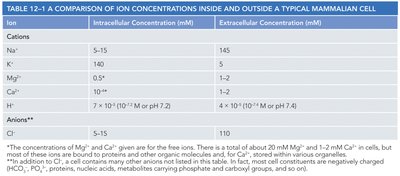
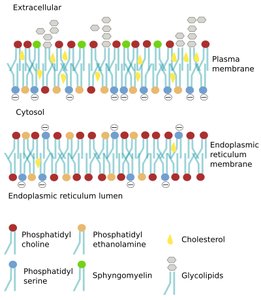
Cells maintain distinct ion concentrations inside and outside the membrane, contributing to the membrane potential (voltage difference across the membrane). The asymmetric distribution of ions and charged phospholipids is crucial for cell function.
Electrochemical Gradient
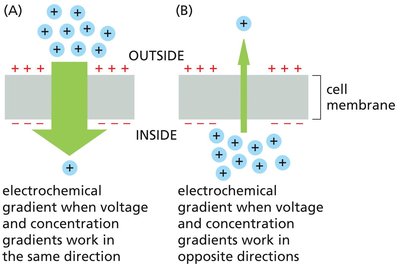
The driving force for moving charged molecules across a membrane is the electrochemical gradient, which combines the concentration gradient and the voltage gradient (membrane potential).
Transporters and Their Functions
Types of Transporters
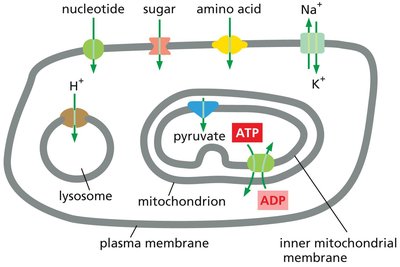
Each membrane contains a characteristic set of transporters, reflecting the specific needs of the cell or organelle.
Active Transport Mechanisms
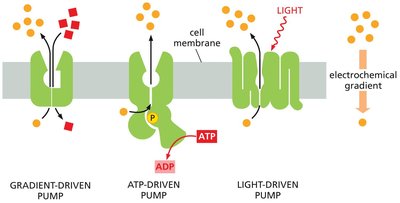
Active transport is carried out by pumps that use energy to move solutes against their gradients. There are three main types:
Gradient-driven pumps (secondary active transport): Couple the uphill transport of one solute to the downhill movement of another.
ATP-driven pumps: Use energy from ATP hydrolysis.
Light-driven pumps: Use energy from sunlight (mainly in bacteria).
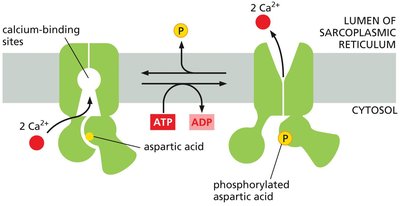
ATP-Driven Pumps: Ca2+ and Na+/K+ Pumps
The Ca2+ pump in the sarcoplasmic reticulum uses ATP to transport calcium ions out of the cytosol, crucial for processes like muscle contraction and nerve signaling.
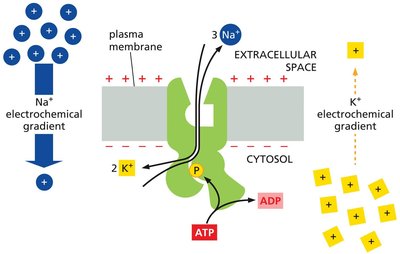
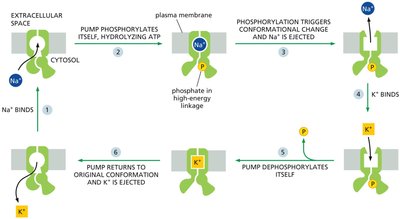
The Na+/K+ pump uses ATP to export three Na+ ions and import two K+ ions, maintaining essential gradients for cell function and contributing to the membrane potential.
Secondary Active Transport: Symporters and Antiporters
Gradient-driven pumps can function as symporters (co-transporting two molecules in the same direction) or antiporters (transporting molecules in opposite directions).
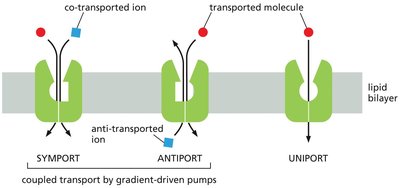
Example: Glucose-Na+ Symporter
The glucose-Na+ symporter uses the energy stored in the Na+ electrochemical gradient to drive the active import of glucose into cells, especially in the gut epithelium.
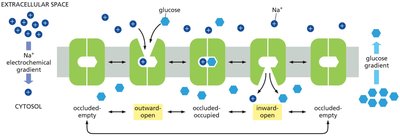
Summary Table: Types of Membrane Transport
Transport Type | Energy Requirement | Direction Relative to Gradient | Example |
|---|---|---|---|
Simple Diffusion | No | Down | O2, CO2 |
Facilitated Diffusion | No | Down | Glucose via GluT |
Active Transport | Yes (ATP or gradient) | Against | Na+/K+ pump |
Secondary Active Transport | Yes (gradient) | Against (for one solute) | Glucose-Na+ symporter |
