 뒤로
뒤로College Algebra Study Guide: Equations, Complex Numbers, and Inequalities
스터디 가이드 - 스마트 노트
 자료에 맞춘 맞춤형 노트, 핵심 정의, 예시, 맥락을 확장해 제공합니다.
Complex Numbers
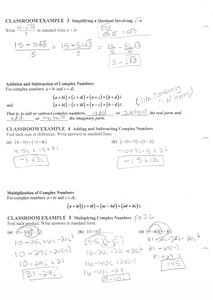
Addition and Subtraction of Complex Numbers
Complex numbers are numbers of the form a + bi, where a and b are real numbers and i is the imaginary unit, defined by . To add or subtract complex numbers, combine the real parts and the imaginary parts separately.
Formula:
Formula:
Example:
Multiplication of Complex Numbers
To multiply complex numbers, use the distributive property and remember that .
Formula:
Example:
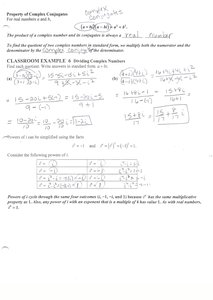
Division of Complex Numbers
To divide complex numbers, multiply the numerator and denominator by the conjugate of the denominator to eliminate the imaginary part.
Formula:
Example:
Complex Conjugates
The conjugate of a complex number a + bi is a - bi. Multiplying a complex number by its conjugate yields a real number.
Formula:
Example:
Powers of i
The powers of the imaginary unit i repeat in a cycle of four:
Power | Value |
|---|---|
i1 | i |
i2 | -1 |
i3 | -i |
i4 | 1 |
Quadratic Equations
Definition and Standard Form
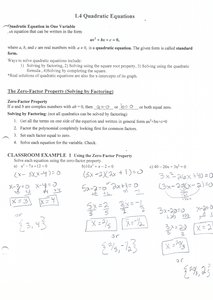
A quadratic equation in one variable is an equation that can be written in the form , where a, b, and c are real numbers and a ≠ 0.
Standard form:
Zero-Factor Property (Factoring)
If a product of two factors equals zero, then at least one of the factors must be zero. This property is used to solve quadratic equations by factoring.
Steps:
Write the equation in standard form.
Factor the quadratic expression.
Set each factor equal to zero and solve for x.
Example:
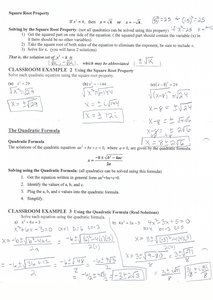
Square Root Property
Quadratic equations of the form can be solved by taking the square root of both sides.
Formula:
Example:
The Quadratic Formula
The quadratic formula is used to solve any quadratic equation :
Formula:
Example:
Applications and Modeling with Quadratic Equations
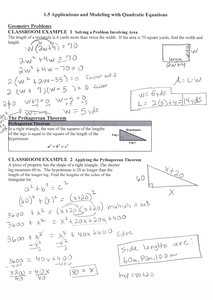
Geometry Problems
Quadratic equations are often used to solve geometry problems, such as finding the dimensions of rectangles or triangles given certain conditions.
Example: If the area of a rectangle is 70 square yards and the length is 2 yards more than twice the width, set up and solve .
Pythagorean Theorem
The Pythagorean Theorem relates the sides of a right triangle: , where c is the hypotenuse.
Example: If one leg is 60 and the other is x, and the hypotenuse is 100, solve .
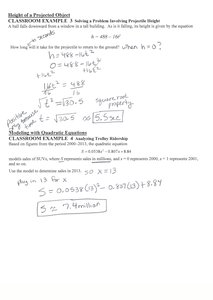
Height of a Projected Object
Quadratic equations can model the height of a projected object, such as a ball thrown from a building. The height as a function of time is often given by .
Example: A ball is dropped from a height of 488 ft. How long does it take to reach the ground? Set and solve .
Solving Other Types of Equations
Rational Equations
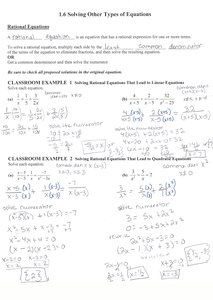
A rational equation is an equation that contains rational expressions (fractions with polynomials in the numerator and denominator). To solve, multiply both sides by the least common denominator (LCD) to clear fractions.
Example:
Equations with Radicals
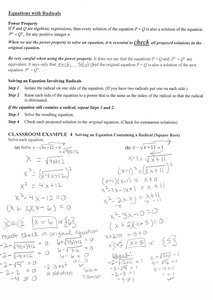
Equations containing radicals can be solved by isolating the radical and then squaring both sides. Always check for extraneous solutions.
Example:
Quadratic and Rational Inequalities
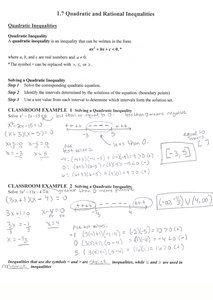
Quadratic Inequalities
A quadratic inequality is an inequality that can be written in the form , , etc. Solve by finding the zeros of the quadratic and testing intervals.
Example:
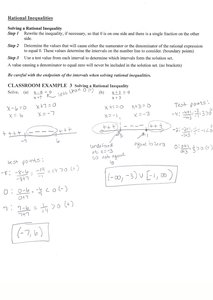
Rational Inequalities
Rational inequalities involve rational expressions. Solve by finding critical points (where the numerator or denominator is zero) and testing intervals.
Example:
Summary Table: Powers of i
n | in |
|---|---|
1 | i |
2 | -1 |
3 | -i |
4 | 1 |
Additional info: These notes cover key College Algebra topics including complex numbers, quadratic equations, applications, rational equations, and inequalities, with examples and step-by-step solutions. Images included are directly relevant to the mathematical procedures and visual explanations.
