 뒤로
뒤로Functions and Their Representations: Study Guide for College Algebra
스터디 가이드 - 스마트 노트
 자료에 맞춘 맞춤형 노트, 핵심 정의, 예시, 맥락을 확장해 제공합니다.
Functions and Their Representations
Relations and Functions
A relation is a set of ordered pairs (x, y), where x is an input and y is an output. The domain of a relation is the set of all x-values, and the range is the set of all y-values. A function is a special type of relation in which each x-value in the domain corresponds to exactly one y-value in the range.
Relation: Any set of ordered pairs (x, y).
Domain: Set of all x-values in the relation.
Range: Set of all y-values in the relation.
Function: A relation where each x-value has only one corresponding y-value.
Example:
Set 1: {(2,3), (2,4), (3,5)} Not a function (x = 2 has two y-values: 3 and 4). Domain = {2, 3}, Range = {3, 4, 5}
Set 2: {(1,3), (2,3), (3,5)} Is a function (each x has one y). Domain = {1, 2, 3}, Range = {3, 5}
Vertical Line Test
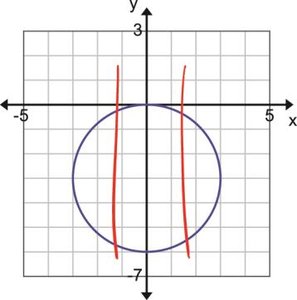
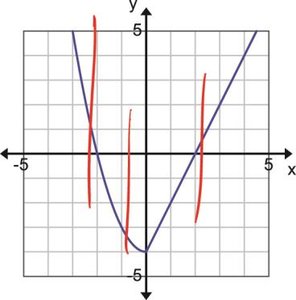
The vertical line test is a graphical method to determine if a relation is a function. If any vertical line intersects the graph at more than one point, the graph does not represent a function.
Passes the test: Each vertical line touches the graph at most once → function.
Fails the test: Some vertical lines touch the graph more than once → not a function.
Example:
Graph with a circle: Fails the vertical line test (not a function).
Graph with a parabola: Passes the vertical line test (is a function).
Function Notation
Function notation is written as y = f(x), read as "y equals f of x." This means that the function f, with input x, produces output y. The ordered pair (x, y) is created by f(x) = y.
Example: If f(x) = -3x + 1, then f(3) = -3(3) + 1 = -8. The point (3, -8) is on the graph of f(x).
For f(A), substitute x = A: f(A) = -3A + 1.
Domain and Range of Functions
The domain of a function is the set of all possible input values (x) for which the function is defined. The range is the set of all possible output values (y). For functions involving division, any x-value that makes the denominator zero is excluded from the domain.
Example: f(x) = \frac{2x+6}{x+9} Domain: All real numbers except x = -9.
Example: f(x) = 3x^2 - 5x + 1 Domain: All real numbers (no division).
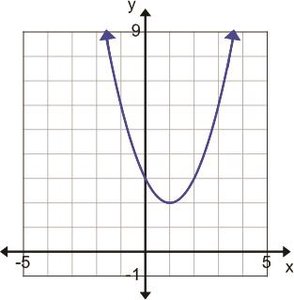
Interval Notation: Used to describe domains and ranges. For example, the domain of a function that continues forever in both directions is .
Evaluating Functions from Graphs
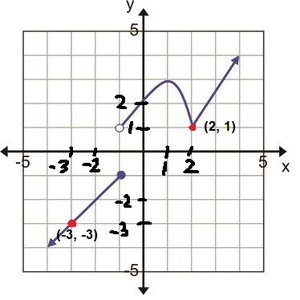
To evaluate a function at a specific value, locate the x-value on the graph and find the corresponding y-value.
Example: If the graph passes through (2, 1), then f(2) = 1.
If the graph passes through (-3, -3), then f(-3) = -3.
Summary Table: Domain and Range Determination
Function Type | Domain | Range |
|---|---|---|
Polynomial | Depends on degree and leading coefficient | |
Rational | All real numbers except where denominator = 0 | Depends on numerator and denominator |
Graph with arrows | Starts at lowest y-value, goes to |
Additional info: Interval notation and domain/range concepts are foundational for understanding functions in algebra. The vertical line test is a visual tool for quickly identifying functions from graphs.
