 뒤로
Multiplication of Polynomials: Methods and Examples
스터디 가이드 - 스마트 노트
 자료에 맞춘 맞춤형 노트, 핵심 정의, 예시, 맥락을 확장해 제공합니다.
Polynomial Functions
Multiplication of Polynomials
Multiplying polynomials is a fundamental operation in algebra, essential for simplifying expressions and solving equations. The process involves distributing each term of the first polynomial to every term of the second polynomial, then combining like terms.
Definition: A polynomial is an expression consisting of variables and coefficients, combined using addition, subtraction, and multiplication, with non-negative integer exponents.
Multiplication Process: Multiply each term in the first polynomial by each term in the second polynomial. Combine like terms to simplify the result.
Applications: Polynomial multiplication is used in expanding expressions, solving equations, and modeling real-world phenomena.
Examples of Polynomial Multiplication
Below are several examples illustrating the multiplication of polynomials, ranging from binomials to higher-degree polynomials.
Example 1: Multiply
Expand:
Result:
Example 2: Multiply
Expand:
Result:
Combine like terms:
Example 3: Multiply
Expand each term and combine like terms.
Result:
Example 4: Multiply
Expand: , , etc.
Result:
Example 5: Multiply
Expand and combine like terms.
Result:
Key Properties of Polynomial Multiplication
Commutative Property:
Associative Property:
Distributive Property:
Summary Table: Steps for Multiplying Polynomials
Step | Description |
|---|---|
1 | Write both polynomials in standard form |
2 | Multiply each term in the first polynomial by each term in the second polynomial |
3 | Combine like terms |
4 | Simplify the resulting expression |
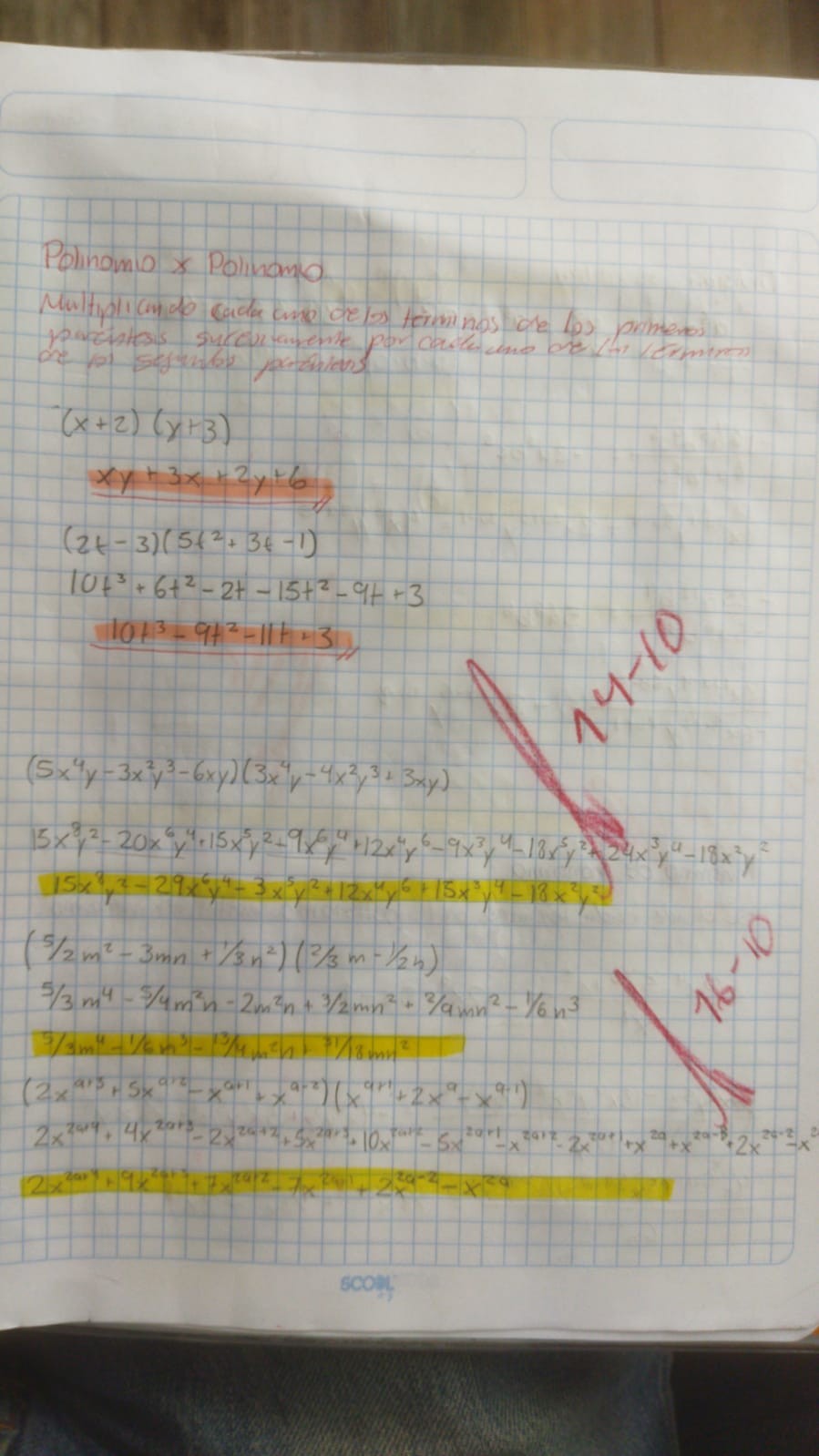
Additional info: The notes provide step-by-step worked examples, highlighting the importance of distributing and combining like terms. The image visually reinforces the process and results of polynomial multiplication, making it directly relevant to the explanation above.
