 뒤로
뒤로Piecewise Defined Functions – College Algebra Study Notes
스터디 가이드 - 스마트 노트
 자료에 맞춘 맞춤형 노트, 핵심 정의, 예시, 맥락을 확장해 제공합니다.
Section 2.1: Piecewise Defined Functions
Introduction to Piecewise Defined Functions
Piecewise defined functions are functions that are described by different expressions depending on the input value. These functions are useful for modeling situations where a rule or relationship changes based on the domain of the input variable. Understanding how to evaluate, graph, and interpret piecewise functions is essential in College Algebra.
Definition of a Piecewise Function
Piecewise Function: A function defined by multiple sub-functions, each applying to a certain interval of the domain.
Each "piece" of the function has its own formula and domain restriction.
Notation: The function is typically written using braces to show the different cases.
General Form:
Examples and Applications
Example 1: Pay as a Piecewise Function
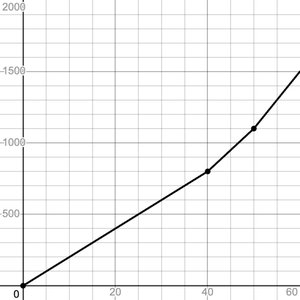
This example models weekly pay based on hours worked, with different pay rates for different intervals of hours:
0 ≤ x ≤ 40: Regular pay at $20/hour.
40 < x ≤ 50: Overtime pay at $30/hour for hours above 40.
x > 50: Double time at $40/hour for hours above 50.
Evaluating the Function:
P(30):
P(45):
P(60):
Graph: The graph below shows the pay as a function of hours worked, with distinct slopes for each interval.
Example 2: Evaluating and Graphing a Piecewise Function
Consider the function:
f(0): Since ,
f(3): Since ,
f(2): Since and , is undefined based on the given intervals.
f(-4): Since ,
Domain:
Range: All real values produced by the three pieces; analyze each interval for specifics.
Example 3: Writing a Piecewise Function from a Graph
Given a graph, you can determine the equations for each segment and write the function in piecewise form. The graph below shows three linear segments, each corresponding to a different interval of the domain.
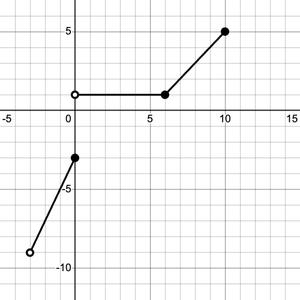
Step 1: Identify the endpoints and slopes of each segment.
Step 2: Write the equation for each segment using the point-slope or slope-intercept form.
Step 3: Specify the domain for each piece based on the graph.
Domain: The set of all x-values covered by the graph.
Range: The set of all y-values the function attains.
Example 4: Evaluating and Graphing Another Piecewise Function
Given:
f(-5):
f(-3):
f(-2): Since does not include , is undefined based on the given intervals.
f(0): (since )
f(3): (since )
f(5): (since )
Domain:
Range: All values produced by the three pieces; analyze each interval for specifics.
Summary Table: Key Properties of Piecewise Functions
Property | Description |
|---|---|
Definition | Function defined by different expressions over different intervals |
Domain | Union of all intervals for which the function is defined |
Range | All output values produced by the function over its domain |
Graph | Consists of segments or curves, each corresponding to a piece of the function |
Continuity | May or may not be continuous at the endpoints of intervals |
Additional info: When evaluating piecewise functions, always check which interval the input value belongs to before applying the corresponding formula. When graphing, use open or closed circles to indicate whether endpoints are included in the interval.
