 뒤로
뒤로Problem Solving and Applications: Interest, Mixture, Uniform Motion, and Job Problems
스터디 가이드 - 스마트 노트
 자료에 맞춘 맞춤형 노트, 핵심 정의, 예시, 맥락을 확장해 제공합니다.
Problem Solving in College Algebra
Overview of the Problem-Solving Process
Solving applied problems in algebra involves translating real-world situations into mathematical language, formulating equations, and interpreting solutions. The process is systematic and requires careful analysis at each stage.
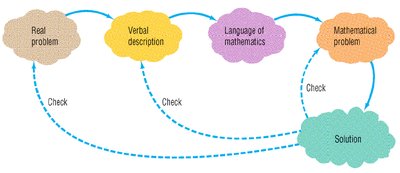
Real Problem: The initial scenario or question from a real-life context.
Verbal Description: Restating the problem in clear, everyday language.
Language of Mathematics: Expressing the problem using variables, equations, and mathematical terms.
Mathematical Problem: The formal algebraic representation to be solved.
Solution: The answer, checked for consistency with the original context.
Steps for Solving Applied Problems
Follow these structured steps to approach and solve applied algebraic problems efficiently:
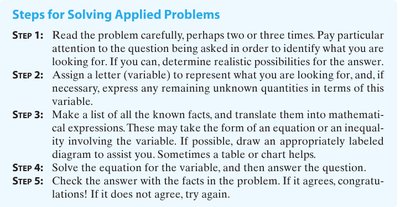
Read the problem carefully to understand what is being asked.
Assign a variable to represent the unknown quantity.
Translate all known facts into mathematical expressions or equations.
Solve the equation for the variable and answer the question.
Check the solution in the context of the problem.
Interest Problems
Simple Interest Formula
Interest problems involve calculating the amount earned or paid on a principal over time at a given rate. The simple interest formula is:
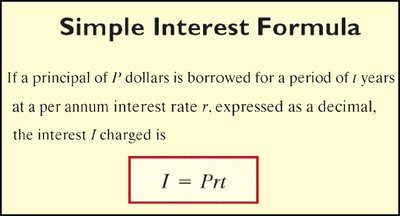
Where:
I = Interest earned or paid
P = Principal (initial amount)
r = Annual interest rate (as a decimal)
t = Time (in years)
Example: If you borrow $1000 for 6 months at 6% per annum, the interest is calculated as:
The total amount owed after 6 months is $1000 + $30 = $1030.
Mixture Problems
Mixture problems involve combining two or more substances with different characteristics to achieve a mixture with a desired property.
Example: Mixing two types of coffee to achieve a blend at a specific price.

Type | Price per Pound | Pounds |
|---|---|---|
B Grade Colombian | $5 | x |
A Grade Arabica | $10 | 100 - x |
Blend | $7 | 100 |
The equation for the mixture is:
Solving for gives the required pounds of each type of coffee.
Uniform Motion Problems
Uniform Motion Formula
Uniform motion problems involve objects moving at constant speeds. The fundamental formula is:

Where:
d = distance traveled
r = rate (speed)
t = time
Example: Tanya runs at 8 mi/hr, and you follow at 40 mi/hr after 2 hours. To find when you catch up:
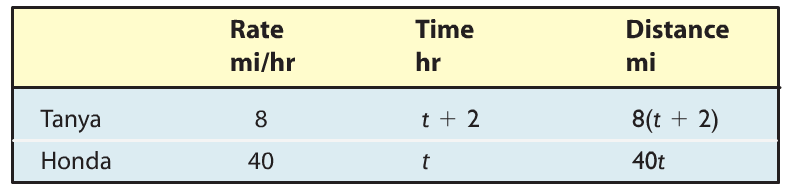
Rate (mi/hr) | Time (hr) | Distance (mi) | |
|---|---|---|---|
Tanya | 8 | t + 2 | |
Honda | 40 | t |
Set distances equal to solve for :
Motion with Currents
When moving in a medium with a current (like a river), adjust the rate by adding or subtracting the current's speed.
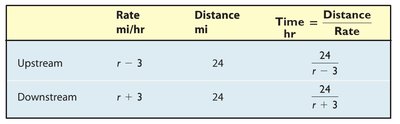
Rate (mi/hr) | Distance (mi) | Time (hr) | |
|---|---|---|---|
Upstream | 24 | ||
Downstream | 24 |

The total time for the round trip is 6 hours:
Constant Rate Job Applications
Work Problems
Work problems involve finding how long it takes for people or machines working together to complete a task. The rate is typically given as "part of the job done per unit time."

Hours to Do Job | Part Done in 1 Hour | |
|---|---|---|
Danny | 4 | |
Mike | 6 | |
Together | t |
The equation for their combined work is:
Solving for gives the time to complete the job together. In this example, hours, or 2 hours and 24 minutes.
Summary Table: Key Formulas
Application | Formula |
|---|---|
Simple Interest | |
Uniform Motion | |
Mixture | Sum of parts = Total mixture |
Work |
