 뒤로
뒤로Quadratic Inequalities: Algebraic and Graphical Approaches
스터디 가이드 - 스마트 노트
 자료에 맞춘 맞춤형 노트, 핵심 정의, 예시, 맥락을 확장해 제공합니다.
Quadratic Inequalities
Introduction to Quadratic Inequalities
Quadratic inequalities are mathematical expressions involving a quadratic function set in an inequality form, such as , , , or . Solving these inequalities is a fundamental skill in College Algebra, as it extends the concept of solving quadratic equations to determining ranges of values that satisfy the inequality.
Quadratic Inequality: An inequality involving a quadratic expression.
Standard Form: or similar, where .
Solution: The set of values that make the inequality true.
Steps to Solving Quadratic Inequalities Algebraically
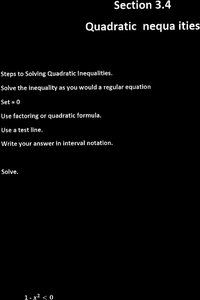
The algebraic approach to solving quadratic inequalities involves several systematic steps.
Step 1: Solve the inequality as you would a regular equation (set the quadratic expression equal to zero).
Step 2: Factor the quadratic or use the quadratic formula to find the roots.
Step 3: Use a test line (number line) to check which intervals satisfy the inequality.
Step 4: Write your answer in interval notation.
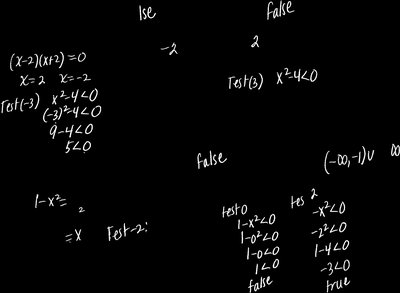
Example: Solve .
Set .
Test values in the intervals , , .
For : (true).
For : (false).
For : (true).
Solution: .
Using the Quadratic Formula for Non-Factorable Quadratics
When a quadratic cannot be factored easily, the quadratic formula is used to find the roots.
Quadratic Formula:
Apply the formula to find the critical points (roots).
Test intervals between and outside the roots to determine where the inequality holds.
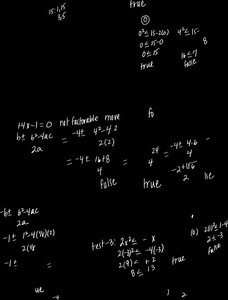
Example: Solve .
Not factorable, so use quadratic formula:
Calculate discriminant and roots.
Test values in the resulting intervals.
Graphical Approach to Quadratic Inequalities
Understanding the Graphical Method
The graphical approach involves analyzing the graph of the quadratic function to determine where it lies above or below the x-axis, corresponding to the solution of the inequality.
Graph: The graph of is a parabola.
Solution: The intervals where the parabola is above () or below () the x-axis correspond to the solution set.
Critical Points: The x-intercepts (roots) divide the number line into intervals.

Worked Example: Graphical and Algebraic Solution
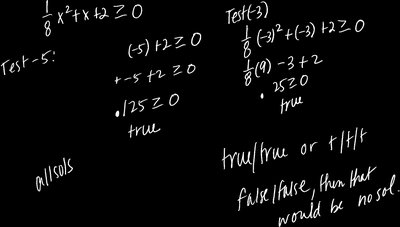
Given .
Test values in different intervals (e.g., , ).
For : (true).
For : (true).
If all test values in the intervals are true, then all real numbers are solutions.
If some intervals are false, only those where the inequality holds are included in the solution set.
Summary Table: Steps for Solving Quadratic Inequalities
Step | Description |
|---|---|
1 | Set the quadratic expression equal to zero to find critical points. |
2 | Factor or use the quadratic formula to solve for roots. |
3 | Test values in each interval between and outside the roots. |
4 | Determine which intervals satisfy the inequality. |
5 | Write the solution in interval notation. |
Key Points and Applications
Quadratic inequalities are solved by finding roots and testing intervals.
Both algebraic and graphical approaches are valid and often complementary.
Interval notation is used to express the solution set.
Applications include determining ranges for physical quantities, economics, and optimization problems.
Additional info: The notes infer standard College Algebra procedures for solving quadratic inequalities, including the use of test values and interval notation, and provide context for graphical interpretation.
