 뒤로
뒤로Solving Linear Inequalities
스터디 가이드 - 스마트 노트
 자료에 맞춘 맞춤형 노트, 핵심 정의, 예시, 맥락을 확장해 제공합니다.
Equations & Inequalities
Linear Inequalities
Linear inequalities are mathematical statements that compare algebraic expressions using inequality symbols. Understanding how to solve these inequalities is essential for analyzing ranges of possible solutions in algebraic contexts.
Inequality Symbols:
< : "is less than"
≤ : "is less than or equal to"
> : "is greater than"
≥ : "is greater than or equal to"
Key Properties:
When multiplying or dividing both sides of an inequality by a negative number, the inequality symbol must be reversed.
When adding, subtracting, or multiplying/dividing by a positive number, the inequality symbol remains unchanged.
To solve a linear inequality, follow the same steps as solving a linear equation, but always be mindful of the rule about reversing the inequality when multiplying or dividing by a negative number.
Solving Linear Inequalities: Step-by-Step
Clear parentheses using the distributive property.
Combine like terms on each side of the inequality.
Isolate the variable on one side by adding or subtracting terms.
Solve for the variable by dividing or multiplying, remembering to reverse the inequality if multiplying/dividing by a negative.
Express the solution in interval notation.
Example 1: Solving a Linear Inequality
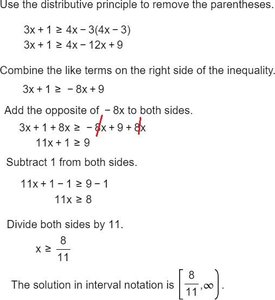
Solve the inequality and write the solution in interval notation:
Step 1: Distribute and simplify both sides:
Step 2: Add to both sides:
Step 3: Subtract $1$ from both sides:
Step 4: Divide both sides by $11$:
Solution in interval notation:
Example 2: Solving a Linear Inequality with Fractions
Solve the inequality and write the solution in interval notation:
Step 1: Find the least common denominator (LCD) of $6, which is $18$.
Step 2: Multiply all terms by $18$ to clear fractions:
Step 3: Distribute and combine like terms:
Step 4: Subtract $13$ from both sides:
Step 5: Divide both sides by $5$:
Solution in interval notation:
Interval Notation
Interval notation is used to express the set of solutions for inequalities:
Open interval : All numbers between and , not including $a$ or $b$.
Closed interval : All numbers between and , including $a$ and $b$.
Infinite intervals: Use or to indicate unbounded intervals, e.g., or .
