 뒤로
Current and Contingent Liabilities: Financial Accounting Study Notes
스터디 가이드 - 스마트 노트
 자료에 맞춘 맞춤형 노트, 핵심 정의, 예시, 맥락을 확장해 제공합니다.
Current and Contingent Liabilities
Overview of Liabilities
Liabilities represent probable future sacrifices of economic benefits, typically in the form of cash payments or provision of goods and services. They are classified as either current or long-term based on their expected settlement period and are presented on the balance sheet in order of liquidity.
Current Liabilities: Debts generally payable within one year (or operating cycle, if longer) from the balance sheet date. These are associated with day-to-day operating activities.
Long-Term Liabilities: Debts expected to be paid more than one year from the balance sheet date, often related to financing activities.
Classification of Current Liabilities
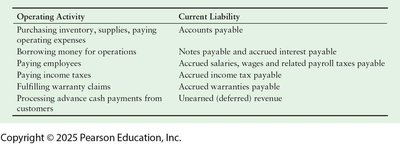
Current liabilities arise from various operating activities. The table below summarizes common operating activities and their related current liabilities:
Operating Activity | Current Liability |
|---|---|
Purchasing inventory, supplies, paying operating expenses | Accounts payable |
Borrowing money for operations | Notes payable and accrued interest payable |
Paying employees | Accrued salaries, wages and related payroll taxes payable |
Paying income taxes | Accrued income tax payable |
Fulfilling warranty claims | Accrued warranties payable |
Processing advance cash payments from customers | Unearned (deferred) revenue |
Accounts Payable and Inventory
Accounts payable are obligations to suppliers for goods and services purchased on credit. Inventory accounts track the flow of goods purchased, discounts, returns, and allowances. T-accounts are used to visualize these relationships and calculate purchases.
Accounts Payable: Increased by credit purchases, decreased by payments, discounts, returns, and allowances.
Inventory: Increased by purchases and freight-in, decreased by discounts, returns, allowances, and cost of goods sold (COGS).
Example Calculation
Given beginning and ending inventory, COGS, and cash purchases, students can calculate credit purchases using T-accounts.
Notes Payable and Accrued Interest
Notes payable are written promises to pay a specified amount, often used to finance operations. Short-term notes are due within one year or operating cycle. Interest must be accrued and recognized as an expense.
Total Interest Formula:
Maturity Value Formula:
Journal Entries: Record note issuance, accrue interest, and settle note at maturity.
Current Portion of Long-Term Debt
Long-term debt often requires installment payments. The portion due within the next year is reclassified as a current liability, known as the current maturity or current portion of long-term debt. No journal entry is required for this reclassification.
Accrued Liabilities
Accrued liabilities are expenses recognized as incurred, following the matching principle. Common examples include sales tax, commissions, salaries, rent, and payroll taxes.
Sales Taxes Payable: Retailers collect sales tax from customers and remit it to the state.
Sales Tax Formula:
Total Amount Collected:
Journal Entries: Record cash received, sales tax payable, and sales revenue.
Payroll Liabilities
Payroll liabilities include employee compensation and related taxes. Gross pay is the total compensation, while net pay is after deductions for income tax and FICA (Social Security and Medicare).
FICA Rates: Social Security: 6.2%, Medicare: 1.45%
Journal Entries: Record salary expense, income tax payable, FICA tax payable, and salary payable.
Accrued Liabilities: Warranties Payable
Product warranties guarantee repair or replacement for defects within a specified period. Warranty expense is estimated based on sales and matched to the period of sale.
Warranty Expense Formula:
Journal Entries: Record sales, COGS, warranty expense, and payments for warranty claims.
Unearned Revenues (Deferred Revenues)
Unearned revenue arises when customers prepay for goods or services. The company records a liability until the revenue is earned.
Journal Entries: Record receipt of cash as unearned revenue, then recognize revenue as earned.
Contingent Liabilities
Contingent liabilities are potential obligations dependent on future events. If the event is probable and the amount can be estimated, the liability must be accrued. Otherwise, it is disclosed in the financial statement footnotes.
Accrual Rule: Accrue if probable and estimable; disclose if probable but not estimable or possible; no disclosure if remote.
Journal Entry for Accrual:
Loss from Contingency Estimated Contingency Liability
Disclosure Scenarios: Probable (not estimable), possible, or remote (no disclosure).
Summary Table: Contingent Liability Disclosure
Likelihood | Estimable? | Action |
|---|---|---|
Probable | Yes | Accrue and disclose in footnote |
Probable | No | Disclose in footnote |
Possible | Yes or No | Disclose in footnote |
Remote | No | No disclosure |
Example: Legal cases, product recalls, and tax disputes are common contingent liabilities.
