 뒤로
Stockholders’ Equity: Structure, Transactions, and Financial Reporting
스터디 가이드 - 스마트 노트
 자료에 맞춘 맞춤형 노트, 핵심 정의, 예시, 맥락을 확장해 제공합니다.
Stockholders’ Equity
Features of a Corporation
A corporation is a distinct legal entity, separate from its owners, with unique features that impact its financial accounting and reporting.
Separate Legal Entity: Corporations exist independently of their owners.
Stockholders/Shareholders: Owners of the corporation, holding shares of stock.
Continuous Life and Transferability: Ownership can be transferred without affecting the corporation’s existence.
Limited Liability: Stockholders are only liable up to their investment.
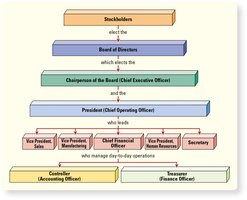
Separation of Ownership and Management: The board of directors, elected by stockholders, manages the business.
Corporate Taxation: Corporations face double taxation—once on corporate income, and again on dividends paid to stockholders.
Government Regulation: Corporations are subject to regulatory oversight.
Stockholders’ Rights
Stockholders possess four basic rights:
Vote: Participate in major corporate decisions.
Dividends: Receive a share of declared dividends.
Liquidation: Share in remaining assets upon dissolution.
Preemption: Maintain proportional ownership when new shares are issued.
Components of Stockholders’ Equity
Stockholders’ equity represents owners’ claims on corporate assets, classified as:
Paid-in Capital (Contributed Capital): Amounts invested by stockholders, including stock accounts and additional paid-in capital.
Retained Earnings: Profits earned and retained by the corporation, reduced by dividends.
The accounting equation: (Assets = Liabilities + Equity).
Types of Stock
Common Stock vs. Preferred Stock
Corporations may issue different types of stock:
Common Stock: Basic ownership, with four rights and potential for greatest benefit if the corporation succeeds.
Preferred Stock: Priority in dividends and liquidation, may have conversion features, and is rarely publicly traded.
Par-Value and No-Par-Value Stock
Stock may be issued with or without a par value:
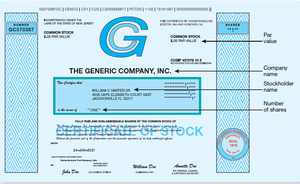
Par-Value Stock: Assigned a nominal value per share; sets minimum legal capital.
No-Par-Value Stock: No assigned value; may have a stated value.
Issuance of Stock
Issuing Common Stock
Stock can be issued at par, above par, or for assets/services other than cash.
At Par: Debit cash, credit common stock for par value.
Above Par: Debit cash, credit common stock for par value, credit paid-in capital in excess of par for the remainder.
No-Par Stock: Debit cash, credit common stock for total proceeds.
For Assets/Services: Record at fair market value of asset/service received or stock issued.
Example Journal Entry:
Db. Cash $140,000
Cr. Common Stock $20,000 (4,000 shares x $5 par)
Cr. Paid-in Capital in Excess of Par $120,000
Treasury Stock
Definition and Effects
Treasury stock is a corporation’s own stock that has been repurchased. It is recorded at cost and reduces stockholders’ equity.
Reasons for Repurchase: Employee distributions, price speculation, takeover defense, EPS increase, return excess cash.
Recording: Debit treasury stock at cost; contra-equity account.
Resale: Increases assets and equity; excess proceeds credited to paid-in capital from treasury stock transactions.
Example Journal Entry:
Db. Treasury Stock $28,000 (2,000 shares x $14)
Cr. Cash $28,000
Retained Earnings, Dividends, and Stock Splits
Retained Earnings
Retained earnings accumulate net income less losses and dividends over the corporation’s life.
Credit Balance: Lifetime earnings exceed losses/dividends.
Debit Balance: Lifetime losses/dividends exceed earnings (deficit).
Dividends
Dividends are distributions to stockholders, usually in cash, stock, or noncash assets.
Cash Dividends: Most common; must have sufficient retained earnings and cash.
Three Dates: Declaration (liability created), Record (no entry), Payment (cash outflow).
Preferred Dividends: Paid before common; may be cumulative (arrears must be paid).
Stock Dividends and Splits
Stock dividends distribute additional shares; stock splits increase shares and reduce par value.
Stock Dividend: Increases common stock and paid-in capital, decreases retained earnings; total equity unchanged.
Stock Split: No journal entry; increases shares, reduces par value, decreases market price.
Evaluating Performance: Ratios and Metrics
Earnings Per Share (EPS)
EPS measures net income attributable to each share of outstanding common stock.
Formula:
Example: Net income \text{EPS} = \frac{360,000 - 60,000}{25,000} = 12.00$
Effect of Equity Financing on EPS
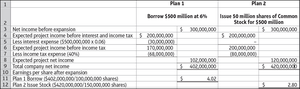
Financing asset purchases can impact EPS and risk:
Retained Earnings: Low risk, no dilution.
Issuing Stock: Dilutes EPS and ownership.
Debt Financing: No dilution, higher EPS, increased risk.
Market Capitalization and Price-Earnings Ratio
Market capitalization is the market price per share multiplied by shares outstanding. The price-earnings ratio reflects investor assessment of value.
Dividend Yield
Dividend yield measures the percentage of a stock’s market value returned annually as dividends:
Formula:
Reporting Stockholders’ Equity Transactions
Statement of Cash Flows
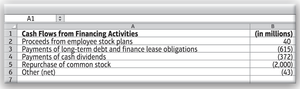
Equity transactions are classified as financing activities:
Issuance of stock
Treasury stock transactions
Dividend payments
Consolidated Statements of Stockholders’ Equity
These statements summarize changes in equity accounts over time, including stock issuance, repurchase, dividends, and other comprehensive income.
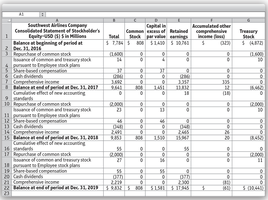
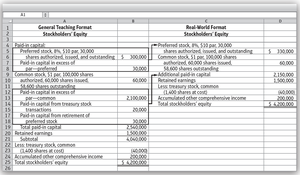
Formats for Reporting Stockholders’ Equity
Stockholders’ equity can be reported in various formats, distinguishing between teaching and real-world practice.
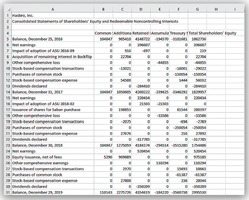
Formatting Financial Statements
General Guidelines
Proper formatting enhances clarity and comparability:
Center and bold headings
Wrap column headings
Use thousand separators and right-justify numbers
Consistent decimal places
Dollar signs for first numbers, subtotals, and totals
Dashes for zeros
Single lines above subtotals, double lines below totals
Use 11-point Calibri font
Spell-check statements
Additional info: These notes expand on the original content by providing definitions, formulas, and examples for key concepts, ensuring a comprehensive and self-contained study guide for Financial Accounting students.
