 뒤로
A Brief Tour of How Atoms Assemble: The Periodic Table, Atomic Structure, and Basic Organic Chemistry
스터디 가이드 - 스마트 노트
 자료에 맞춘 맞춤형 노트, 핵심 정의, 예시, 맥락을 확장해 제공합니다.
The Periodic Table
Structure and Organization
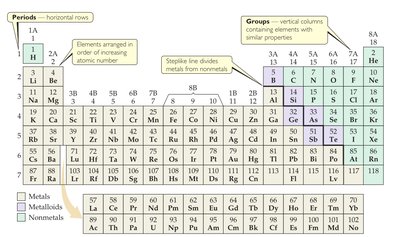
The periodic table is a fundamental tool in chemistry, organizing elements according to their atomic number and properties. Elements are arranged in horizontal rows called periods and vertical columns called groups. Groups contain elements with similar chemical properties.
Periods: Horizontal rows; elements increase in atomic number from left to right.
Groups: Vertical columns; elements in the same group share similar properties.
Stepped line: Divides metals from nonmetals.
Common Groups and Their Properties
Certain groups in the periodic table have distinctive characteristics:
Group | Name | Elements | Common Characteristics |
|---|---|---|---|
1 | Alkali metals | Li, Na, K, Rb, Cs, Fr | Very reactive metals; soft; form +1 ions |
2 | Alkaline earth metals | Be, Mg, Ca, Sr, Ba, Ra | Reactive metals; harder than alkali metals; form +2 ions |
16 | Chalcogens | O, S, Se, Te, Po, Lv | Includes nonmetals and metalloids; often form -2 ions |
17 | Halogens | F, Cl, Br, I, At, Ts | Very reactive nonmetals; form -1 ions |
18 | Noble gases | He, Ne, Ar, Kr, Xe, Rn, Og | Very stable; mostly unreactive; full valence shells |
Metals, Nonmetals, and Metalloids
Classification and Properties
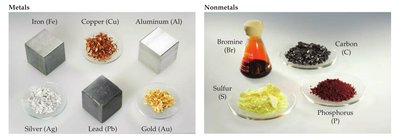
Elements are broadly classified as metals, nonmetals, or metalloids based on their physical and chemical properties.
Metals: Good conductors of heat and electricity, malleable, ductile, tend to lose electrons and form positive ions (cations), found on the left and center of the periodic table.
Nonmetals: Poor conductors, brittle when solid, tend to gain electrons and form negative ions (anions), found on the right side of the periodic table.
Metalloids: Have properties of both metals and nonmetals, can be semiconductors, found on the border between metals and nonmetals.
Atomic-Level Structure of Matter
Molecules, Metals, and Ionic Compounds
Matter is commonly found as molecules, metals, or ionic compounds, each with distinct atomic-level structures.
Molecules: Smallest unit of a pure substance that retains its chemical properties; typically made of nonmetals and held together by covalent bonds (atoms share electrons).
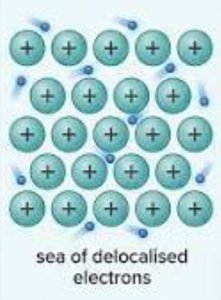
Metals: Nuclei are held together by a "sea" of delocalized electrons, allowing for conductivity and malleability; metallic bonding is distinct from covalent or ionic bonding.
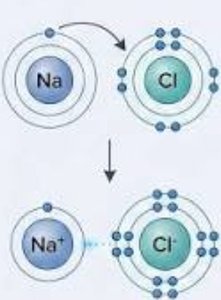
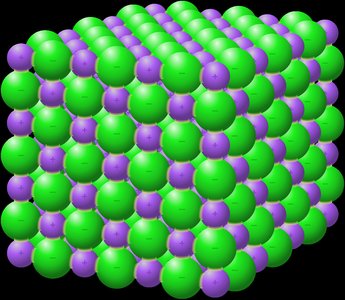
Ionic Compounds: Formed by electrostatic attraction between cations (positive ions) and anions (negative ions); typically crystalline solids formed from metals and nonmetals.
Molecular and Empirical Formulas
Representing Molecules
Chemists use formulas to represent molecules:
Molecular Formula: Shows the exact number and type of atoms in a molecule (e.g., H2O for water, C6H12O6 for glucose).
Empirical Formula: Shows the simplest whole-number ratio of atoms (e.g., CH2O for glucose).
Neither formula conveys 3D or bonding information.
Visualizing Molecules
Structural Representations
Chemists use several methods to visualize molecules, each with different levels of detail:
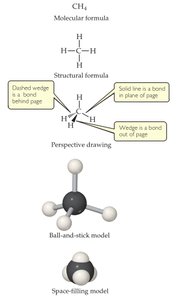
Structural formulas: Bonds are lines, atoms are shown by their symbols.
Perspective drawings: Use wedges and dashes to show 3D orientation of bonds.
Ball-and-stick models: Atoms are spheres, bonds are sticks; colors indicate elements.
Space-filling models: Atoms are spheres sized proportionally to atomic radii; more realistic but less clear for bonding.
Ions and Ionic Compounds
Formation and Properties
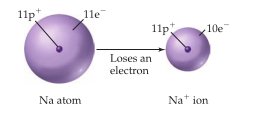
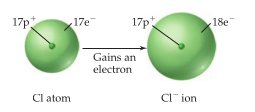
Ionic compounds are formed when one atom loses an electron (becoming a cation) and another gains it (becoming an anion). Electrostatic forces hold these ions together.
Metals: Typically lose electrons to form cations.
Nonmetals: Typically gain electrons to form anions.
Metalloids: Can form positive or negative ions.
Electroneutrality: The compound must be electrically neutral overall.
Basic Ions
Single-atom ions: Elements near the edge of the periodic table tend to lose or gain electrons to reach a noble-gas configuration.
Group 1 metals: Form +1 ions (e.g., Na+).
Group 2 metals: Form +2 ions (e.g., Mg2+).
Group 17 nonmetals: Form -1 ions (e.g., Cl-).
Group 16 nonmetals: Form -2 ions (e.g., O2-).
Polyatomic ions: Groups of atoms bonded together with a net charge (e.g., OH-, NH4+, NO3-, SO42-).
Structure of Organic Molecules
Organic Chemistry and Carbon
Organic chemistry is the study of carbon-containing compounds. Carbon can form four covalent bonds, enabling complex molecular structures.
Alkanes: The Simplest Organic Molecules
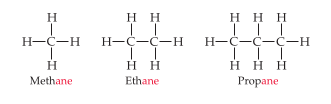
Hydrocarbons: Molecules containing only carbon and hydrogen.
Alkanes: Hydrocarbons with only single bonds; general formula is .
Examples: Methane (CH4), Ethane (C2H6), Propane (C3H8).
Isomers
Isomers are molecules with the same molecular formula but different structures, leading to different properties.
Functional Groups
Functional groups are specific groups of atoms within molecules that determine their chemical properties.
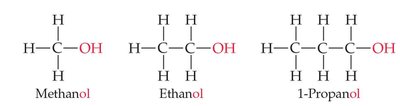
Alcohols: Contain a hydroxyl group (-OH) bonded to carbon; general formula R-OH.
Carboxylic Acids: Contain a carboxyl group (-COOH) bonded to carbon; general formula R-COOH.
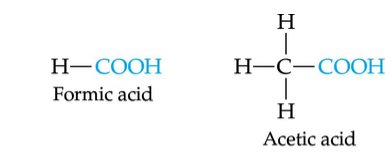
Example: Methanol (CH3OH) is an alcohol; acetic acid (CH3COOH) is a carboxylic acid.
Summary Table: Types of Matter
Type | Composition | Bonding | Example |
|---|---|---|---|
Molecule | Nonmetals | Covalent | H2O |
Metal | Metals | Metallic | Fe |
Ionic Compound | Metals + Nonmetals | Ionic | NaCl |
Additional info: Polyatomic ions and functional groups are essential for understanding advanced chemical behavior and nomenclature.
