 뒤로
Acid-Base Equilibria: Classification, Strength, and Calculations
스터디 가이드 - 스마트 노트
 자료에 맞춘 맞춤형 노트, 핵심 정의, 예시, 맥락을 확장해 제공합니다.
Chapter 16 – Acid-Base Equilibria
16.1 – Classification of Acids and Bases
Acids and bases are fundamental chemical species, and their classification has evolved through several definitions. Understanding these definitions is crucial for predicting chemical behavior in aqueous solutions.
Arrhenius Definition: An acid produces H+ ions in aqueous solution, while a base produces OH- ions. Example: Example:
Brønsted–Lowry Definition: An acid is a proton (H+) donor, and a base is a proton acceptor. Example: Example:
Lewis Definition: An acid is an electron pair acceptor, and a base is an electron pair donor. Example: The reaction between HCl and NH3 illustrates Lewis acid-base behavior.
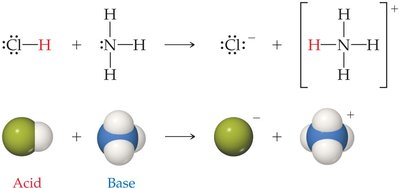
Amphiprotic Species: Water (H2O) can act as both a Brønsted-Lowry acid and base. Example:
16.2 – Conjugate Acid-Base Pairs
Acid-base reactions often reach equilibrium, involving the transfer of a proton between species. Each acid has a conjugate base, and each base has a conjugate acid.
General Reaction:
Acid/Base Strength Spectrum: Acids and bases vary in strength, from strong to weak to negligible.
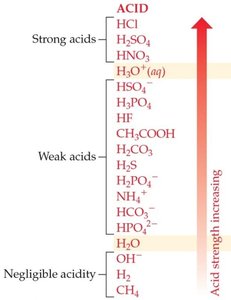
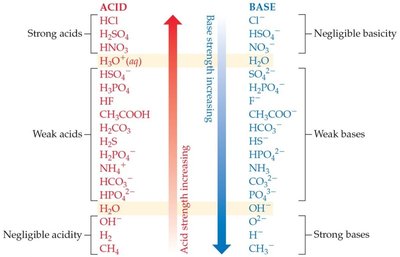
Inverse Relationship: The stronger the acid, the weaker its conjugate base, and vice versa.
Equilibrium Direction: The equilibrium position depends on the relative strengths of acids and bases involved.
16.3 – The Autoionization of Water
Water can react with itself, producing hydronium and hydroxide ions. This process is called autoionization and is fundamental to understanding pH and acid-base equilibria.
Autoionization Reaction:


Equilibrium Constant: at 25°C
Acidic, Basic, and Neutral Solutions:
[OH-] > [H+]: Basic
[H+] > [OH-]: Acidic
[OH-] = [H+]: Neutral
16.4 – The pH Scale
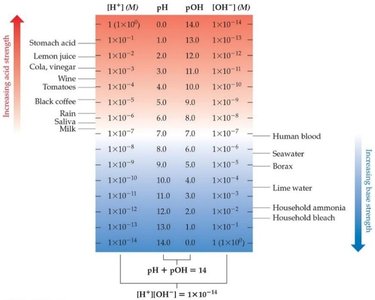
The pH scale quantifies the acidity or basicity of a solution. It is logarithmic and relates directly to the concentration of hydrogen ions in solution.
pH Definition:
Neutral Solution: ,
pOH Definition:
Relationship:
Acidic Solution: pH < 7.00
Basic Solution: pH > 7.00
pH and pOH Scales:
16.5 – Strong Acids and Bases
Strong acids and bases dissociate completely in water, meaning their reactions do not reach equilibrium. There are a limited number of common strong acids and bases.
Common Strong Acids: HCl, HBr, HI, HNO3, HClO3, HClO4, H2SO4
Example:
Common Strong Bases: LiOH, NaOH, KOH, RbOH, CsOH, Ca(OH)2, Sr(OH)2, Ba(OH)2
Example:
16.6 – Weak Acids
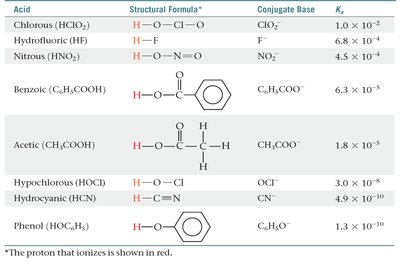
Weak acids only partially dissociate in water, establishing an equilibrium. Their strength is quantified by the acid-dissociation constant, Ka.
General Reaction:
Acid-Dissociation Constant:
Magnitude of Ka: Indicates the tendency of the acid to dissociate.
Percent Ionization:
Monoprotic vs. Polyprotic Acids:
Monoprotic: One available H+ ion (e.g., acetic acid)
Polyprotic: More than one available H+ ion (e.g., sulfurous acid, H2SO3)
Quadratic Formula: Sometimes required for equilibrium calculations, but mathematical shortcuts exist for weak acids/bases.
16.7 – Weak Bases
Weak bases also establish equilibrium in water, and their strength is described by the base-dissociation constant, Kb.
General Reaction:
Base-Dissociation Constant:
Magnitude of Kb: Indicates the tendency to gain a proton (H+).
16.8 – The Relationship Between Ka and Kb
The acid and base dissociation constants for a conjugate acid-base pair are related through the ion-product constant for water, Kw.
Relationship:
pKa + pKb = pKw = 14.00
Additional info:
Practice problems throughout the chapter reinforce calculation skills for pH, equilibrium, and acid/base strength.
Tables and figures provide visual comparisons of acid/base strength and typical values for Ka and Kb.
