 뒤로
Adiabatic Processes for an Ideal Gas
스터디 가이드 - 스마트 노트
 자료에 맞춘 맞춤형 노트, 핵심 정의, 예시, 맥락을 확장해 제공합니다.
Adiabatic Processes for an Ideal Gas
Definition and Qualitative Description
An adiabatic process is a thermodynamic process in which no heat is exchanged between a system and its surroundings (Q = 0). For an ideal gas, this means that any change in internal energy is due solely to work done on or by the system. Adiabatic processes are contrasted with isothermal processes, where temperature remains constant and heat exchange occurs to maintain that temperature.
Adiabatic Compression: Work is done on the gas, increasing its temperature.
Adiabatic Expansion: The gas does work on its surroundings, causing its temperature to decrease.
Real-World Example: In automobile engines, rapid compression of the gas-air mixture is nearly adiabatic, leading to significant temperature increases that can cause engine knocking.
Free Expansion of an Ideal Gas
In a free expansion, a gas expands into a vacuum within a thermally insulated container. Since the gas does not do work (expands against zero pressure) and no heat is exchanged, the internal energy and temperature of an ideal gas remain unchanged.
Key Point: For an ideal gas, internal energy depends only on temperature. Thus, after free expansion, the temperature is unchanged.
Mathematical Formulation of Adiabatic Processes
For a quasi-static (reversible) adiabatic process in an ideal gas, the following relationships hold:
First Law of Thermodynamics:
Since ,
For an ideal gas:
Work done by the gas:
Combining,
Using the ideal gas law () and differentiating, we derive the adiabatic condition:
, where
For a diatomic ideal gas,
Alternate forms: and
Comparison: Adiabatic vs. Isothermal Processes
On a pressure-volume (pV) diagram, adiabatic and isothermal expansions are represented by different curves:
Adiabatic Curve: Steeper than the isothermal curve because temperature changes during the process.
Isothermal Curve: Shallower, as temperature remains constant and heat is exchanged to maintain it.
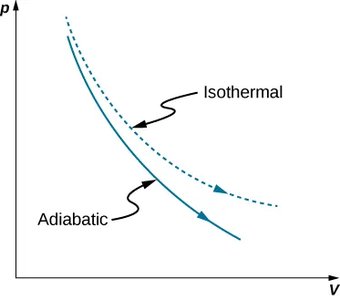
Example: Compression of an Ideal Gas in an Automobile Engine
Problem: A gas-air mixture in a cylinder is compressed adiabatically from an initial state (, , ) to a final volume . Treat the mixture as an ideal diatomic gas ().
Final Pressure:
Final Temperature:
Work Done:
Solution:
Interpretation: The negative sign indicates that work is done on the gas-air mixture (compression).
Summary Table: Key Equations for Adiabatic Processes
Equation | Description |
|---|---|
Adiabatic condition for ideal gas | |
Alternate adiabatic condition | |
Alternate adiabatic condition | |
Work done during adiabatic process |
