 뒤로
Aqueous Reactions: Electrolytes, Precipitation, Redox, and Solution Concentration
스터디 가이드 - 스마트 노트
 자료에 맞춘 맞춤형 노트, 핵심 정의, 예시, 맥락을 확장해 제공합니다.
Aqueous Reactions
Electrolytes and Nonelectrolytes in Aqueous Solution
Aqueous solutions can be classified based on their ability to conduct electricity, which depends on the presence of ions. Electrolytes are substances that dissociate into ions in water, enabling electrical conductivity, while nonelectrolytes do not produce ions and thus do not conduct electricity.
Pure water does not conduct electricity due to the absence of ions.
Nonelectrolyte solutions (e.g., sucrose in water) do not conduct electricity because the solute does not dissociate into ions.
Electrolyte solutions (e.g., sodium chloride in water) conduct electricity because the solute dissociates into ions.
Strong electrolytes dissociate completely in water (e.g., NaCl, strong acids and bases).
Weak electrolytes dissociate partially in water (e.g., weak acids and bases).

Example:
Sucrose (C12H22O11) is a nonelectrolyte, while NaCl is a strong electrolyte.

Ion Formation in Solution
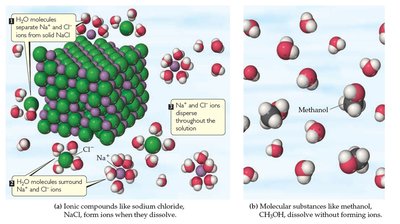
When ionic compounds dissolve in water, they separate into their constituent ions, whereas molecular compounds dissolve without forming ions.
Ionic compounds (e.g., NaCl) dissociate into Na+ and Cl- ions.
Molecular compounds (e.g., methanol) dissolve but do not form ions.
Strong Acids and Bases
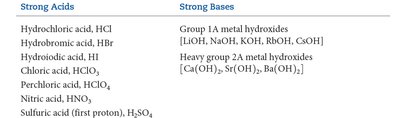
Strong acids and bases are important examples of strong electrolytes. They dissociate completely in water, providing a high concentration of ions.
Strong acids: HCl, HBr, HI, HClO3, HClO4, HNO3, H2SO4 (first proton)
Strong bases: Group 1A metal hydroxides (LiOH, NaOH, KOH, RbOH, CsOH), heavy group 2A metal hydroxides (Ca(OH)2, Sr(OH)2, Ba(OH)2)
Solubility Guidelines for Ionic Compounds
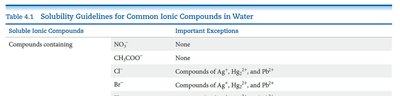
Solubility rules help predict whether an ionic compound will dissolve in water or form a precipitate. These guidelines are essential for understanding precipitation reactions.
Soluble compounds: Nitrates (NO3-), acetates (CH3COO-), most chlorides, bromides, and sulfates.
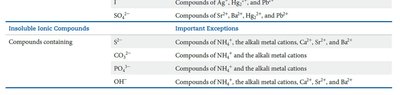
Insoluble compounds: Sulfides (S2-), carbonates (CO32-), phosphates (PO43-), hydroxides (OH-), with exceptions for alkali metals and ammonium.
Soluble Ionic Compounds | Important Exceptions |
|---|---|
NO3- | None |
CH3COO- | None |
Cl- | Ag+, Hg22+, Pb2+ |
Br- | Ag+, Hg22+, Pb2+ |
SO42- | Ba2+, Hg22+, Pb2+ |
Insoluble Ionic Compounds | Important Exceptions |
S2- | NH4+, alkali metals, Ca2+, Sr2+, Ba2+ |
CO32- | NH4+, alkali metals |
PO43- | NH4+, alkali metals |
OH- | NH4+, alkali metals, Ca2+, Sr2+, Ba2+ |
Precipitation Reactions
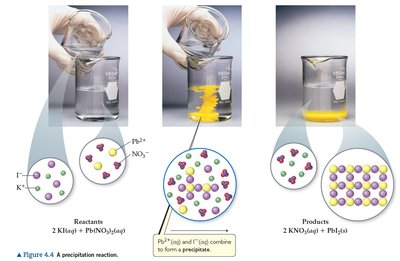
Precipitation reactions occur when two solutions containing soluble ions are mixed and an insoluble product (precipitate) forms. The solubility rules are used to predict the formation of a precipitate.
Example: Mixing KI and Pb(NO3)2 forms PbI2 (yellow precipitate) and KNO3 (soluble).
Molecular equation:

Ionic and Net Ionic Equations
Chemical reactions in aqueous solution are often represented by molecular, complete ionic, and net ionic equations. The net ionic equation shows only the species that participate in the reaction.
Molecular equation: Shows all reactants and products as compounds.
Complete ionic equation: Shows all strong electrolytes as ions.
Net ionic equation: Shows only the ions and molecules directly involved in the reaction.

Oxidation-Reduction (Redox) Reactions and Oxidation Numbers
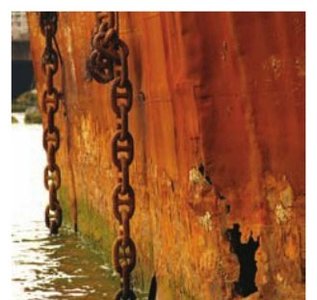
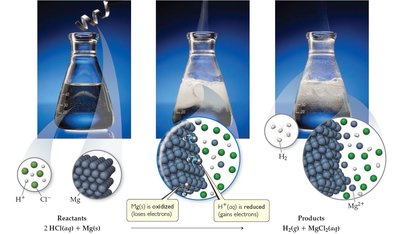
Redox reactions involve the transfer of electrons between substances. Oxidation is the loss of electrons (increase in oxidation number), and reduction is the gain of electrons (decrease in oxidation number).
Oxidizing agent (oxidant): Causes oxidation, is itself reduced.
Reducing agent (reductant): Causes reduction, is itself oxidized.
Sum of oxidation numbers in a compound equals its overall charge.
Rules: H is +1 with nonmetals, -1 with metals; O is -2 except in peroxides; halogens are -1 except in oxyanions.
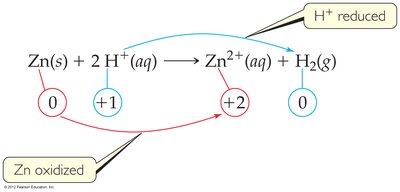
Example:
Zn(s) + 2H+(aq) → Zn2+(aq) + H2(g)
Zn is oxidized (loses electrons), H+ is reduced (gains electrons).
Concentration of Solutions (Molarity)
The concentration of a solution is commonly expressed as molarity (M), defined as moles of solute per liter of solution.
Molarity formula:
Example: 7.2 g of CaCl2 dissolved in 60 mL of water. Calculate molarity of CaCl2, Ca2+, and Cl-.
Dilution of Solutions
When a solution is diluted, the amount of solute remains unchanged, but the volume increases, decreasing the concentration.
Dilution equation:
Example:
In one analysis, 45.7 mL of 0.500 M H2SO4 is required to neutralize 20.0 mL of NaOH solution. What is the concentration of the NaOH solution?

