 뒤로
뒤로Atomic Mass, Isotopes, and Mass Spectrometry
스터디 가이드 - 스마트 노트
 자료에 맞춘 맞춤형 노트, 핵심 정의, 예시, 맥락을 확장해 제공합니다.
Atoms and Elements
Atomic Mass: The Average Mass of an Element’s Atoms
The atomic mass of an element is the weighted average mass of all the naturally occurring isotopes of that element. This value reflects both the mass and the relative abundance of each isotope present in a typical sample.
Isotopes are atoms of the same element with the same number of protons but different numbers of neutrons, resulting in different mass numbers.
The atomic mass listed on the periodic table is not the mass of a single atom, but the average mass of all isotopes, weighted by their natural abundance.

Normal and Weighted Averages
Understanding averages is essential for calculating atomic mass. There are two main types:
Normal (Arithmetic) Average: The sum of values divided by the number of values. Used when all values are equally important.
Weighted Average: Each value is multiplied by its relative importance (weight), and the sum is divided by the total weight. Used when values contribute unequally, such as isotopic abundances.
Example: Calculating a Normal Average
Sarah’s scores: Algebra (85), Chemistry (90), English (88), Physics (92), Spanish (87).
Normal average = (85 + 90 + 88 + 92 + 87) / 5 = 88.4
Example: Calculating a Weighted Average (GPA)
John’s grades and credits: CHEM 101 (A, 4 credits), MATH 101 (B, 4), ENG 101 (A, 3), PSY 101 (B, 3), FYS 101 (A, 1).
Assign grade points (A = 4, B = 3): GPA = [(4×4) + (3×4) + (4×3) + (3×3) + (4×1)] / (4+4+3+3+1) = 3.6
Calculating Atomic Mass Using Weighted Averages
To find the atomic mass of an element with multiple isotopes:
Multiply the mass of each isotope by its fractional abundance (as a decimal).
Add the results for all isotopes.
Formula:
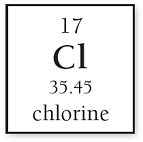
Example: Chlorine
Chlorine-35: 75.77% (0.7577), mass = 34.97 amu
Chlorine-37: 24.23% (0.2423), mass = 36.97 amu
Atomic mass = (0.7577 × 34.97) + (0.2423 × 36.97) = 35.45 amu
Practice Problems
Example 1: An element has two isotopes: 68.9255 amu (60.11%) and 70.9247 amu (39.89%). Calculate the atomic mass.
Solution: (0.6011 × 68.9255) + (0.3989 × 70.9247) = 41.41 + 28.30 = 69.71 amu
Example 2: Magnesium has three isotopes: 23.9850 amu (78.99%), 24.9858 amu (10.00%), 25.9826 amu (11.01%). Calculate the atomic mass.
Solution: (0.7899 × 23.9850) + (0.1000 × 24.9858) + (0.1101 × 25.9826) = 24.305 amu
Mass Spectrometry: Identifying Masses and Abundances of Isotopes
Principle of Mass Spectrometry
Mass spectrometry is an analytical technique used to determine the isotopic composition of elements. It works by ionizing atoms or molecules and separating the resulting ions based on their mass-to-charge ratio (m/z).
The output, called a mass spectrum, displays the relative abundance of each isotope as a peak at its respective mass.
Interpreting Mass Spectra
Each peak in a mass spectrum corresponds to an isotope. The height (intensity) of the peak reflects the relative abundance of that isotope.
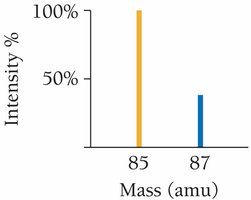
Example: Rubidium
Two peaks at 85 amu (100% intensity) and 87 amu (50% intensity).
Rubidium-85 is twice as abundant as rubidium-87 (72.2% vs. 27.8%).
Application: Identifying Isotopic Composition from Mass Spectra
Given a set of mass spectra, you can determine which spectrum matches a naturally occurring sample by comparing the relative heights and positions of the peaks to the known isotopic masses and abundances.
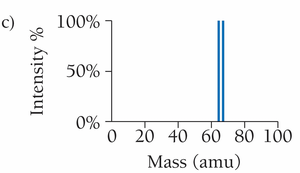
Example: Copper
Copper has two isotopes: 62.94 amu and 64.93 amu; atomic mass is 63.55 amu.
The correct mass spectrum will show two peaks near these masses, with the peak for 62.94 amu being higher (since the atomic mass is closer to this value).
Conceptual Understanding: Atomic Mass and Isotopic Abundance
The atomic mass of an element is closest to the mass of its most abundant isotope. For example, carbon’s atomic mass is closest to 12.0000 amu because C-12 is by far the most abundant isotope (98.93%).
Key Point: The atomic mass will be closest to the isotope with the highest natural abundance.
Summary Table: Steps for Calculating Atomic Mass
Step | Description |
|---|---|
1 | List each isotope’s mass and natural abundance (%) |
2 | Convert abundance to decimal (divide by 100) |
3 | Multiply each mass by its decimal abundance |
4 | Add the results for all isotopes |
Additional info: Mass spectrometry is also used in analytical chemistry for identifying unknown compounds, determining molecular structures, and quantifying mixtures.
