 뒤로
Atomic Theory, Subatomic Particles, and the Periodic Table
스터디 가이드 - 스마트 노트
 자료에 맞춘 맞춤형 노트, 핵심 정의, 예시, 맥락을 확장해 제공합니다.
Atomic Theory and the Structure of Matter
Elements and Atoms
All matter is composed of elements, which are substances that cannot be broken down into simpler substances by chemical means. The smallest identifiable unit of an element is the atom. Modern technology, such as Scanning Tunneling Microscopy (STM), allows scientists to observe and manipulate individual atoms, confirming their existence and structure.
Element: A pure substance consisting of only one type of atom.
Atom: The smallest unit of an element that retains its chemical properties.
Laws Leading to Atomic Theory
Several fundamental laws led to the development of atomic theory:
Law of Conservation of Mass: In a chemical reaction, matter is neither created nor destroyed.
Law of Definite Proportions: All samples of a given compound have the same proportions of their constituent elements.
Law of Multiple Proportions: When two elements form more than one compound, the masses of one element that combine with a fixed mass of the other are in ratios of small whole numbers.
Dalton’s Atomic Theory
John Dalton proposed a theory in 1808 to explain these laws:
Each element is composed of tiny, indestructible particles called atoms.
All atoms of a given element have the same mass and properties.
Atoms combine in simple, whole-number ratios to form compounds.
Atoms of one element cannot change into atoms of another element; they only rearrange in chemical reactions.
Subatomic Particles and Atomic Structure
Subatomic Particles
Atoms are composed of three main subatomic particles:
Protons: Positively charged particles found in the nucleus.
Neutrons: Neutral particles also located in the nucleus.
Electrons: Negatively charged particles that orbit the nucleus.
Atomic Number and the Identity of Elements
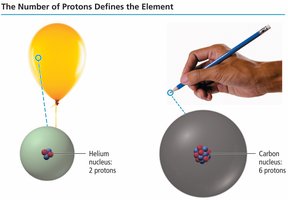
The atomic number (Z) is the number of protons in the nucleus of an atom and defines the element. For example, helium has 2 protons, while carbon has 6 protons. Changing the number of protons changes the element itself.
Representing Elements
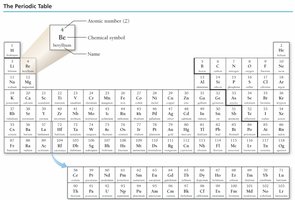
Each element is represented by a unique chemical symbol (e.g., H for hydrogen, He for helium, C for carbon). The periodic table organizes these symbols along with atomic numbers and names.
Isotopes
Isotopes are atoms of the same element (same number of protons) but with different numbers of neutrons. The mass number (A) is the sum of protons and neutrons. Natural abundance refers to the relative amount of each isotope in a naturally occurring sample.
Example: Carbon-12 and Carbon-14 are isotopes of carbon.
Ions
Atoms can gain or lose electrons during chemical reactions, forming ions:
Cation: Positively charged ion (loss of electrons).
Anion: Negatively charged ion (gain of electrons).
In neutral atoms, the number of electrons equals the number of protons. In compounds, cations and anions combine to maintain overall neutrality (e.g., Na+ + Cl- → NaCl).
The Periodic Table and Periodic Law
The Periodic Law
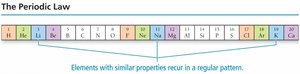
The Periodic Law states that when elements are arranged in order of increasing mass, certain sets of properties recur periodically. This regular pattern is the foundation of the periodic table.
General Structure of the Periodic Table
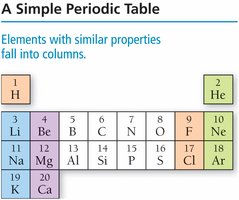
The periodic table is organized into rows called periods (where mass increases from left to right) and columns called groups or families (where elements have similar properties).
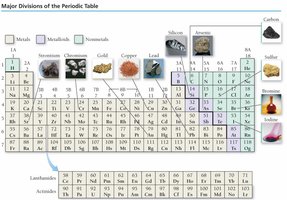
Major Divisions of the Periodic Table
The periodic table is divided into metals, nonmetals, and metalloids:
Metals: Left side and center; good conductors, malleable, ductile, shiny, tend to lose electrons.
Nonmetals: Upper right; poor conductors, not malleable or ductile, tend to gain electrons.
Metalloids: Zigzag line between metals and nonmetals; mixed properties, some are semiconductors.
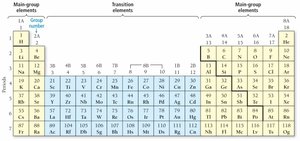
Main-Group and Transition Elements
The periodic table is further divided into main-group elements (with predictable properties) and transition elements (with less predictable properties).
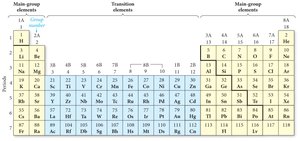
Main Group Families
Main-group elements are classified into families based on their properties:
Alkali metals (Group 1A): Extremely reactive metals.
Alkaline earth metals (Group 2A): Reactive metals, less reactive than alkali metals.
Halogens (Group 7A): Very reactive nonmetals.
Noble gases (Group 8A): Mostly unreactive gases.
Ions and the Periodic Table
Formation of Ions
Main-group elements tend to form ions that achieve the same number of electrons as the nearest noble gas:
Main-group metals: Lose electrons to form cations.
Main-group nonmetals: Gain electrons to form anions.
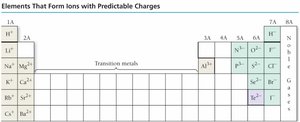
Predictable Charges of Ions
The charge of ions formed by main-group elements can be predicted:
Main-group cations: Charge equals the group number.
Main-group anions: Charge equals the group number minus eight.
Transition elements: May form several different ions.
Atomic Mass and Isotopes
Atomic Mass
The atomic mass of an element is the weighted average of the masses of its naturally occurring isotopes, based on their natural abundance.
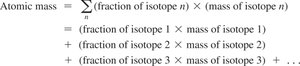
Formula:
Example: Gallium has two naturally occurring isotopes. To calculate its atomic mass, multiply the mass of each isotope by its fractional abundance and sum the results.
Practice Problem: Bromine has two isotopes, Br-79 and Br-81. Given the atomic mass and the abundance of Br-81, you can calculate the mass and abundance of Br-79 using the atomic mass formula.
