 뒤로
Atoms and Elements: Foundations of Modern Atomic Theory
스터디 가이드 - 스마트 노트
 자료에 맞춘 맞춤형 노트, 핵심 정의, 예시, 맥락을 확장해 제공합니다.
Atoms and Elements
Classification of Matter
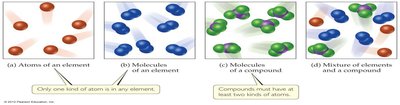
Matter can be classified based on its composition and structure. Understanding the differences between elements, compounds, and mixtures is fundamental in chemistry.
Element: A pure substance consisting of only one kind of atom.
Compound: A substance composed of two or more different types of atoms chemically bonded together.
Mixture: A physical combination of two or more substances where each retains its own properties. Mixtures can be homogeneous (uniform composition) or heterogeneous (non-uniform composition).
Example: Oxygen gas (O2) is an element, water (H2O) is a compound, and air is a mixture.
Atomic Structure and Visualization
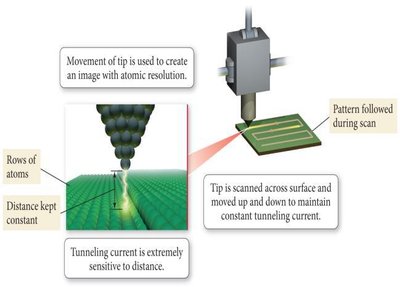
Atoms are the smallest units of elements and are composed of subatomic particles: protons, neutrons, and electrons. Although atoms are too small to be seen with the naked eye, advanced techniques such as Scanning Tunneling Microscopy (STM) allow scientists to visualize individual atoms by scanning a sharp tip over a surface and measuring tunneling current.
Modern Atomic Theories
Law of Conservation of Mass
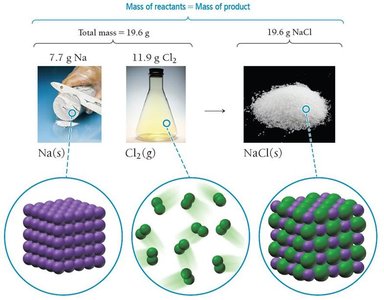
The Law of Conservation of Mass, formulated by Antoine Lavoisier, states that matter is neither created nor destroyed in a chemical reaction. The total mass of reactants equals the total mass of products.
Equation:
Law of Definite Proportions
Joseph Proust's Law of Definite Proportions states that all samples of a given compound have the same proportions of their constituent elements, regardless of the sample's source or preparation method.
Example: Water always decomposes into hydrogen and oxygen in a mass ratio of 2:16 (or 1:8).
Equation:
Law of Multiple Proportions
John Dalton's Law of Multiple Proportions states that when two elements form more than one compound, the masses of one element that combine with a fixed mass of the other are in ratios of small whole numbers.
Example: Nitrogen and oxygen form NO and NO2; the mass ratios of oxygen that combine with a fixed mass of nitrogen are simple whole numbers.
Atomic Structure and Subatomic Particles
Structure of the Atom
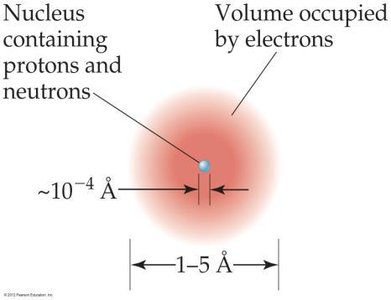
An atom consists of a small, dense nucleus containing protons and neutrons, surrounded by electrons that occupy most of the atom's volume. The nucleus contains nearly all the atom's mass, while electrons define the atom's size.
Proton (p+): Positively charged, mass ≈ 1 amu
Neutron (n0): Neutral, mass ≈ 1 amu
Electron (e-): Negatively charged, mass ≈ 0.00055 amu
Electric Charge and Atomic Neutrality
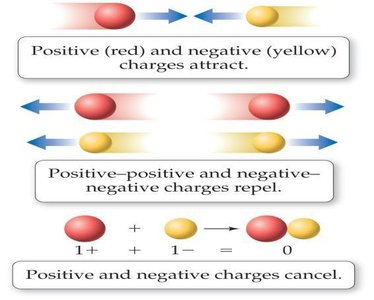
Atoms are electrically neutral because they contain equal numbers of protons and electrons. Opposite charges attract, while like charges repel.
Charge Imbalance in Matter
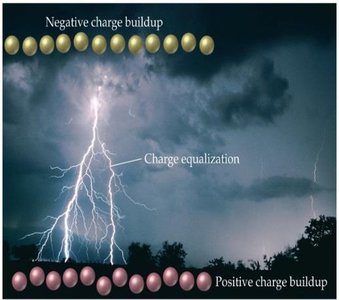
While matter is usually neutral, charge imbalances can occur, such as static electricity or lightning, which are rapid rebalancing events.
Atomic Number, Mass Number, and Isotopes
Atomic Number (Z)
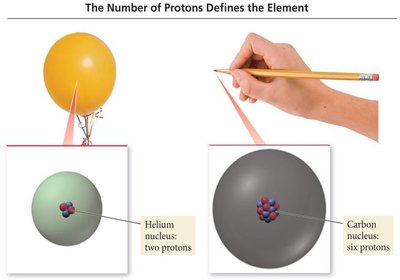
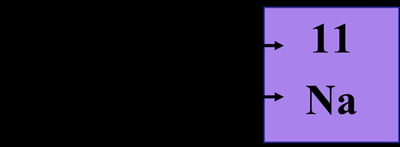
The atomic number (Z) is the number of protons in an atom's nucleus and defines the element. Each element has a unique atomic number.
Mass Number (A) and Isotopes
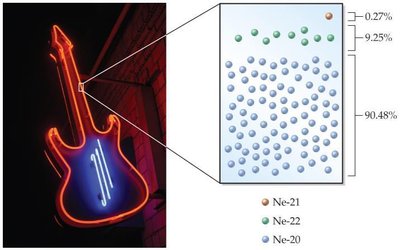
The mass number (A) is the sum of protons and neutrons in an atom. Atoms of the same element with different numbers of neutrons are called isotopes.
Equation:
Isotope notation: , where X is the element symbol.
Measuring Atomic Mass: Mass Spectrometry
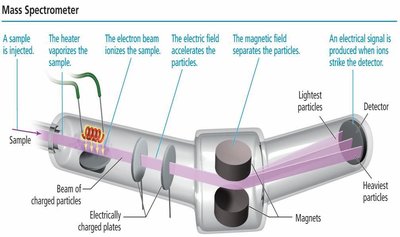
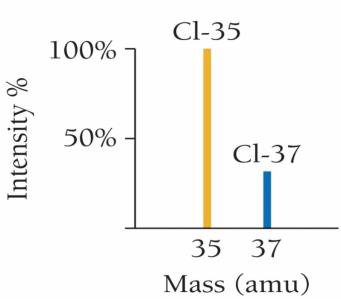
Mass spectrometry is used to measure the masses and relative abundances of isotopes. Atoms are ionized, accelerated, and deflected by a magnetic field; the degree of deflection depends on mass.
Atomic Mass and Natural Abundance
The atomic mass (or atomic weight) of an element is the weighted average of the masses of its naturally occurring isotopes.
Equation:
The Periodic Table
Periodic Law and Table Structure
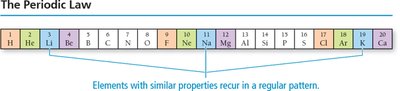
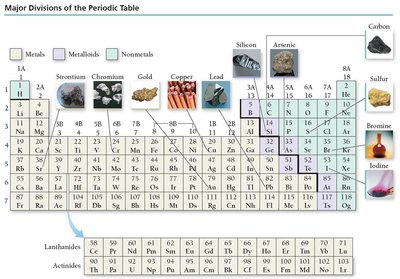
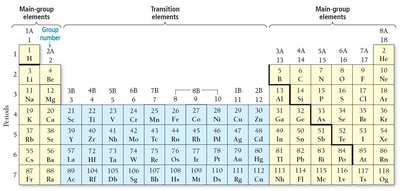
The periodic table arranges elements in order of increasing atomic number so that elements with similar properties fall into columns (groups). Rows are called periods. The periodic law states that properties of elements recur periodically when arranged by atomic number.
Classification of Elements
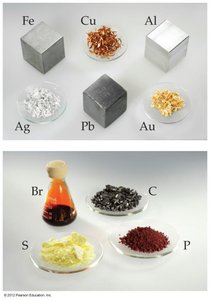
Metals: Good conductors, malleable, ductile, shiny, tend to lose electrons.
Nonmetals: Poor conductors, dull, tend to gain electrons.
Metalloids: Properties intermediate between metals and nonmetals.
Groups and Periods
Groups (columns): Elements with similar chemical properties (e.g., alkali metals, halogens, noble gases).
Periods (rows): Horizontal arrangement of elements.
Molecular Elements and Polyatomic Elements
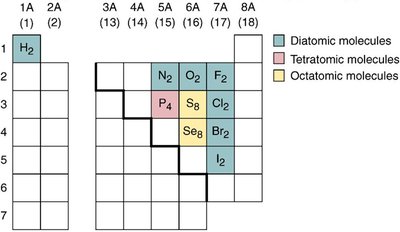
Some elements exist naturally as molecules rather than individual atoms. Diatomic molecules (e.g., H2, O2, N2) and polyatomic molecules (e.g., P4, S8) are common forms.
Elements Essential for Life
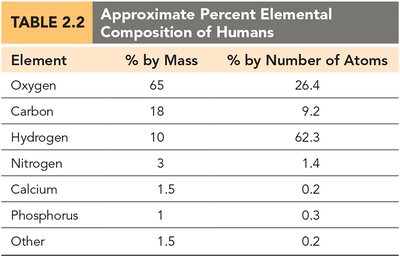
Certain elements are especially important for life, such as oxygen, carbon, hydrogen, and nitrogen. Their abundance in the human body can be expressed by mass and by number of atoms.
Element | % by Mass | % by Number of Atoms |
|---|---|---|
Oxygen | 65 | 26.4 |
Carbon | 18 | 9.2 |
Hydrogen | 10 | 62.3 |
Nitrogen | 3 | 1.4 |
Calcium | 1.5 | 0.2 |
Phosphorus | 1 | 0.3 |
Other | 1.5 | 0.2 |
Ions and Compounds
Formation of Ions
Atoms can gain or lose electrons to form ions. Cations are positively charged (loss of electrons), and anions are negatively charged (gain of electrons).
Example: Na → Na+ + e- (cation); Cl + e- → Cl- (anion)
Ionic and Molecular Compounds
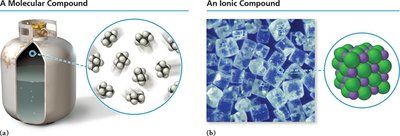
Ionic compounds are formed from metals (cations) and nonmetals (anions) and are held together by ionic bonds. Molecular compounds are formed from nonmetals and are held together by covalent bonds.
Types of Ions and Their Charges
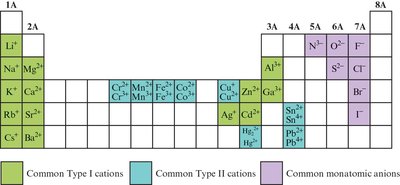
The charges of representative elements can often be predicted from their group numbers, while transition metals may form multiple ions with different charges.
Naming Compounds
Naming Ionic Compounds
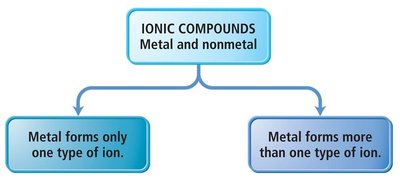
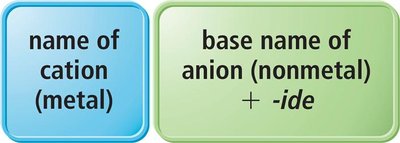
Ionic compounds are named based on the cation and anion present. If the metal forms only one type of ion, the name is simply the metal followed by the nonmetal with an -ide ending. If the metal can form more than one ion, the charge is specified with Roman numerals.
Naming Compounds with Polyatomic Ions
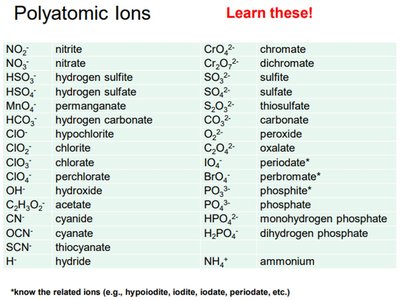
Polyatomic ions are ions composed of more than one atom. Their names and formulas must be memorized for proper nomenclature.
Naming Molecular Compounds
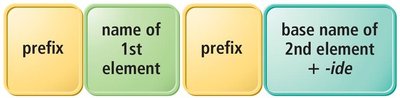
Molecular compounds use prefixes to indicate the number of each atom present. The first element keeps its name; the second element's name ends in -ide.
Naming Acids
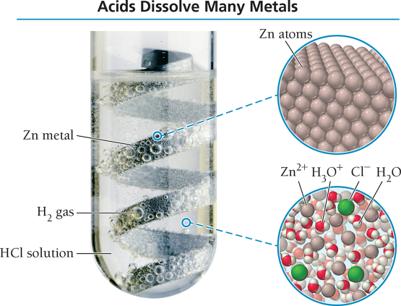
Acids are named based on their composition. Binary acids (hydrogen + nonmetal) use the prefix "hydro-" and the suffix "-ic acid". Oxyacids (hydrogen + polyatomic ion) are named based on the polyatomic ion: "-ate" becomes "-ic acid", "-ite" becomes "-ous acid".
Summary
Atoms are the fundamental units of matter, composed of protons, neutrons, and electrons.
Elements are defined by their atomic number (number of protons).
Isotopes are atoms of the same element with different numbers of neutrons.
The periodic table organizes elements by atomic number and recurring properties.
Ions form when atoms gain or lose electrons; compounds are named according to systematic rules.
