 뒤로
Atoms and Elements: Structure, Subatomic Particles, Isotopes, and Ions
스터디 가이드 - 스마트 노트
 자료에 맞춘 맞춤형 노트, 핵심 정의, 예시, 맥락을 확장해 제공합니다.
Atoms and Elements
The Structure of the Atom
The understanding of atomic structure has evolved through scientific experimentation and theoretical models. Early models attempted to explain the arrangement of subatomic particles within the atom.
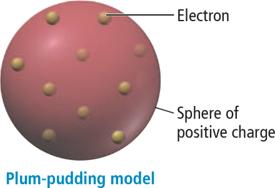
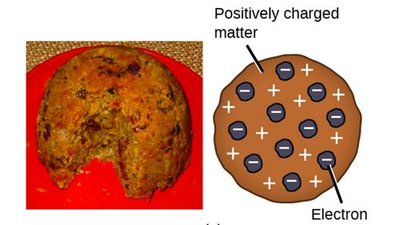
J. J. Thomson's Plum Pudding Model: Thomson described the atom as a sphere of positive charge with negatively charged electrons embedded within it, resembling a plum pudding dessert.
Uniform Distribution: This model suggested that positive and negative charges were uniformly distributed throughout the atom.
Rutherford’s Gold Foil Experiment
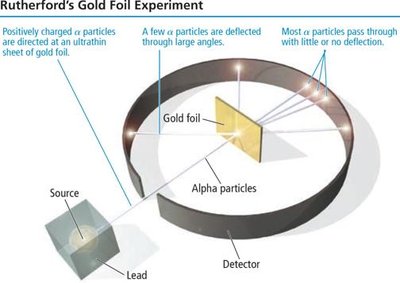
In 1909, Ernest Rutherford conducted an experiment to test the plum pudding model by directing positively charged alpha particles at a thin sheet of gold foil.
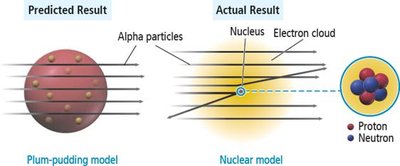
Unexpected Results: Most particles passed through the foil, but some were deflected at large angles, and a few even bounced back, indicating the presence of a dense core within the atom.
Conclusion: Matter is not as uniform as previously thought; atoms contain large regions of empty space and a small, dense nucleus.
Nuclear Theory of the Atom: Rutherford proposed that:
Most of the atom’s mass and all its positive charge are in a small core called the nucleus.
Most of the atom’s volume is empty space, with electrons dispersed throughout.
The number of electrons outside the nucleus equals the number of protons inside, making the atom electrically neutral.
Discovery of the Neutron
Rutherford’s model was incomplete because it could not account for all the atomic mass. James Chadwick later discovered the neutron, a neutral particle within the nucleus.
Neutron Properties: The neutron has a mass nearly equal to that of the proton but carries no electrical charge.
Example: Helium has two protons and two neutrons, making it four times as massive as hydrogen, which has only one proton and no neutrons.
Subatomic Particles
Protons, Neutrons, and Electrons
Atoms are composed of three fundamental subatomic particles: protons, neutrons, and electrons.
Protons and Neutrons: Located in the nucleus; protons are positively charged, neutrons are neutral.
Electrons: Negatively charged particles found outside the nucleus.
Charge Balance: Protons and electrons have equal but opposite charges, resulting in overall electrical neutrality in atoms.
Particle | Mass (kg) | Mass (amu) | Actual Charge (C) | Relative Charge |
|---|---|---|---|---|
Proton | 1.67262 × 10⁻²⁷ | 1.00727 | +1.60218 × 10⁻¹⁹ | +1 |
Neutron | 1.67493 × 10⁻²⁷ | 1.00866 | 0 | 0 |
Electron | 0.00091 × 10⁻²⁷ | 0.00055 | −1.60218 × 10⁻¹⁹ | −1 |
Atomic Number and Mass Number
Definitions and Calculations
Each element is defined by its atomic number and mass number.
Atomic Number (Z): The number of protons in an atom; unique to each element.
Mass Number (A): The sum of protons and neutrons in an atom.
Formulas:
Atomic number:
Mass number:

Isotopes
Definition and Properties
Isotopes are atoms of the same element that differ in the number of neutrons and thus in mass number and physical properties, but have the same number of protons, electrons, atomic number, and chemical properties.
Example: Neon has three isotopes: Ne-20, Ne-21, and Ne-22, with 10, 11, and 12 neutrons, respectively.
Physical Properties: Isotopes may differ in mass and stability but behave similarly in chemical reactions.
Sample Question: Argon has an atomic number of 18 and a common isotope with mass number 40. Number of neutrons = 40 − 18 = 22.
Ions: Losing and Gaining Electrons
Formation of Ions
Atoms can gain or lose electrons during chemical reactions, forming ions.
Cations: Positively charged ions (e.g., Na+, Mg2+, Al3+) have fewer electrons than protons.
Anions: Negatively charged ions (e.g., F−, O2−, N3−) have more electrons than protons.
Sample Question: How many electrons are present in the O2− anion? Oxygen has 8 protons; O2− has 10 electrons.
Determining Subatomic Particles in Atoms and Ions
Practice Problems
To determine the number of protons, neutrons, and electrons in an atom or ion, use the following steps:
Number of protons = atomic number (Z)
Number of neutrons = mass number (A) − atomic number (Z)
Number of electrons = number of protons (for neutral atoms); adjust for charge in ions
Examples:
23Na: 11 protons, 12 neutrons, 11 electrons
16O: 8 protons, 8 neutrons, 8 electrons
18O: 8 protons, 10 neutrons, 8 electrons
44Ca2+: 20 protons, 24 neutrons, 18 electrons
18O2−: 8 protons, 10 neutrons, 10 electrons
