 뒤로
뒤로Atoms, Elements, and the Periodic Table: Study Notes for General Chemistry
스터디 가이드 - 스마트 노트
 자료에 맞춘 맞춤형 노트, 핵심 정의, 예시, 맥락을 확장해 제공합니다.
Atoms and Elements
Subatomic Particles: Protons, Neutrons, and Electrons
Atoms are the fundamental building blocks of matter, composed of three primary subatomic particles: protons, neutrons, and electrons. The discovery and understanding of these particles have shaped modern atomic theory.
Electron: Discovered by J.J. Thomson (1897) via cathode ray experiments. Electrons are negatively charged and much lighter than protons and neutrons.
Plum Pudding Model: Thomson proposed that electrons were embedded in a positively charged 'pudding.'
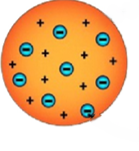
Millikan's Oil-Drop Experiment: Measured the charge of the electron (1909).
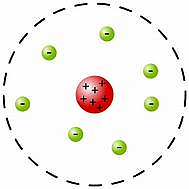
Rutherford's Gold Foil Experiment: Revealed the existence of a dense, positively charged nucleus, leading to the Nuclear Model (Planetary Model).
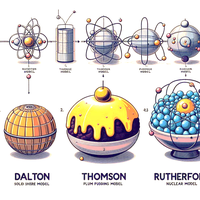
Proton: Identified by Rutherford (1917) as a positively charged particle in the nucleus. Goldstein (1886) discovered canal rays, indicating positive charges.
Neutron: Discovered by James Chadwick (1932), explaining atomic mass discrepancies.
Protons and neutrons have nearly identical masses, while electrons are much lighter. The charge of the proton and electron are equal in magnitude but opposite in sign; neutrons have no charge.
Table: Subatomic Particles
The following table summarizes the properties of subatomic particles:
Particle | Charge | Approximate Mass (amu) |
|---|---|---|
Proton | +1 | 1 |
Neutron | 0 | 1 |
Electron | -1 | 1/1836 |
Additional info: The atomic mass unit (amu) is defined as 1/12 the mass of a carbon-12 atom.
Atomic Number and Mass Number
Atomic Number (Z)
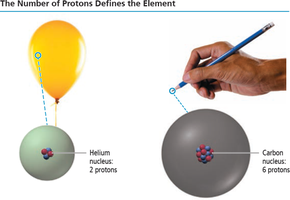
The atomic number (Z) is the number of protons in an atom's nucleus and defines the element. Each element has a unique atomic number.
Example: Helium (Z = 2), Carbon (Z = 6).
Mass Number (A)
The mass number (A) is the sum of protons and neutrons in an atom:
Formula:
Example: Chlorine (Z = 17, A = 35): Number of neutrons =
Atomic number and mass number are often written as:

Isotopes
Definition and Properties
Isotopes are atoms of the same element (same number of protons) but different numbers of neutrons. This results in different mass numbers for each isotope.
Example: Neon has three isotopes: Ne-20, Ne-21, Ne-22. All have 10 protons, but 10, 11, or 12 neutrons respectively.
Table: Neon Isotopes
The table below summarizes the isotopes of Neon:
Symbol | Number of Protons | Number of Neutrons | A (Mass Number) | Natural Abundance (%) |
|---|---|---|---|---|
Ne-20 or | 10 | 10 | 20 | 90.48 |
Ne-21 or | 10 | 11 | 21 | 0.27 |
Ne-22 or | 10 | 12 | 22 | 9.25 |
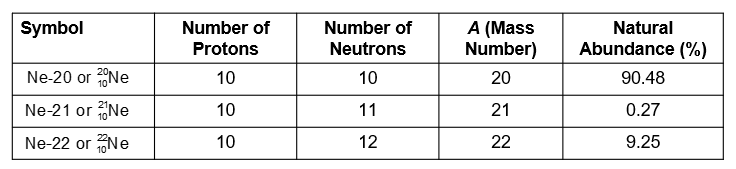
Natural abundance refers to the relative percentage of each isotope found in nature.
Ions: Losing and Gaining Electrons
Formation of Ions
Atoms can gain or lose electrons to form ions. Metals tend to lose electrons, forming positively charged cations, while nonmetals tend to gain electrons, forming negatively charged anions.
Example: Oxygen atom (O) gains two electrons to form O2- anion, which has 8 protons and 10 electrons.
Finding Patterns: The Periodic Law and the Periodic Table
The Periodic Law
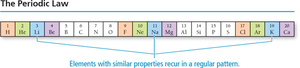
In 1869, Dmitri Mendeleev observed that when elements are arranged in order of increasing mass, certain sets of properties recur periodically. This observation is known as the periodic law.
Periodic: Exhibiting a repeating pattern.
Mendeleev's Table: Arranged elements so that those with similar properties were in the same columns. Predicted undiscovered elements (e.g., germanium).
Modern Periodic Table
The modern periodic table arranges elements by increasing atomic number (not mass), resolving earlier inaccuracies. It contains more elements than Mendeleev's original table.
18 vertical columns (groups) and 7 horizontal rows (periods).
Main-group elements: Groups 1A–8A (1, 2, 13–18).
Transition metals: Groups 3–12 (B groups).
Classification of Elements
Metals, Nonmetals, and Metalloids
Elements are classified based on their physical and chemical properties:
Metals: Good conductors, malleable, ductile, shiny, tend to lose electrons.
Nonmetals: Poor conductors, varied states, not malleable or ductile, tend to gain electrons.
Metalloids: Exhibit mixed properties, often semiconductors.
Additional info: The zigzag line on the periodic table separates metals from nonmetals; metalloids lie along this line.
Element Groups
Alkali Metals (Group 1A): Highly reactive (e.g., Li, Na, K).
Alkaline Earth Metals (Group 2A): Reactive, less so than alkali metals (e.g., Mg, Ca).
Halogens (Group 7A): Very reactive nonmetals (e.g., F, Cl, Br, I).
Noble Gases (Group 8A): Chemically stable, unreactive (e.g., He, Ne, Ar).
Ions and the Periodic Table
Trends in Ion Formation
Main-group metals tend to lose electrons and form cations with the same number of electrons as the nearest noble gas. Main-group nonmetals tend to gain electrons and form anions with the same number of electrons as the nearest noble gas.
Alkali metals (1A): Lose one electron, form 1+ ions.
Alkaline earth metals (2A): Lose two electrons, form 2+ ions.
Halogens (7A): Gain one electron, form 1- ions.
Chalcogens (6A): Gain two electrons, form 2- ions.
Additional info: The tendency to gain or lose electrons is determined by the element's position in the periodic table and its electronic configuration.
