 뒤로
Atoms, Elements, Compounds, and Classification of Matter: Study Notes for General Chemistry
스터디 가이드 - 스마트 노트
 자료에 맞춘 맞춤형 노트, 핵심 정의, 예시, 맥락을 확장해 제공합니다.
Chapter 8 - The Atom
Definition of Chemistry
Chemistry is the science that studies macroscopic subjects by understanding their fundamental building blocks: molecules and atoms. Chemistry connects to many aspects of daily life and other scientific fields.
Atoms: The smallest units of matter that retain the properties of an element.
Molecules: Groups of two or more atoms bonded together in a specific arrangement.
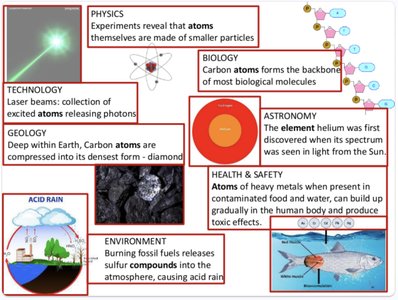
Atoms and Molecules
Atoms are the basic particles that make up all matter. Molecules are formed when two or more atoms join together chemically.
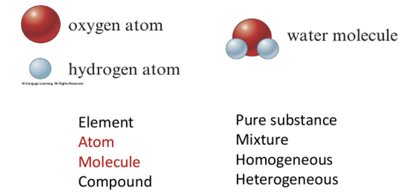
Atom: Example: Oxygen atom (O), Hydrogen atom (H).
Molecule: Example: Water molecule (H2O), which consists of two hydrogen atoms and one oxygen atom.
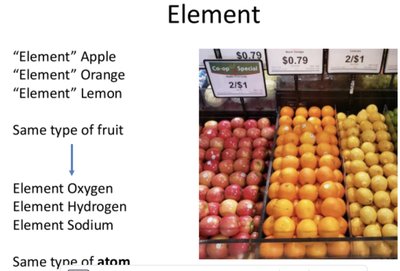
Elements and Compounds
Definition and Examples
Element: A substance that contains only one type of atom. Examples include helium (He), carbon (C), aluminum (Al), and gold (Au).
Compound: A substance composed of at least two different types of atoms (or elements) chemically bonded together. Examples: sodium chloride (NaCl), sodium hydroxide (NaOH), hydrochloric acid (HCl), carbon monoxide (CO).
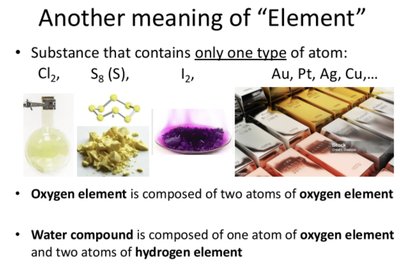
Alternative Meaning of "Element"
Sometimes, an element refers to a substance made of only one type of atom, even if it forms molecules (e.g., O2, S8, I2).
Oxygen element: O2 is composed of two oxygen atoms.
Water compound: H2O is composed of one oxygen atom and two hydrogen atoms.
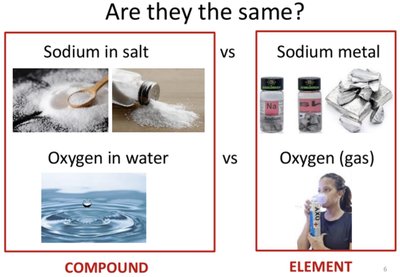
Comparison: Compound vs. Element
Sodium in salt (NaCl): Sodium is part of a compound.
Sodium metal (Na): Sodium as an element.
Oxygen in water (H2O): Oxygen is part of a compound.
Oxygen gas (O2): Oxygen as an element.
Classification of Matter
Types of Matter and Classification
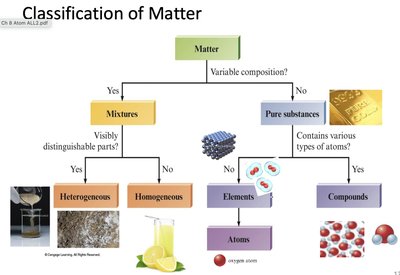
Matter can be classified based on its composition and properties.
Mixtures: Composed of two or more substances physically combined. Can be heterogeneous (visibly distinguishable parts) or homogeneous (uniform composition).
Pure Substances: Have a fixed composition. Can be elements (one type of atom) or compounds (two or more types of atoms chemically bonded).
Examples of Classification
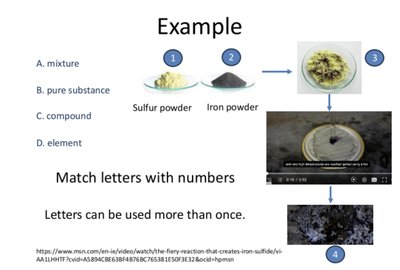
Mixture: Sulfur powder and iron powder mixed together.
Pure Substance: Sulfur powder or iron powder alone.
Compound: Iron sulfide (FeS), formed from a chemical reaction between sulfur and iron.
Element: Sulfur powder or iron powder as individual substances.
The Periodic Table
Classification of Elements
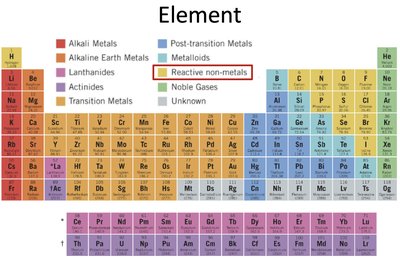
The periodic table organizes elements by their atomic number and properties.
Metals: Most elements are metals (colored in various shades).
Non-metals: Only yellow and green regions represent non-metals.
Groups: Includes alkali metals, alkaline earth metals, transition metals, lanthanides, actinides, metalloids, reactive non-metals, noble gases, and unknowns.
Mixtures: Types and Examples
Heterogeneous vs. Homogeneous Mixtures
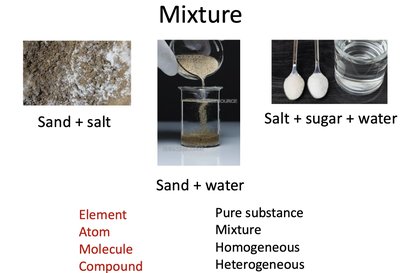
Heterogeneous Mixture: Components are visibly distinguishable. Example: sand + salt, sand + water.
Homogeneous Mixture: Components are not visibly distinguishable; uniform throughout. Example: salt + sugar + water.
Key Terms and Definitions
Element: Substance with only one type of atom.
Atom: Fundamental particle of matter.
Molecule: Two or more atoms bonded together.
Compound: Substance with two or more different atoms chemically bonded.
Pure Substance: Matter with a fixed composition (element or compound).
Mixture: Physical combination of two or more substances.
Homogeneous Mixture: Uniform composition throughout.
Heterogeneous Mixture: Non-uniform composition; visibly different parts.
Additional Academic Context
Formulas and Equations
Chemical Formula: Represents the composition of a compound. Example: for water.
Nuclide Symbol: Represents isotopes of elements. Example: for carbon-12.
Valence Electrons
Valence electrons are the outermost electrons of an atom and are important in determining chemical reactivity and bonding.
Periodic Table Applications
The periodic table is used to predict element properties, chemical reactivity, and bonding patterns. Additional info: Academic context was added to clarify definitions, classification, and examples for completeness.
