 뒤로
Chapter 2: Atoms, Ions, and Elements: Foundations of Modern Atomic Theory
스터디 가이드 - 스마트 노트
 자료에 맞춘 맞춤형 노트, 핵심 정의, 예시, 맥락을 확장해 제공합니다.
Atoms, Ions, and Elements
Introduction
Chemistry is the study of matter, which is composed of atoms. Understanding the structure and behavior of atoms is fundamental to explaining chemical phenomena at both the macroscopic and microscopic levels.
Atom: The smallest unit of matter that retains the chemical identity of an element.
Element: A pure substance made of only one kind of atom.
Key Idea: The properties and behavior of matter are determined by the structure and interactions of atoms.
Fundamental Chemical Laws
Law of Conservation of Mass
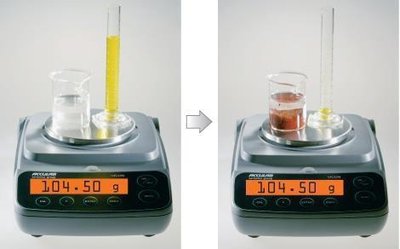
The Law of Conservation of Mass states that matter can neither be created nor destroyed in a chemical reaction. The total mass of substances remains constant before and after a reaction.
Example: When calcium oxide reacts with carbon dioxide to form calcium carbonate, the total mass remains unchanged.
Law of Multiple Proportions
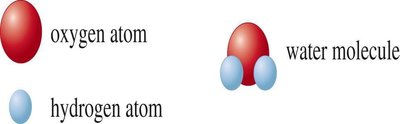
When two elements combine to form more than one compound, the masses of one element that combine with a fixed mass of the other are in ratios of small whole numbers.
Example: Water (H2O) and hydrogen peroxide (H2O2) both contain hydrogen and oxygen, but in different ratios.
Law of Definite Composition (Constant Proportion)
A given compound always contains the same elements in the same proportion by mass, regardless of its source or method of preparation.
Example: Water always contains hydrogen and oxygen in a mass ratio of 1:8.
Early Atomic Theory
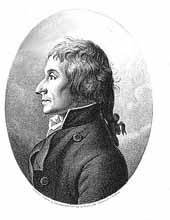
Dalton’s Atomic Theory
John Dalton proposed a theory to explain the fundamental laws of matter:
All matter consists of indivisible atoms.
Atoms of a given element are identical in mass and properties.
Compounds are formed by the combination of atoms of different elements in fixed ratios.
Atoms are neither created nor destroyed in chemical reactions; they are simply rearranged.
Modern science has refined Dalton’s theory, but the core ideas remain foundational.
The Electron and the Atom
Discovery of the Electron
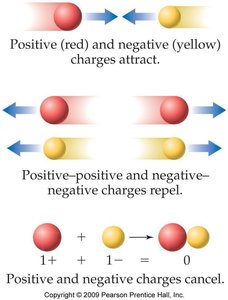
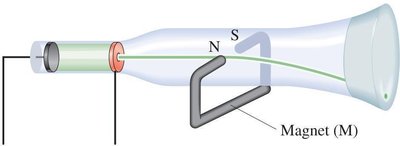
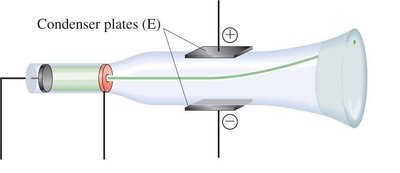
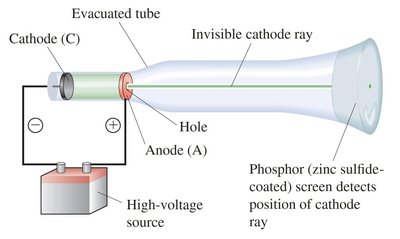
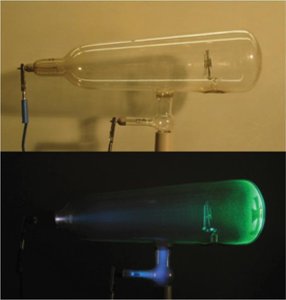
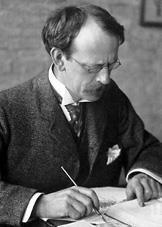
J. J. Thomson discovered the electron through experiments with cathode-ray tubes, showing that all matter contains negatively charged particles (electrons).
Electrons are present in all atoms.
Charge-to-mass ratio of the electron:
Thomson’s Plum Pudding Model
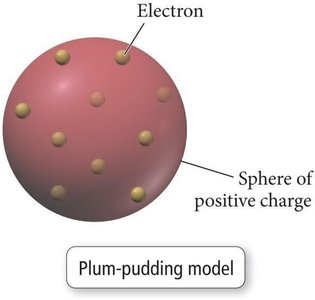
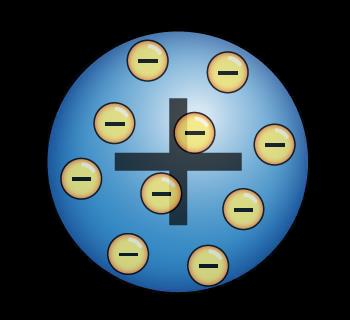
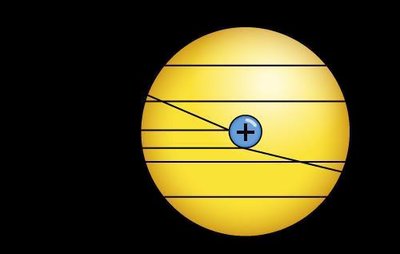
Thomson proposed that atoms are spheres of positive charge with electrons embedded within them, like plums in a pudding.

Millikan’s Oil Drop Experiment
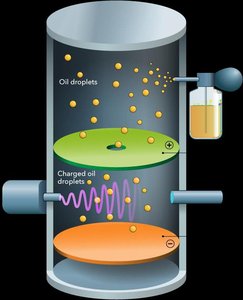
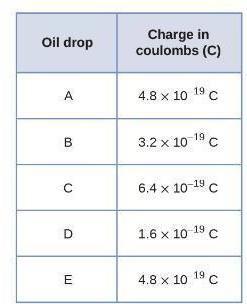
Robert Millikan measured the charge of the electron using the oil drop experiment, determining the fundamental unit of electric charge ( C).
Rutherford’s Gold Foil Experiment and the Nuclear Model
Gold Foil Experiment
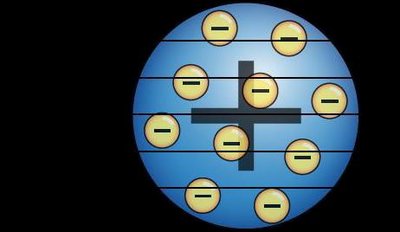
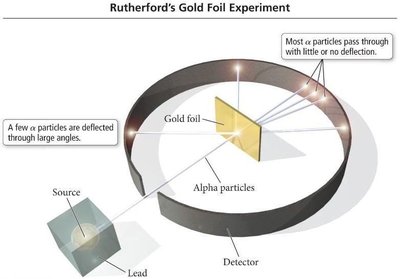
Ernest Rutherford’s experiment involved firing alpha particles at thin gold foil. Most particles passed through, but some were deflected at large angles, indicating a small, dense, positively charged nucleus.
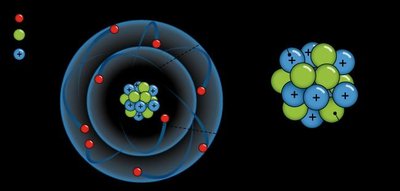
Led to the nuclear model of the atom: a dense nucleus surrounded by electrons.

Subatomic Particles
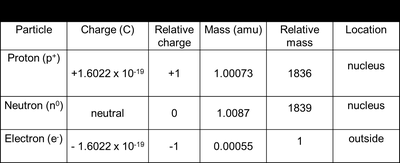
Atoms are composed of protons, neutrons, and electrons:
Particle | Charge (C) | Relative charge | Mass (amu) | Relative mass | Location |
|---|---|---|---|---|---|
Proton (p+) | +1.6022 × 10⁻¹⁹ | +1 | 1.0073 | 1836 | Nucleus |
Neutron (n0) | 0 | 0 | 1.0087 | 1839 | Nucleus |
Electron (e−) | −1.6022 × 10⁻¹⁹ | −1 | 0.00055 | 1 | Outside nucleus |

Atomic Number, Mass Number, and Isotopes
Atomic Number (Z)
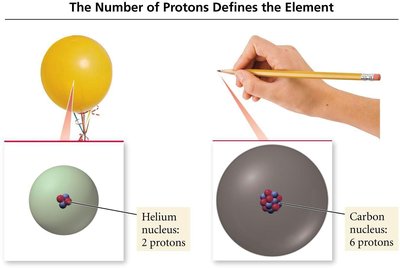
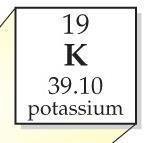
The atomic number is the number of protons in the nucleus and defines the element. All atoms of a given element have the same atomic number.

Isotopes
Isotopes are atoms of the same element with different numbers of neutrons. They have the same atomic number but different mass numbers.
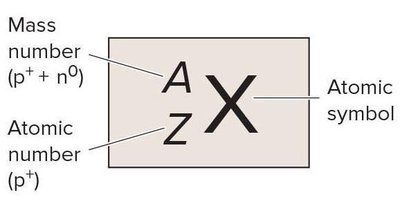
Mass number (A): Total number of protons and neutrons in the nucleus ().
Isotopic notation: or X–A (e.g., or C-12).
Atomic Mass and Weighted Average
The atomic mass of an element is the weighted average of the masses of its naturally occurring isotopes.
Formula:
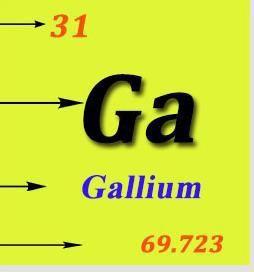
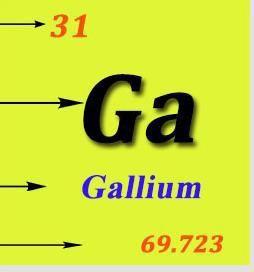
Example: Gallium has two isotopes: Ga-69 (68.9256 amu, 60.11%) and Ga-71 (70.9247 amu, 39.89%). The atomic mass is calculated as:
The Periodic Table
Structure and Organization
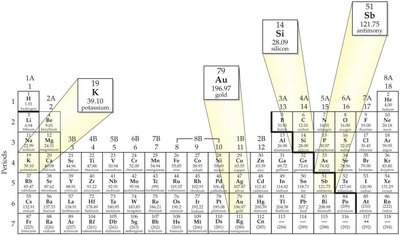
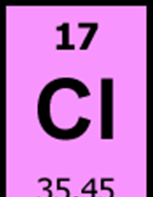
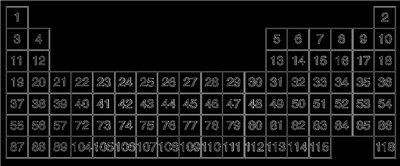
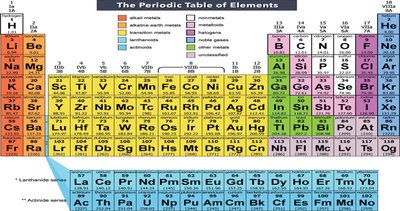
The periodic table arranges elements by increasing atomic number. Elements with similar chemical properties are grouped in columns called families or groups.
Groups (families): Vertical columns (numbered 1–18).
Periods: Horizontal rows (numbered 1–7).
Main group elements: Groups 1, 2, and 13–18 (A groups).
Transition elements: Groups 3–12 (B groups).
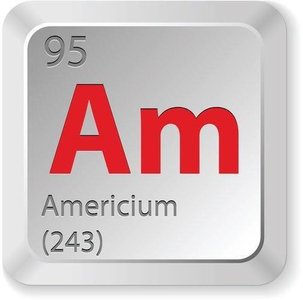
Inner transition elements: Lanthanides and actinides (bottom rows).
Metals, Nonmetals, and Metalloids
Elements are classified based on their physical and chemical properties:
Metals: Malleable, ductile, lustrous, good conductors, tend to form cations.
Nonmetals: Brittle, dull, poor conductors, tend to form anions.
Metalloids: Intermediate properties, semiconductors.
Counting Atoms: The Mole Concept
Avogadro’s Number and the Mole
The mole is a counting unit in chemistry, defined as the amount of substance containing entities (Avogadro’s number).
1 mole of atoms, molecules, or ions contains particles.
Example: 1 mol Cl2 = molecules of Cl2
Atomic Mass, Molar Mass, and Conversions
The atomic mass (amu) is the mass of a single atom, while the molar mass (g/mol) is the mass of one mole of atoms. These values allow conversion between mass, moles, and number of particles.
Conversion factors:
Example: How many copper atoms are in a penny weighing 3.10 g?
Given: 3.10 g Cu, Molar mass = 63.55 g/mol
Solution: mol Cu; atoms Cu
Summary Table: Key Atomic Concepts
Concept | Definition | Key Equation |
|---|---|---|
Atomic Number (Z) | Number of protons in nucleus | |
Mass Number (A) | Number of protons + neutrons | |
Isotope | Atoms with same Z, different A | |
Mole | 6.022 × 10²³ particles | |
Atomic Mass | Weighted average of isotopes |
