 뒤로
Atoms, Molecules, and Ions: Foundations of Atomic Theory and Chemical Nomenclature
스터디 가이드 - 스마트 노트
 자료에 맞춘 맞춤형 노트, 핵심 정의, 예시, 맥락을 확장해 제공합니다.
Atoms, Molecules, and Ions
Dalton’s Atomic Theory
Dalton’s Atomic Theory laid the groundwork for modern chemistry by describing the nature of atoms and their role in chemical reactions.
Elements are composed of atoms: Atoms are tiny, hard, unbreakable spheres.
All atoms of an element are identical: Atoms of different elements have distinct chemical and physical properties.
Atoms combine in simple, whole-number ratios: Atoms must combine as whole atoms, leading to the Law of Constant Composition.
Atoms are not created or destroyed in chemical reactions: Atoms are rearranged, not changed into other types, supporting the Law of Conservation of Mass.
Dalton’s theory explains:
Law of Conservation of Mass: Mass is neither created nor destroyed in ordinary chemical reactions.
Law of Definite Proportions: Different samples of a pure substance always contain the same proportion by weight.
Law of Multiple Proportions: Elements combine in ratios of small whole numbers.
Classification of Matter
Matter can be classified based on its composition and structure.
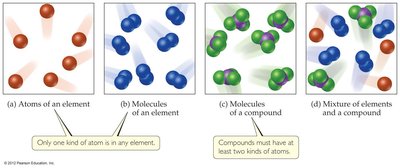
Atoms of an element: Only one kind of atom is present.
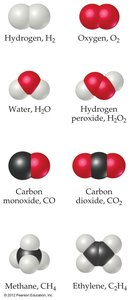
Molecules of an element: Two or more atoms of the same element bonded together.
Molecules of a compound: At least two kinds of atoms bonded together.
Mixture: Contains elements and compounds together.
The Discovery of Atomic Structure
Electron Discovery and Cathode Rays
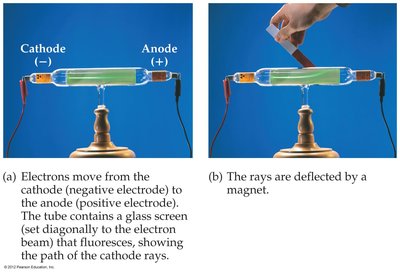
Experiments with cathode rays revealed the existence of electrons, negatively charged particles within atoms.
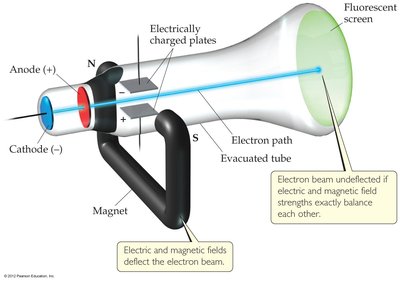
Cathode rays: Produced when high voltage is applied between two metal plates in a vacuum tube.
J. J. Thomson: Discovered electrons by observing the deflection of cathode rays in electric and magnetic fields.
Charge/mass ratio: Determined to be C/g.
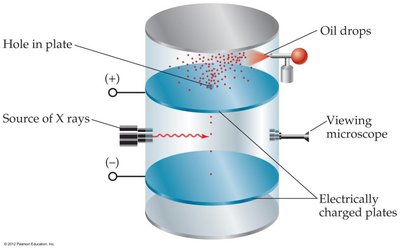
Millikan Oil-Drop Experiment
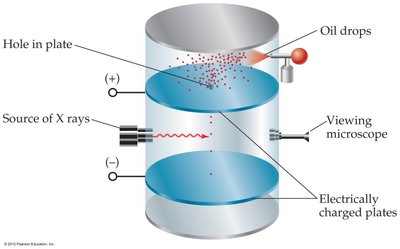
Millikan measured the charge of the electron by observing the behavior of charged oil droplets in an electric field.
Charge of electron: C
Mass of electron: g
Combined with Thomson’s experiment, the mass of the electron was determined.
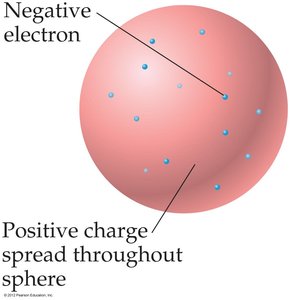
Thomson’s Atomic Model
Thomson proposed the "plum pudding" model, where electrons are embedded in a positively charged sphere.
Atoms are breakable and have structure.
Electrons are suspended in a positively charged field.
Mass of atoms is due to electrons.
Atoms are mostly empty space.
Radioactivity and the Nuclear Atom
Radioactivity
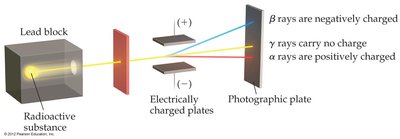
Radioactivity is the spontaneous emission of radiation by an atom, revealing the presence of subatomic particles.
Discovered by: Henri Becquerel, studied by Marie and Pierre Curie.
Types of radiation: α (alpha), β (beta), and γ (gamma) rays.
α-particles: Positively charged, similar to helium nuclei.
β-particles: Negatively charged, similar to electrons.
γ-rays: High-energy electromagnetic radiation, no charge.
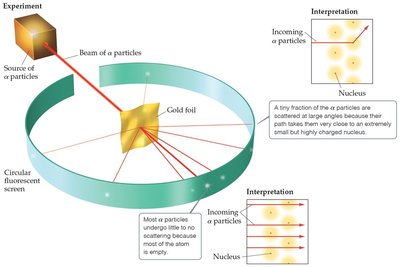
Discovery of the Nucleus: Rutherford’s Gold Foil Experiment
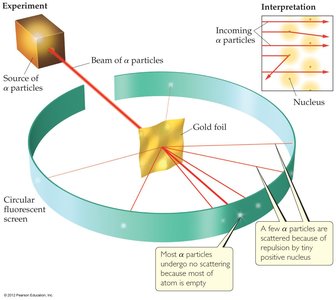
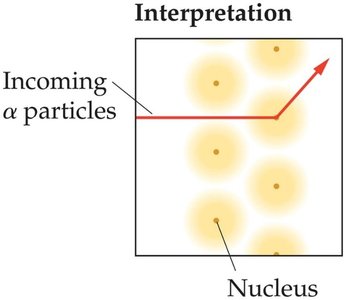
Rutherford’s experiment demonstrated that atoms have a small, dense, positively charged nucleus.
Most α-particles passed through gold foil: Atoms are mostly empty space.
Some α-particles deflected: Presence of a dense nucleus.
Rutherford’s atomic model: Electrons move around the nucleus in empty space.
Subatomic Particles
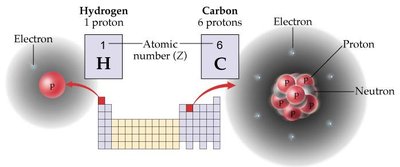
Atoms are composed of protons, neutrons, and electrons.
Protons: Positively charged, discovered by Rutherford.
Neutrons: Neutral, discovered by Chadwick.
Electrons: Negatively charged, discovered by Thomson.
Atomic distances: Measured in angstroms (Å) or picometers (pm).
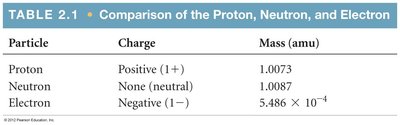
Particle | Charge | Mass (amu) |
|---|---|---|
Proton | Positive (1+) | 1.0073 |
Neutron | None (neutral) | 1.0087 |
Electron | Negative (1−) | 5.486 × 10⁻⁴ |
Atomic Number, Mass Number, and Isotopes
Atomic Number (Z) and Mass Number (A)
The atomic number is the number of protons in the nucleus, while the mass number is the sum of protons and neutrons.
Atomic number (Z): Determines the element’s identity.
Mass number (A): Total number of protons and neutrons.
Isotopes: Atoms of the same element with different numbers of neutrons.
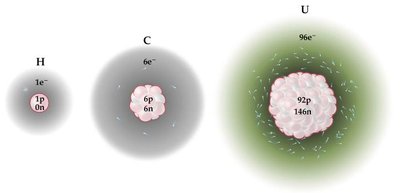
Symbol | Number of Protons | Number of Electrons | Number of Neutrons |
|---|---|---|---|
Carbon-11 | 6 | 6 | 5 |
Carbon-12 | 6 | 6 | 6 |
Carbon-13 | 6 | 6 | 7 |
Carbon-14 | 6 | 6 | 8 |
Atomic Mass and Isotopic Abundance
Atomic Mass and Mass Spectrometry
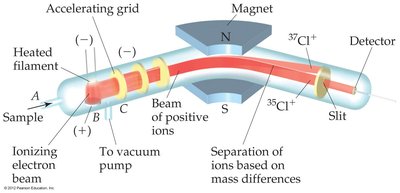
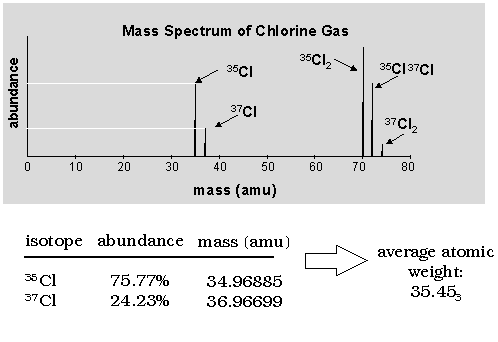
Atomic and molecular masses are measured using mass spectrometry, which separates ions based on mass differences.
Average atomic mass: Weighted average of isotopic masses based on their abundance.
Calculation:
The Periodic Table and Classification of Elements
Periodic Table Structure
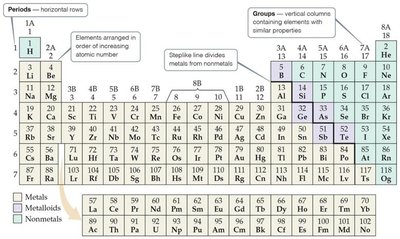
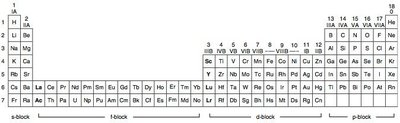
The periodic table organizes elements by atomic number, grouping those with similar properties.
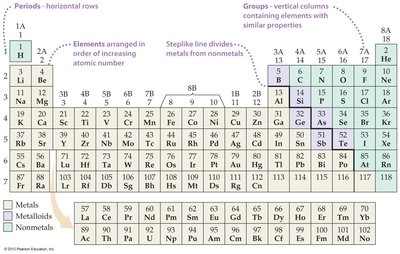
Groups (columns): Elements with similar properties.
Periods (rows): Patterns of properties repeat in each period.
Metals, Nonmetals, and Metalloids
Elements are classified as metals, nonmetals, or metalloids based on their physical and chemical properties.
Metals: Lustrous, malleable, ductile, conduct heat and electricity.
Nonmetals: Dull, brittle, insulating when solid.
Metalloids: Exhibit properties of both metals and nonmetals.
Groups and Periodicity
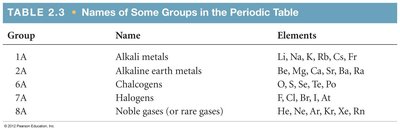
Specific groups in the periodic table have characteristic names and properties.
Group | Name | Elements |
|---|---|---|
1A | Alkali metals | Li, Na, K, Rb, Cs, Fr |
2A | Alkaline earth metals | Be, Mg, Ca, Sr, Ba, Ra |
6A | Chalcogens | O, S, Se, Te, Po |
7A | Halogens | F, Cl, Br, I, At |
8A | Noble gases | He, Ne, Ar, Kr, Xe, Rn |
Chemical Formulas and Molecular Structure
Chemical Formulas
Chemical formulas indicate the types and numbers of atoms in a compound.
Subscript: Indicates the number of atoms of each element in a molecule.
Molecular compounds: Composed of molecules, usually only nonmetals.
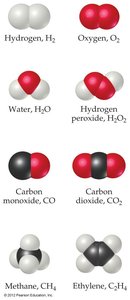
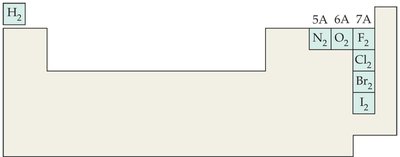
Diatomic molecules: Seven elements naturally occur as diatomic molecules (H2, N2, O2, F2, Cl2, Br2, I2).
Types of Chemical Formulas
Different types of formulas provide varying levels of information about compounds.
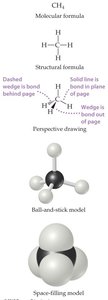
Empirical formula: Lowest whole-number ratio of atoms.
Molecular formula: Exact number of atoms of each element.
Structural formula: Shows bonding order.
Perspective drawing: Shows three-dimensional arrangement.
Ions and Ionic Compounds
Ions
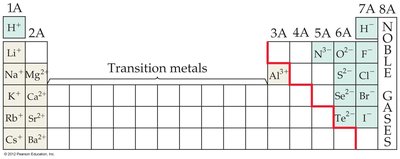
Atoms become ions by gaining or losing electrons, resulting in charged particles.
Cations: Positively charged, formed by loss of electrons (usually metals).
Anions: Negatively charged, formed by gain of electrons (usually nonmetals).
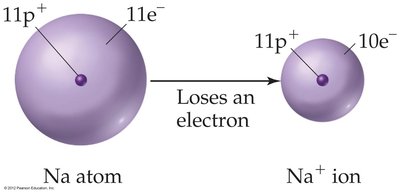
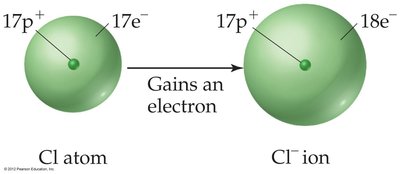
Ionic Compounds and Bonding
Ionic compounds are formed from the electrostatic attraction between cations and anions.
Example: NaCl (sodium chloride) is formed from Na+ and Cl−.
Generally formed: Between metals and nonmetals.
Nomenclature of Compounds
Inorganic Nomenclature
Naming conventions for cations and anions are essential for identifying compounds.
Cations: Named after the metal; variable charge indicated by Roman numerals.
Anions: Monoatomic anions end in -ide; polyatomic anions may end in -ate or -ite.
Oxyanions: Prefixes hypo- and per- indicate fewer or more oxygens, respectively.
Hydrogen addition: Prefix hydrogen or dihydrogen added to oxyanions.
Acid Nomenclature
Acids are named based on the anion they contain.
-ide anion: Hydro- prefix and -ic ending (e.g., HCl: hydrochloric acid).
-ate anion: -ic ending (e.g., HNO3: nitric acid).
-ite anion: -ous ending (e.g., HClO2: chlorous acid).
Binary Compounds and Organic Chemistry
Binary compounds and organic compounds follow specific naming rules.
Binary compounds: Less electronegative element listed first; prefixes denote number of atoms.
Organic compounds: Alkanes contain only C and H; alcohols end in -ol; isomers have same formula but different arrangements.
Summary Table: Comparison of Subatomic Particles
Particle | Charge | Mass (amu) |
|---|---|---|
Proton | +1 | 1.0073 |
Neutron | 0 | 1.0087 |
Electron | -1 | 5.486 × 10⁻⁴ |
Additional info: These notes expand on brief points from the original materials, providing definitions, examples, and context for each topic. All included images directly reinforce the adjacent explanations and are strictly relevant to the content.
