 뒤로
Atoms, Molecules, and Ions: Foundations of Modern Chemistry
스터디 가이드 - 스마트 노트
 자료에 맞춘 맞춤형 노트, 핵심 정의, 예시, 맥락을 확장해 제공합니다.
Atoms, Molecules, and Ions
Atomic Theory of Matter
The concept of the atom as the fundamental building block of matter has evolved from ancient philosophy to modern science. Key experimental laws led to the development of Dalton’s Atomic Theory, which forms the basis of our understanding of chemical substances and reactions.
Law of Constant Composition: Compounds always contain the same proportion of elements by mass. For example, water (H2O) always contains two hydrogen atoms for every oxygen atom.
Law of Conservation of Mass: The total mass remains unchanged during a chemical reaction; mass is neither created nor destroyed.
Law of Multiple Proportions: When two elements form more than one compound, the masses of one element that combine with a fixed mass of the other are in small whole-number ratios.
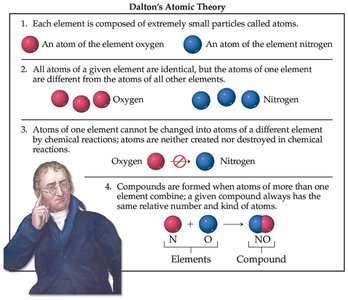
These laws were foundational for Dalton’s Atomic Theory, which states:
Elements are composed of small particles called atoms.
All atoms of a given element are identical in mass and properties, but differ from atoms of other elements.
Atoms are not created or destroyed in chemical reactions.
Atoms combine in simple whole-number ratios to form compounds.
Discovery of Subatomic Particles
While Dalton considered atoms indivisible, later experiments revealed that atoms are composed of smaller particles: electrons, protons, and neutrons.
Electrons: Discovered by J.J. Thomson through cathode ray experiments, electrons are negatively charged particles found outside the nucleus.
Protons: Positively charged particles located in the nucleus.
Neutrons: Electrically neutral particles also found in the nucleus.

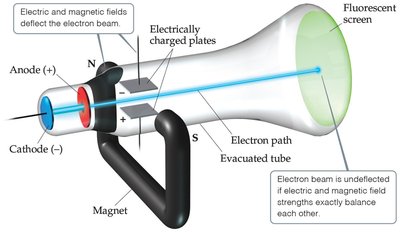
Millikan’s oil-drop experiment determined the charge of the electron, allowing calculation of its mass.

Radioactivity, discovered by Becquerel and studied by the Curies, revealed that atoms can emit high-energy radiation (α, β, γ rays), indicating internal structure.

Models of the Atom
Early models, such as Thomson’s "plum pudding" model, were replaced by Rutherford’s nuclear model after the gold foil experiment demonstrated that atoms have a small, dense, positively charged nucleus.




Subatomic Particles: Properties and Comparison
Atoms are composed of protons, neutrons, and electrons, each with distinct properties:
Particle | Charge | Mass (amu) |
|---|---|---|
Proton | +1 | 1.0073 |
Neutron | 0 | 1.0087 |
Electron | -1 | 5.486 \times 10^{-4} |
Atomic Number, Mass Number, and Isotopes
The atomic number (Z) is the number of protons in the nucleus and defines the element. The mass number (A) is the sum of protons and neutrons. Isotopes are atoms of the same element with different numbers of neutrons.
Isotope | Protons | Neutrons | Electrons |
|---|---|---|---|
Carbon-11 | 6 | 5 | 6 |
Carbon-12 | 6 | 6 | 6 |
Carbon-13 | 6 | 7 | 6 |
Carbon-14 | 6 | 8 | 6 |
Atomic Mass and Atomic Weight
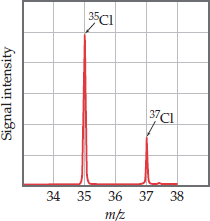
Atomic masses are measured in atomic mass units (amu), where 1 amu is defined as one-twelfth the mass of a carbon-12 atom. The atomic weight of an element is the weighted average of the masses of its naturally occurring isotopes.
Atomic weight calculation:

The Periodic Table
Organization and Classification
The periodic table arranges elements by increasing atomic number. Rows are called periods, and columns are groups. Elements in the same group have similar chemical properties.
Group | Name | Elements |
|---|---|---|
1A | Alkali metals | Li, Na, K, Rb, Cs, Fr |
2A | Alkaline earth metals | Be, Mg, Ca, Sr, Ba, Ra |
6A | Chalcogens | O, S, Se, Te, Po |
7A | Halogens | F, Cl, Br, I, At |
8A | Noble gases | He, Ne, Ar, Kr, Xe, Rn |
Metals are on the left, nonmetals on the right, and metalloids border the staircase line, exhibiting properties of both.
Molecules, Ions, and Compounds
Molecules and Molecular Compounds
A molecule is a group of atoms held together by chemical bonds. Molecular compounds are composed of molecules and typically contain only nonmetals. The chemical formula indicates the number and type of atoms present.
Diatomic molecules: H2, N2, O2, F2, Cl2, Br2, I2
Empirical formula: Lowest whole-number ratio of atoms (e.g., CH2O for glucose).
Molecular formula: Actual number of atoms (e.g., C6H12O6 for glucose).
Structural formula: Shows how atoms are connected.
Ions and Ionic Compounds
Ions are charged particles formed when atoms gain or lose electrons. Cations are positively charged (loss of electrons), typically metals. Anions are negatively charged (gain of electrons), typically nonmetals. Ionic compounds are formed from the electrostatic attraction between cations and anions, usually between metals and nonmetals.
Naming Inorganic Compounds
Chemical Nomenclature
Chemical nomenclature provides systematic rules for naming compounds:
Ionic compounds: Name the cation first, then the anion. For transition metals, indicate the charge with Roman numerals (e.g., FeCl2: iron(II) chloride).
Binary molecular compounds: Use prefixes to indicate the number of each atom (e.g., CO2: carbon dioxide).
Acids: If the anion ends in -ide, the acid name begins with hydro- and ends in -ic acid (e.g., HCl: hydrochloric acid). If the anion ends in -ate, the acid ends in -ic acid (e.g., HNO3: nitric acid). If the anion ends in -ite, the acid ends in -ous acid (e.g., HNO2: nitrous acid).
Prefix | Number |
|---|---|
mono- | 1 |
di- | 2 |
tri- | 3 |
tetra- | 4 |
penta- | 5 |
hexa- | 6 |
hepta- | 7 |
octa- | 8 |
nona- | 9 |
deca- | 10 |
Common Ions
Some ions are so common that their names and formulas must be memorized. Here are selected examples:
Ion | Formula | Name |
|---|---|---|
Cation | Na+ | Sodium ion |
Cation | Ca2+ | Calcium ion |
Anion | Cl- | Chloride ion |
Anion | SO42- | Sulfate ion |
Polyatomic | NH4+ | Ammonium ion |
Polyatomic | NO3- | Nitrate ion |
Simple Organic Compounds
Hydrocarbons and Alcohols
Organic chemistry focuses on compounds containing carbon. The simplest organic compounds are alkanes (hydrocarbons with only single bonds). When a hydrogen atom is replaced by a functional group, such as –OH, the compound is classified as an alcohol (ending in -ol).
Isomers: Compounds with the same molecular formula but different structures (e.g., 1-propanol vs. 2-propanol).
Example: C3H8O can be 1-propanol or 2-propanol, depending on the position of the –OH group.
Additional info: For further study, students should practice writing chemical formulas, naming compounds, and identifying ions and isotopes using the periodic table.
