 뒤로
Basic Concepts of Chemical Bonding: Study Notes
스터디 가이드 - 스마트 노트
 자료에 맞춘 맞춤형 노트, 핵심 정의, 예시, 맥락을 확장해 제공합니다.
Chemical Bonds
Types of Chemical Bonds
Chemical bonds are the forces that hold atoms together in compounds. There are three primary types of chemical bonds:
Ionic Bonds: Result from electrostatic attraction between ions, typically formed between metals and nonmetals.
Covalent Bonds: Involve the sharing of electrons between atoms, usually between nonmetals.
Metallic Bonds: Feature free electrons that hold metal atoms together, creating a 'sea' of electrons.
Lewis Symbols and the Octet Rule
Lewis Symbols
G. N. Lewis introduced a method to represent valence electrons using dots around the element symbol. This helps visualize potential bonding electrons.
Valence Electrons: Electrons in the outermost shell, involved in bonding.
Lewis Dot Structure: One dot per valence electron placed around the element symbol.
The Octet Rule
Atoms tend to gain, lose, or share electrons to achieve eight valence electrons, resembling the electron configuration of a noble gas.
Octet Rule: Atoms are most stable when surrounded by eight valence electrons.
Ionic Bonding
Formation and Properties
Ionic bonding occurs between metals and nonmetals (except group 8A), involving the transfer of electrons. The process is highly exothermic.
Electron Transfer: One element (low ionization energy) gives up electrons; another (high electron affinity) gains them.
Properties: Ionic substances are brittle, have high melting points, are crystalline, and cleave along smooth lines.
Energetics of Ionic Bonding
The formation of ionic compounds involves several energy changes:
Energy required to convert elements to atoms (endothermic).
Energy required to create cations (endothermic).
Energy released to form anions (exothermic).
Formation of solid releases a large amount of energy (exothermic).
This process is described by the Born–Haber Cycle.
Lattice Energy
Lattice energy measures the stability gained by arranging oppositely charged ions in an ionic solid. It is defined as the energy required to completely separate one mole of a solid ionic compound into its gaseous ions.
Trends: Lattice energy increases with increasing charge on cations and decreasing size of ions.
Equation:
where is lattice energy, and are charges, and is the distance between ions.
Electron Configuration of Ions
Main Group and Transition Metals
Main group metals lose electrons to achieve the electron configuration of the previous noble gas. Nonmetals gain electrons to achieve the configuration of the nearest noble gas. Transition metals do not always follow the octet rule and lose valence electrons first, then d-electrons as needed.
Covalent Bonding
Formation and Interactions
Covalent bonds involve the sharing of electrons, primarily between nonmetals. Several electrostatic interactions occur:
Attractions between electrons and nuclei
Repulsions between electrons
Repulsions between nuclei
For a bond to form, attractions must outweigh repulsions.
Lewis Structures
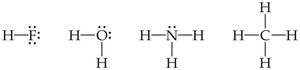
Lewis structures illustrate the sharing of electrons in covalent bonds. Each atom aims to achieve the electron configuration of the nearest noble gas by sharing electrons.
Lone Pairs: Unshared pairs of electrons on one atom.
Bonding Pairs: Shared electrons between two atoms, represented by two dots or a line.
Multiple Bonds
Atoms can share more than one pair of electrons:
Single Bond: One pair shared
Double Bond: Two pairs shared
Triple Bond: Three pairs shared
Polarity of Bonds and Electronegativity
Bond Polarity
Bond polarity measures how equally electrons are shared in a covalent bond:
Nonpolar Covalent Bond: Electrons shared equally
Polar Covalent Bond: One atom attracts electrons more strongly
Electronegativity
Electronegativity is the ability of an atom to attract electrons in a molecule. It increases from left to right across a period and from bottom to top within a group.
Greater difference in electronegativity leads to more polar bonds.
Electronegativity difference > 2.0 often indicates ionic bonding.
Dipole Moment Equation:
where is the dipole moment, is the charge, and is the distance between charges.
Drawing Lewis Structures
Steps for Drawing Lewis Structures
To draw Lewis structures:
Sum the valence electrons from all atoms, adjusting for charge.
Write the symbols for atoms, connect with single bonds.
Complete octets around atoms bonded to the central atom.
Place remaining electrons on the central atom.
If needed, use multiple bonds to complete octets.
Assign formal charges to atoms.
The dominant structure has formal charges closest to zero and negative charges on the most electronegative atom.
Resonance Structures
Resonance
Some molecules cannot be accurately depicted by a single Lewis structure. Resonance structures are used to represent such molecules, where electrons are delocalized over multiple atoms.
Example: Ozone (O3) and benzene (C6H6)
Delocalized electrons are shared by multiple atoms, while localized electrons are on one atom or shared between two.
Exceptions to the Octet Rule
Types of Exceptions
Three types of ions or molecules do not follow the octet rule:
Ions or molecules with an odd number of electrons
Ions or molecules with less than an octet
Ions or molecules with more than eight valence electrons (expanded octet)
Elements in period 3 or higher can have expanded octets due to available d-orbitals.
Strengths and Lengths of Single and Multiple Bonds
Bond Enthalpy and Bond Length
Bond enthalpy is the energy required to break a bond (always positive, endothermic). Multiple bonds are stronger and shorter than single bonds.
As the number of bonds increases, bond length decreases.
Bond enthalpy values are averages over many compounds.
Equation:
Additional info: Academic context was added to clarify steps for drawing Lewis structures, resonance, and exceptions to the octet rule.
