 뒤로
Bonding and Lewis Structures: AP Chemistry Unit 2 Study Guide
스터디 가이드 - 스마트 노트
 자료에 맞춘 맞춤형 노트, 핵심 정의, 예시, 맥락을 확장해 제공합니다.
Types of Chemical Bonds and Electronegativity
Bonding Models and Electron Distribution
Chemical bonding arises from electrostatic interactions between atomic nuclei and electrons. The distribution of valence electrons determines the nature of the bond formed between atoms.
Nonpolar Covalent Bonds: Electrons are shared equally between atoms, resulting in discrete molecules with little or no bond dipole. Example: Cl2, C–C.
Polar Covalent Bonds: Electrons are shared unequally, creating partial charges (δ+ and δ−) and a bond dipole toward the more electronegative atom. Example: H–F, C–O.
Ionic Bonds: Electrostatic attraction between cations and anions forms extended lattices. These compounds often have high melting points and conduct electricity when ions are mobile. Example: NaCl, MgO.
Metallic Bonds: Valence electrons are delocalized among positive metal cores, resulting in conductive, malleable, and ductile solids. Example: Cu, Zn.
Electronegativity increases across a period and decreases down a group. The more electronegative atom in a polar bond carries δ−, while the less electronegative atom carries δ+. A larger electronegativity difference leads to greater bond polarity and ionic character.
Example: In Si–Cl, Cl is more electronegative, so electron density shifts toward Cl: Siδ+—Clδ−.
Bond Length, Bond Energy, and Potential Energy
Potential Energy Curves and Bond Properties
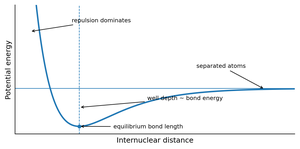
The potential energy curve models the competition between attractive and repulsive forces as two atoms approach each other. The minimum of the curve represents the most stable separation, known as the equilibrium bond length.
Equilibrium Bond Length: The x-position of the minimum on the curve.
Bond Energy: The depth of the well corresponds to the magnitude of the bond energy; a deeper well indicates a stronger bond.
Repulsion: At very short distances, repulsive forces between nuclei and electrons dominate, causing potential energy to rise sharply.
Bond Order: Higher bond order (e.g., triple vs. double vs. single) results in shorter and stronger bonds.
Atomic Size: Larger atoms form longer bonds due to greater internuclear separation at equilibrium.
Coulombic Attraction in Ionic Compounds: Stronger ionic charge and smaller ion-to-ion distance increase the strength of attraction, leading to more strongly bound lattices and higher melting points.
Ionic Solids, Metallic Solids, and Alloys
Structure and Properties of Solids
Ionic Solids: Extended three-dimensional arrays of cations and anions. Solid ionic compounds do not conduct electricity because ions are fixed; molten or aqueous forms conduct due to mobile ions. Ionic solids are hard and brittle.
Metallic Solids and Alloys: Positive metal cores in a lattice surrounded by delocalized electrons. This explains electrical and thermal conductivity, malleability, and ductility.
Substitutional Alloy: Atoms of similar size replace each other in the lattice (e.g., Cu/Zn brasses).
Interstitial Alloy: Smaller atoms occupy spaces between larger metal atoms (e.g., C in Fe in steel).
Lewis Symbols, the Octet Rule, and Covalent Bonds
Lewis Symbols and Valence Electrons
A Lewis symbol represents an element with dots for valence electrons. Main-group elements typically follow the octet rule, aiming for eight valence electrons. Hydrogen is an exception, stable with two electrons (duet rule).
Single Bond: One shared pair (2 electrons).
Double Bond: Two shared pairs (4 electrons).
Triple Bond: Three shared pairs (6 electrons).
Lone Pair: Pair of valence electrons not used in bonding.
Note: The octet rule is a model with exceptions, such as incomplete octets, odd-electron species, and expanded valence shells for heavier atoms.
Drawing Lewis Structures
Stepwise Method for Lewis Structures
Follow a consistent sequence to avoid errors:
Count total valence electrons (add for anions, subtract for cations).
Choose the central atom (least electronegative, never hydrogen).
Connect atoms with single bonds (each line = 2 electrons).
Complete terminal octets first (hydrogen needs only 2 electrons).
Place remaining electrons on the central atom.
Form multiple bonds if the central atom lacks an octet.
Check formal charges and electron count.
Example: For H2O, 8 electrons are distributed with two lone pairs on O. For CO2, double bonds are required for C to achieve an octet.
Formal Charge — Evaluating Lewis Structures
Formal Charge Calculation and Use
Formal charge is a bookkeeping tool to evaluate Lewis structures:
Formula:
Shortcut:
The sum of formal charges must equal the overall charge.
Smaller-magnitude formal charges are preferred; negative charges should be on more electronegative atoms.
Example: In NO2−, N = 0, double-bonded O = 0, single-bonded O = −1; sum matches the ion charge.
Resonance
Resonance Contributors and Hybrids
Resonance occurs when multiple valid Lewis structures differ only in electron placement. The actual structure is a resonance hybrid, with delocalized electrons.
Atom positions remain fixed; only electrons move.
Preserve total electrons and charge.
Use double-headed arrows (↔) between contributors.
Example: For NO2−, two equivalent contributors exist. For CO32−, three equivalent contributors exist.
Average Bond Order: For CO32−, bond order = ; bonds are intermediate between single and double bonds.
Common Mistakes to Avoid
Typical Errors and Corrections
Electron count errors (forgetting to add/subtract for ions).
Wrong central atom (hydrogen or terminal halogen).
Octet errors (second-period elements lacking octet).
Formal charge errors (not summing to overall charge).
Resonance errors (moving atoms instead of electrons).
Bond polarity errors (reversing δ+ and δ−).
Ionic solid errors (assuming solids conduct electricity).
Potential energy errors (confusing bond length and bond strength).
Unit 2 Summative Study Checklist
Key Skills and Concepts
Determine valence electrons and relate to bonding patterns.
Explain electronegativity trends and identify δ+ / δ−.
Compare bond polarity and ionic/covalent character.
Read potential-energy curves for bond length and strength.
Predict effects of bond order and atomic size.
Compare ionic attractions using charge and size.
Explain conductivity in ionic solids (solid vs. molten/aqueous).
Describe metallic bonding and alloy types.
Draw Lewis structures and identify lone pairs/bonds.
Calculate formal charges and evaluate structures.
Draw and interpret resonance structures and hybrids.
Connect resonance and average bond order to bond length/strength.
Lewis Structure Practice
Practice Species and Tasks
CF4: Neutral molecule; all single bonds.
HCN: Neutral molecule; multiple bond required.
NH4+: Polyatomic cation; subtract one electron.
NO2−: Formal charge and two resonance contributors.
CO32−: Formal charge and three resonance contributors.
O3: Neutral resonance species; compare O–O bonds in hybrid.
Additional info: This guide covers AP Chemistry Unit 2 topics relevant to General Chemistry, including bonding, Lewis structures, formal charge, and resonance. VSEPR, molecular geometry, and hybridization are deferred to later units.
