 뒤로
Chapter 1: Chemical Foundations – General Chemistry Study Notes
스터디 가이드 - 스마트 노트
 자료에 맞춘 맞춤형 노트, 핵심 정의, 예시, 맥락을 확장해 제공합니다.
Chemical Foundations
The Scientific Method
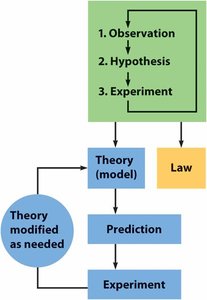
The scientific method is a systematic approach used by scientists to investigate natural phenomena. It involves making observations, forming hypotheses, conducting experiments, and developing theories or laws based on the results. This process ensures that scientific knowledge is built on evidence and logical reasoning.
Observation: The initial step where phenomena are noticed and recorded.
Hypothesis: A tentative explanation for the observations.
Experiment: Testing the hypothesis by collecting data.
Theory: An explanation of why something occurs, developed if the hypothesis is repeatedly supported.
Law: A statement of observed fact describing what occurs.
What is Chemistry?
Chemistry is the study of matter and the changes it undergoes. Matter is anything that has mass and occupies space. Understanding matter is central to chemistry, and scientists classify matter to organize their knowledge.
Matter: Anything with mass and volume.
Mass: A measure of the amount of matter in an object.
Space: The volume occupied by matter.
Classification of Matter
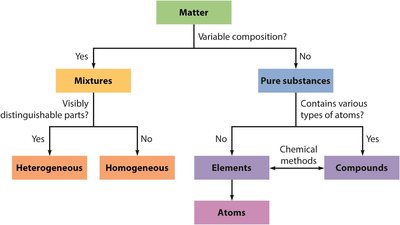
Matter can be classified based on its composition and properties. The main categories are mixtures and pure substances, which are further divided into heterogeneous and homogeneous mixtures, elements, and compounds.
Mixtures: Combinations of two or more substances retaining their distinct properties. Can be heterogeneous (unequally distributed) or homogeneous (equally distributed, also called solutions).
Substances: Forms of matter with definite composition and distinct properties. Includes elements (cannot be broken down) and compounds (can be decomposed).
Separation of Mixtures
Mixtures can be separated by physical methods, which exploit differences in physical properties. Common techniques include filtration, distillation, and chromatography.
Filtration: Separates solids from liquids using a filter.
Distillation: Separates liquids based on boiling points.
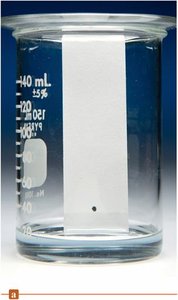
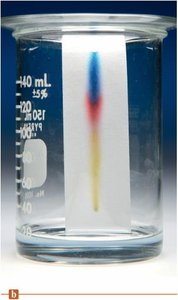
Chromatography: Separates substances based on their interactions with a stationary and mobile phase.
Filtration
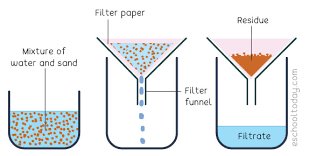
Filtration is used to separate a solid from a liquid by passing the mixture through filter paper, which retains the solid (residue) and allows the liquid (filtrate) to pass through.
Distillation
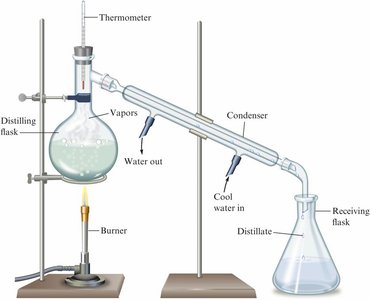
Distillation involves heating a liquid mixture to boil off the more volatile component, which is then condensed and collected separately.
Chromatography
Chromatography separates components based on their movement through a stationary phase under the influence of a mobile phase. The separation depends on the different affinities of substances for the phases.
Physical and Chemical Properties
Properties of matter are classified as physical or chemical. Physical properties can be observed without changing the substance's composition, while chemical properties describe the ability to form new substances.
Physical Property: Observable without changing composition (e.g., melting point, density).
Chemical Property: Describes reactivity and ability to form new substances (e.g., flammability).
Physical and Chemical Changes
Changes in matter are either physical or chemical. Physical changes alter appearance but not composition, while chemical changes result in new substances.
Physical Change: Change in state or appearance (e.g., melting, boiling).
Chemical Change: Change in composition (e.g., rusting, combustion).
States of Matter and Physical Changes
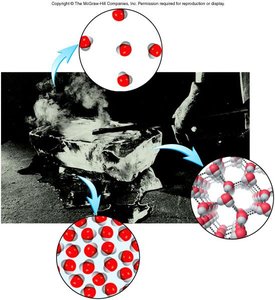
Matter exists in three states: solid, liquid, and gas. Conversions between these states are physical changes.
Solid: Definite shape and volume.
Liquid: Definite volume, indefinite shape.
Gas: Indefinite shape and volume.
Models in Chemistry
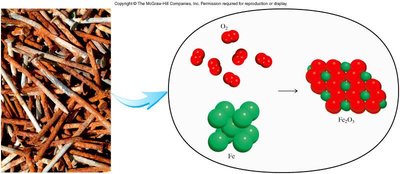
Scientists use models to represent and explain phenomena that are too small to observe directly. Models help bridge the gap between the microscopic and macroscopic worlds.
Macroscopic: Observable phenomena (e.g., rust on nails).
Microscopic: Atomic and molecular interactions (e.g., formation of compounds).
Measurements in Chemistry
Measurements are fundamental in chemistry, involving numbers and units. Scientists use standardized units (SI units) for consistency.
Measurement: Consists of a number and a unit.
SI Units: International System of Units for mass (kg), length (m), time (s), temperature (K), electric current (A), amount of substance (mol), luminous intensity (cd).
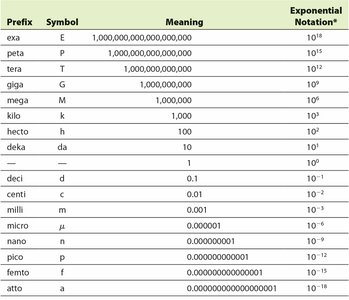
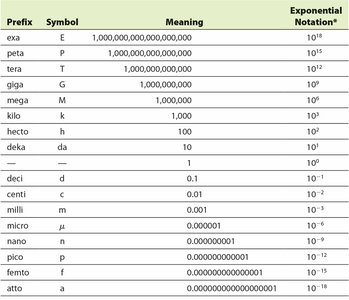
Numerical Prefixes (Metric System)
Prefixes are used to denote multiples or fractions of units in the metric system.
Prefix | Symbol | Meaning | Exponential Notation |
|---|---|---|---|
kilo | k | 1,000 | |
centi | c | 0.01 | |
milli | m | 0.001 | |
micro | \mu | 0.000001 | |
nano | n | 0.000000001 | |
Additional info: See image_9 for full table. |
Length, Volume, and Mass
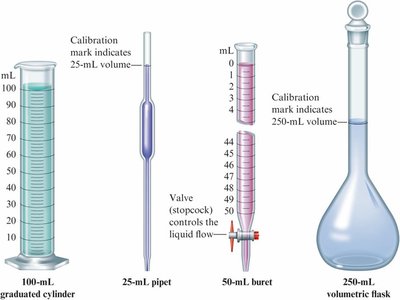
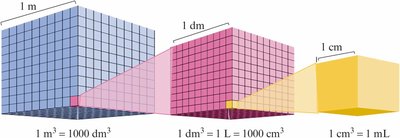
Length is measured in meters (m), volume in liters (L) or cubic centimeters (cm3), and mass in grams (g). Volume is a derived unit, calculated as length × width × height.
1 mL = 1 cm3
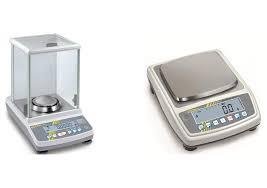
Mass: Measured using balances.
Time and Temperature
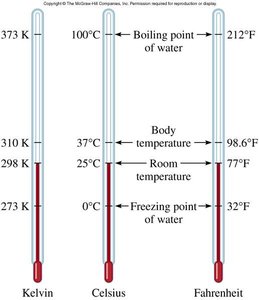
Time is measured in seconds (s), and temperature in degrees Celsius (°C) or Kelvin (K). Temperature conversions are important in chemistry.
°F = (9/5) × °C + 32
K = °C + 273
Absolute Zero: The lowest possible temperature, where all motion stops.
Precision, Accuracy, and Data Collection
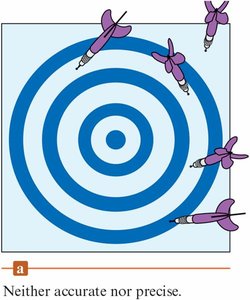
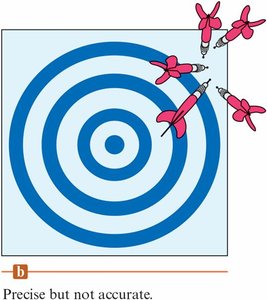
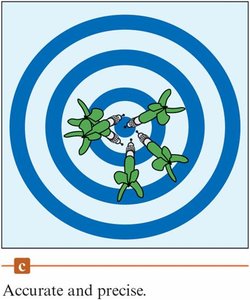
Good data in chemistry is both precise and accurate. Precision refers to the consistency of repeated measurements, while accuracy refers to how close a measurement is to the true value.
Precision: How closely measurements agree with each other.
Accuracy: How close measurements are to the true value.
Measured vs. Exact Numbers
Measured numbers are obtained from experiments and include uncertainty. Exact numbers are obtained by counting or definition and have no uncertainty.
Significant Figures: All digits known with certainty plus one estimated digit.
Example: 25 cm, 25.0 cm, and 25.00 cm have different numbers of significant figures.
Scientific Notation
Scientific notation is used to express very large or small numbers in the form a × 10b, where 1.0 ≤ a < 10 and b is an integer.
Example: 602214199000000000000000 becomes
Example: 0.00000000000000000000000000166 becomes
Significant Figures in Calculations
Rules for significant figures depend on the mathematical operation:
Multiplication/Division: The answer has the same number of significant figures as the factor with the fewest significant figures.
Addition/Subtraction: The answer is rounded to the least precise decimal place.
Conversion Factors and Dimensional Analysis
Conversion factors are used to change units. Dimensional analysis (factor-label method) is a systematic way to convert between units using equalities.
Example:
Example:
Density
Density is a physical property defined as mass per unit volume. It is used to identify substances and convert between mass and volume.
Formula:
Example: A block measuring 2.00 cm × 5.00 cm × 1.00 cm with a mass of 89.2 g has a density of
Compound | Density (g/cm3) at 20°C |
|---|---|
Chloroform | 1.492 |
Diethyl ether | 0.714 |
Ethanol | 0.789 |
Isopropyl alcohol | 0.785 |
Toluene | 0.867 |
Example: Diethyl ether has a density of 0.714 g/mL. To convert to SI units (kg/m3):
Problem Solving in Chemistry
Effective problem solving involves identifying what is being asked, what information is provided, and what relationships or equations are relevant. Combining these elements leads to the solution.
Ask Yourself: What am I looking for? What does the question tell me? What relationships do I know? How do I combine them?
----------------------------------------
