 뒤로
Chapter 1: Introduction to Matter, Measurement, and Chemical Foundations
스터디 가이드 - 스마트 노트
 자료에 맞춘 맞춤형 노트, 핵심 정의, 예시, 맥락을 확장해 제공합니다.
Chapter 1: Introduction to Matter and Measurement
Chemistry: The Central Science
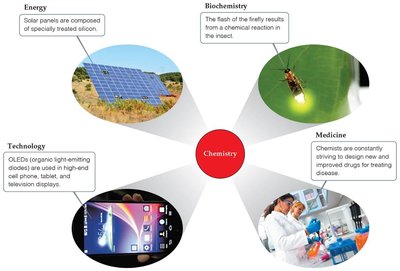
Chemistry is the study of matter, its properties, and the changes it undergoes. It is fundamental to understanding the natural world and is central to many scientific and technological fields, including energy, biochemistry, medicine, and technology.
Classification of Matter
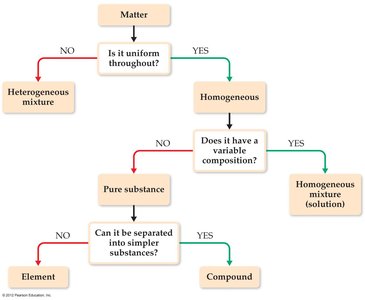
Matter is anything that has mass and occupies space. It can be classified by its physical state and composition.
States of Matter: Solid, liquid, and gas, each with distinct properties regarding shape, volume, and compressibility.
Composition of Matter: Matter can be an element, compound, or mixture.
Elements, Compounds, and Mixtures
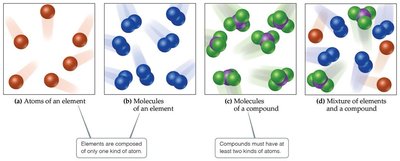
Element: A pure substance made of only one kind of atom. Cannot be decomposed by chemical means.
Compound: A pure substance composed of two or more different elements chemically combined in fixed proportions. Follows the Law of Constant Composition.
Mixture: A combination of two or more substances in which each retains its own identity. Mixtures can be homogeneous (uniform composition) or heterogeneous (non-uniform composition).
Examples of Elements and Compounds
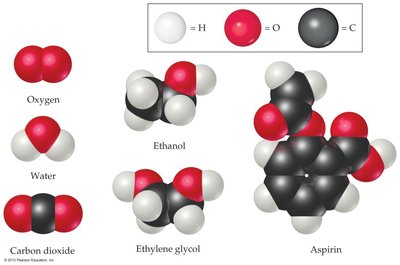
Elements: Oxygen (O2), Gold (Au)
Compounds: Water (H2O), Carbon dioxide (CO2), Ammonia (NH3)
Physical and Chemical Properties of Matter
Properties of matter are used to distinguish between substances and are categorized as physical or chemical, and as intensive or extensive.
Physical Properties: Can be observed without changing the substance (e.g., boiling point, density, color).
Chemical Properties: Can only be observed when a substance is changed into another substance (e.g., flammability, reactivity).
Intensive Properties: Independent of the amount of substance (e.g., density, boiling point).
Extensive Properties: Dependent on the amount of substance (e.g., mass, volume).
Physical and Chemical Changes
Changes in matter are classified as physical or chemical:
Physical Change: Alters the state or appearance but not composition (e.g., melting, boiling).
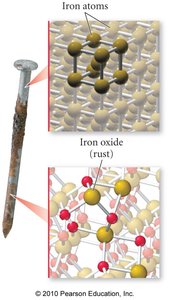
Chemical Change: Alters the composition, resulting in new substances (e.g., rusting, combustion).
Separation of Mixtures
Mixtures can be separated by exploiting differences in physical properties:
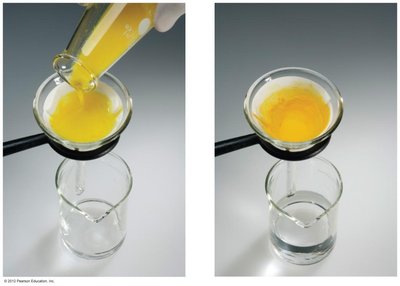
Filtration: Separates solids from liquids.
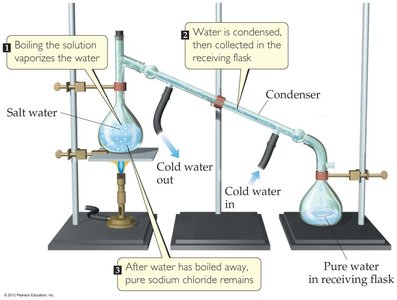
Distillation: Separates substances based on differences in boiling points.
Chromatography: Separates substances based on differences in solubility or affinity for a stationary phase.
Measurement in Chemistry
Quantitative measurements are essential in chemistry. Every measurement includes a number and a unit. The International System of Units (SI) is used for consistency.
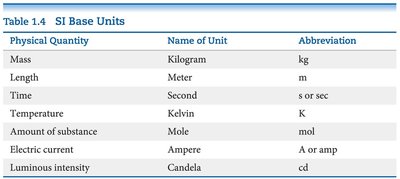
SI Base Units: Mass (kilogram, kg), Length (meter, m), Time (second, s), Temperature (kelvin, K), Amount of substance (mole, mol).
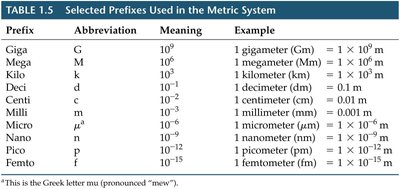
Metric Prefixes
Prefixes are used to express multiples or fractions of base units.
Temperature Scales
Temperature is a measure of the average kinetic energy of particles. The Celsius and Kelvin scales are commonly used in science. The Fahrenheit scale is used in some countries but not in scientific contexts.
Kelvin (K): SI unit, absolute zero is 0 K.
Celsius (°C): Based on water's freezing (0°C) and boiling (100°C) points.
Fahrenheit (°F): Not used in science. Conversion:
Derived Units and Density
Some quantities are derived from base units, such as area (m2), volume (m3), and density (kg/m3 or g/cm3).
Density: (mass per unit volume). It is an intensive property and can be used to identify substances.
Accuracy, Precision, and Significant Figures
Measurements in chemistry are subject to uncertainty. Accuracy refers to how close a measurement is to the true value, while precision refers to how close repeated measurements are to each other. Significant figures reflect the precision of a measurement.
Rules for Significant Figures:
All nonzero digits are significant.
Zeros between significant digits are significant.
Leading zeros are not significant.
Trailing zeros are significant if a decimal point is present.
Calculations:
Addition/Subtraction: Round to the least number of decimal places.
Multiplication/Division: Round to the least number of significant figures.
Dimensional Analysis (Factor-Label Method)
Dimensional analysis is a systematic approach to problem-solving that uses conversion factors to move from one unit to another. Always include units in calculations to ensure correctness.
Example: To convert 8.00 m to inches:
First, convert meters to centimeters:
Then, convert centimeters to inches:
Practice and Application
Apply the concepts of classification, measurement, and calculation to solve problems involving matter, its properties, and its changes.
Use significant figures and dimensional analysis for accurate and precise scientific calculations.
