 뒤로
Chapter 1: Matter, Measurement, and Problem Solving – Structured Study Notes
스터디 가이드 - 스마트 노트
 자료에 맞춘 맞춤형 노트, 핵심 정의, 예시, 맥락을 확장해 제공합니다.
Matter and Its Classification
What is Chemistry?
Chemistry is the science that seeks to understand the behavior of matter by studying the behavior of atoms and molecules. It explores how substances interact, combine, and change, and the energy involved in these processes.
Atoms and Molecules
Atoms are the fundamental building blocks of ordinary matter. They are submicroscopic particles such as carbon (C), sodium (Na), and hydrogen (H). Molecules consist of two or more atoms joined chemically in a specific geometrical arrangement, such as carbon monoxide (CO), carbon dioxide (CO2), oxygen (O2), and water (H2O).
Atoms: Smallest unit of an element, retains chemical properties.
Molecules: Combination of atoms bonded together.
Example: The arrangement of atoms in water (H2O) and hydrogen peroxide (H2O2) leads to very different properties.
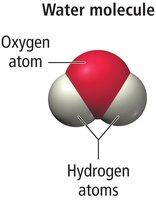
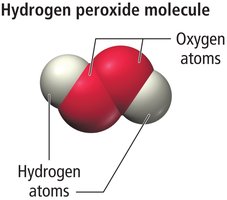
Difference in Arrangement of Atoms
Small differences in the arrangement of atoms and molecules can result in large differences in the matter they compose. For example, water and hydrogen peroxide have similar atoms but different arrangements, resulting in distinct chemical properties.
The Scientific Method
Overview of the Scientific Method
The scientific method is a systematic approach based on observation and experiment. It involves making observations, forming hypotheses, conducting experiments, and developing laws and theories.
Observation: Descriptions about the characteristics or behavior of nature; can be quantitative or qualitative.
Hypothesis: Tentative interpretation or explanation of the observations; must be falsifiable.
Experiment: Designed situation in which observations are made in a careful and repeatable manner.
Law: Brief statement that summarizes past observations and predicts future ones (e.g., Law of Conservation of Mass).
Theory: Attempts to explain why nature behaves as it does; must be validated by experiments.
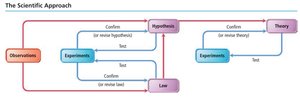
Classification of Matter
Physical States of Matter
Matter is classified according to its physical state (solid, liquid, gas) and composition (element, compound, mixture).
Solid: Atoms or molecules are closely packed in fixed locations; only vibrational movement; fixed volume and shape.
Liquid: Atoms or molecules are closely packed but can move freely; fixed volume but variable shape.
Gas: Atoms or molecules have a lot of space between them and move freely; variable volume and shape.
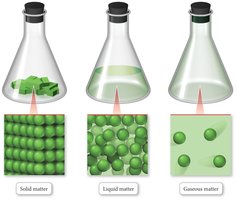
Types of Solids
Crystalline: Long-range repeating order (e.g., diamond).
Amorphous: No long-range order.
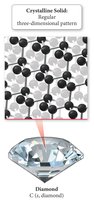
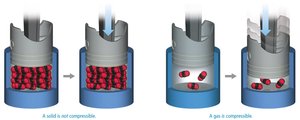
Compressibility of Gases
Gases are easily compressible because their particles are far apart and can be squeezed into a smaller volume, unlike solids and liquids.
Composition of Matter
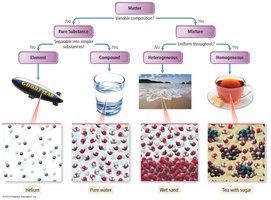
Matter can be classified as pure substances or mixtures:
Element: Cannot be broken down chemically into simpler substances.
Compound: Two or more elements in fixed, definite proportions.
Homogeneous mixture: Uniform composition throughout.
Heterogeneous mixture: Composition varies; multiple substances can be seen.
Physical and Chemical Changes
Physical Changes
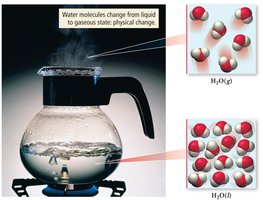
Physical changes alter the state or appearance of matter but not its composition. Atoms or molecules do not change.
Examples: Melting, boiling, dissolving.
Chemical Changes
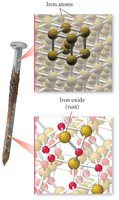
Chemical changes alter the composition of matter. Atoms rearrange, and the substance is transformed into a different substance.
Examples: Rusting, combustion.
Physical and Chemical Properties
Physical Properties
Physical properties are characteristics a substance displays without changing its composition, such as odor, taste, color, appearance, melting point, boiling point, and density.
Chemical Properties
Chemical properties are characteristics a substance displays only by changing its composition via chemical reaction, such as flammability, corrosiveness, acidity, and toxicity.
Energy in Chemistry
Definition of Energy
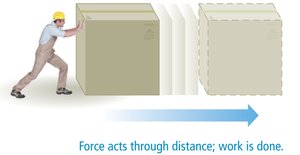
Energy is the capacity to do work. Work is the action of a force through a distance.
Types of Energy
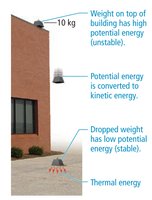
Kinetic energy: Energy associated with the motion of an object.
Potential energy: Energy associated with the position or composition of an object.
Thermal energy: Energy associated with the temperature of an object (a type of kinetic energy).
Law of Conservation of Energy
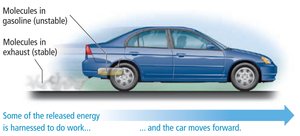
During physical or chemical changes, energy is conserved. The law of conservation of energy states that energy is neither created nor destroyed. Systems with high potential energy change in a way that lowers their potential energy.
Units and Measurements
Units of Measurement
Units are standard quantities used to specify measurements. Every measurement should include a number and a unit. Prefix multipliers are used to report measurements close to the size of the quantity being measured (e.g., 3.88 x 10⁶ g).
Derived Units
Derived units are combinations of other units, such as volume and density.
Density formula:
Reliability of Measurements
The number of digits in a reported measurement indicates the certainty of the measurement. Scientific measurements are reported so that every digit is certain except the last, which is estimated. More digits indicate more certainty.
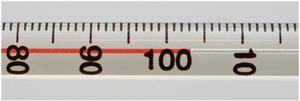
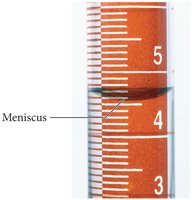
Taking Volume Measurements
Report the volume (which is read at the bottom of the meniscus) to the correct number of digits.
Significant Figures
Rules for Counting Significant Figures
All nonzero digits are significant.
Interior zeroes are significant.
Leading zeroes are NOT significant.
Trailing zeroes after a decimal point are significant.
Trailing zeroes before a decimal point and after a nonzero number are significant.
Trailing zeroes before an implied decimal point are ambiguous; use scientific notation to avoid ambiguity.
Exact Numbers
Exact numbers have no uncertainty and do not limit the number of significant figures reported. Examples include counting discrete objects, defined quantities, and integral numbers that are part of an equation.
Significant Figures in Calculations
Do each calculation in steps; follow the rules for order of operations (PEMDAS).
Evaluate significant figures after each step.
Do not round intermediate steps; round only the final answer.
Keep two insignificant digits until the entire calculation is finished; then round to the correct significant figures.
Precision and Accuracy
Definitions
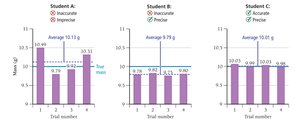
Accuracy: How close the measured value is to the actual value.
Precision: Reproducibility; how close a series of measurements are to one another.
Summary Table: Classification of Matter
Type | Description | Example |
|---|---|---|
Element | Cannot be broken down chemically | Helium |
Compound | Two or more elements in fixed proportions | Pure water |
Homogeneous Mixture | Uniform composition throughout | Tea with sugar |
Heterogeneous Mixture | Composition varies | Wet sand |
