 뒤로
Chapter 12: Solutions and Their Properties – General Chemistry Study Notes
스터디 가이드 - 스마트 노트
 자료에 맞춘 맞춤형 노트, 핵심 정의, 예시, 맥락을 확장해 제공합니다.
Chapter 12: Solutions and Their Properties
Introduction to Solutions
Solutions are homogeneous mixtures composed of two or more substances. The study of solutions is fundamental in chemistry, as it explains how substances interact, dissolve, and affect physical properties such as boiling and freezing points.
Types of Solutions and Solubility
Solubility refers to the ability of a solute to dissolve in a solvent. The process is influenced by the nature of the solute and solvent, temperature, and pressure.
Solute: The substance being dissolved.
Solvent: The substance doing the dissolving (usually present in greater amount).
Solubility: The maximum amount of solute that can dissolve in a given amount of solvent at a specific temperature.
Example: NaCl (table salt) dissolves in water, but not all substances are equally soluble.
Nature’s Tendency Towards Mixing: Entropy
Mixing of substances is driven by entropy, which is a measure of disorder or randomness in a system. The tendency towards mixing increases entropy.
Entropy: A thermodynamic quantity representing the unavailability of a system’s energy for conversion into work.
Example: Mixing of gases or liquids increases entropy.

Relative Interactions and Solution Formation
The formation of a solution depends on the interactions between solute and solvent particles. These interactions can be classified as:
Solvent-solvent interactions
Solute-solute interactions
Solvent-solute interactions
For a solution to form, solvent-solute interactions must be comparable to or stronger than solvent-solvent and solute-solute interactions.

Energetics of Solution Formation
Solution formation involves changes in enthalpy (ΔH). The process can be broken down into three steps:
ΔHsolute: Energy required to separate solute particles.
ΔHsolvent: Energy required to separate solvent particles.
ΔHmix: Energy released when solute and solvent particles interact.
The overall enthalpy change is:
If ΔHsolution is negative, the solution process is exothermic and favored. If positive, it may not occur unless entropy increases sufficiently.
Solubility and Temperature
Solubility of most solids increases with temperature, while solubility of gases decreases with temperature.
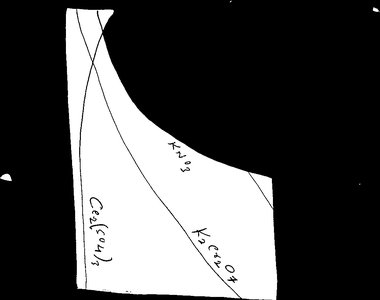
Solubility curves: Graphs showing how solubility changes with temperature for different substances.
Example: KNO3 and Ce2(SO4)3 have different solubility behaviors.
Concentration Units
Concentration describes the amount of solute in a given amount of solution. Common units include:
Molarity (M): Moles of solute per liter of solution.
Molality (m): Moles of solute per kilogram of solvent.
Percent by mass:
Colligative Properties
Colligative properties depend on the number of solute particles in a solution, not their identity. These include:
Vapor pressure lowering
Boiling point elevation
Freezing point depression
Osmotic pressure
For example, adding salt to water lowers its freezing point and raises its boiling point.
Freezing Point Depression and Boiling Point Elevation
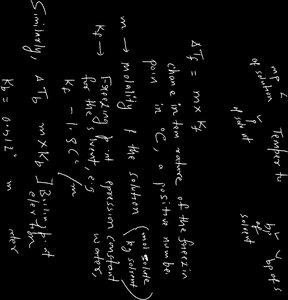
These properties are calculated using the following equations:
Freezing point depression:
Boiling point elevation:
Where m is molality, Kf and Kb are the freezing and boiling point constants for the solvent.
Osmosis and Osmotic Pressure
Osmosis is the movement of solvent molecules through a semipermeable membrane from a region of lower solute concentration to higher concentration. Osmotic pressure is the pressure required to stop this flow.
Osmotic pressure equation:
Where M is molarity, R is the gas constant (0.08206 L·atm/mol·K), and T is temperature in Kelvin.
Raoult’s Law and Vapor Pressure
Raoult’s Law describes the vapor pressure of a solution as proportional to the mole fraction of the solvent:
Where Xsolvent is the mole fraction of the solvent and Psolvent is its vapor pressure.

Deviations from Raoult’s Law
Real solutions may show positive or negative deviations from Raoult’s Law, depending on the interactions between solute and solvent.
Positive deviation: Vapor pressure is higher than predicted.
Negative deviation: Vapor pressure is lower than predicted.


Sample Calculations and Practice Problems
Understanding solution properties often involves calculations. Example problems include determining molar mass from freezing point depression, boiling point elevation, and ranking solutions by boiling point.
Example: Calculate the freezing point depression for a solution using .
Example: Calculate osmotic pressure using .
Summary Table: Colligative Properties
Property | Equation | Effect |
|---|---|---|
Vapor Pressure Lowering | Decreases vapor pressure | |
Boiling Point Elevation | Increases boiling point | |
Freezing Point Depression | Lowers freezing point | |
Osmotic Pressure | Pressure required to stop osmosis |
Practice Worksheet Example
Sample worksheet questions include calculations for molar mass, boiling point elevation, and ranking solutions by boiling point. These exercises reinforce understanding of colligative properties and solution concentration.
Conclusion
Chapter 12 covers the essential concepts of solutions, their formation, properties, and the mathematical relationships governing their behavior. Mastery of these topics is crucial for understanding chemical reactions in aqueous environments and predicting the effects of solutes on physical properties.
