뒤로
Chapter 3: Molecules, Compounds, and Nomenclature – General Chemistry Study Notes
스터디 가이드 - 스마트 노트
 자료에 맞춘 맞춤형 노트, 핵심 정의, 예시, 맥락을 확장해 제공합니다.
Chapter 3: Molecules, Compounds, and Nomenclature
Elements and Compounds
Elements combine to form compounds, which possess properties distinct from their constituent elements. Understanding the nature of compounds and their formation is fundamental to chemistry.
Element: A pure substance consisting of only one type of atom.
Compound: A substance composed of two or more elements chemically bonded together.
Properties: Compounds exhibit unique physical and chemical properties compared to their constituent elements.
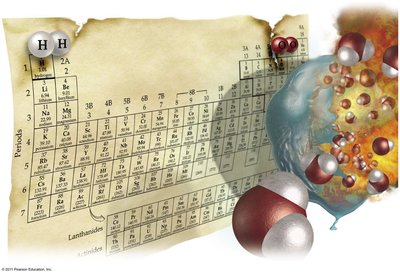
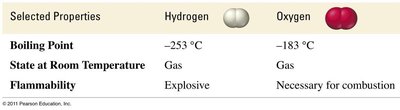
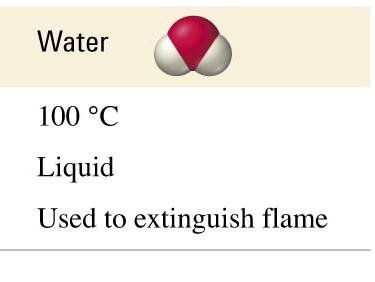
Example: Hydrogen and oxygen are both gases, but their compound, water, is a liquid at room temperature and extinguishes flames.
Chemical Bonds
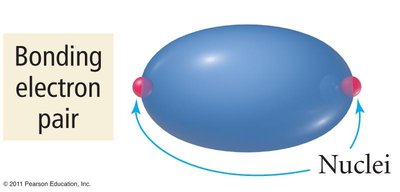
Atoms in compounds are held together by chemical bonds, which are forces of attraction resulting from interactions between protons and electrons.
Chemical bond: The force that holds atoms together in a compound.
Bonding attraction: Originates from the electrostatic attraction between positively charged nuclei and negatively charged electrons.

Types of Chemical Bonds
There are two primary types of chemical bonds found in compounds: ionic and covalent.
Ionic bonds: Formed when electrons are transferred from one atom to another, resulting in oppositely charged ions that attract each other. Typically occur between metals and nonmetals.
Covalent bonds: Formed when two atoms share electrons. Typically occur between nonmetals.
Formulas Describe Compounds
Chemical formulas provide information about the types and numbers of atoms in a compound.
Empirical formula: Shows the simplest whole-number ratio of atoms in a compound.
Molecular formula: Shows the actual number of atoms of each element in a molecule.
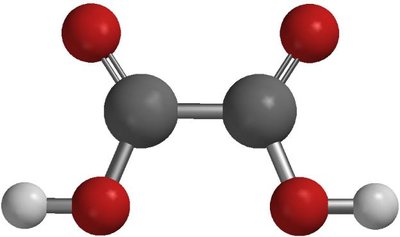
Structural formula: Shows the arrangement of atoms within the molecule.
Example: Oxalic acid has an empirical formula of CHO2 and a molecular formula of C2H2O4.
Classification of Elements and Compounds
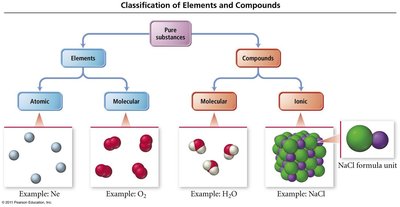
Pure substances can be classified as elements or compounds, and further as atomic, molecular, or ionic.
Atomic elements: Elements whose basic units are single atoms (e.g., Ne).
Molecular elements: Elements whose basic units are molecules composed of two or more atoms (e.g., O2).
Molecular compounds: Compounds whose basic units are molecules made of only nonmetals (e.g., H2O).
Ionic compounds: Compounds whose basic units are formula units composed of cations and anions (e.g., NaCl).
Molecular Elements
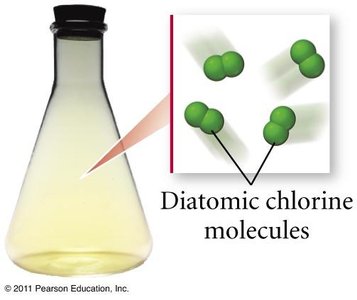
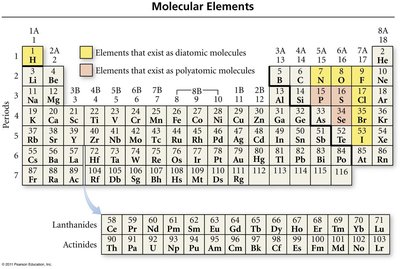
Certain elements exist as molecules rather than individual atoms. Diatomic molecules are especially common among nonmetals.
Diatomic elements: H2, N2, O2, F2, Cl2, Br2, I2.
Polyatomic elements: P4, S8, Se8.
Rule of 7's: Diatomic elements can be found in a pattern on the periodic table.
Ionic Compounds
Ionic compounds are formed from metals and nonmetals, consisting of cations and anions arranged in a three-dimensional lattice.
Cation: Positively charged ion, usually a metal.
Anion: Negatively charged ion, usually a nonmetal.
Formula unit: The simplest ratio of ions in an ionic compound.
Polyatomic ion: An ion composed of multiple atoms covalently bonded, acting as a single unit.
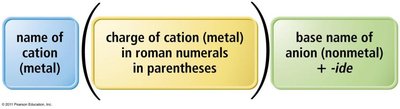
Naming Ionic Compounds
The systematic naming of ionic compounds depends on the type of metal involved and the nature of the anion.
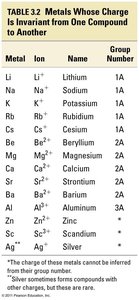
Metals with invariant charge: Name the metal directly (e.g., sodium, potassium).
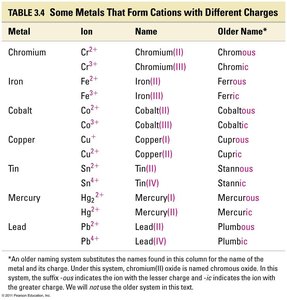
Metals with variable charge: Name the metal followed by its charge in Roman numerals (e.g., iron(III), copper(II)).
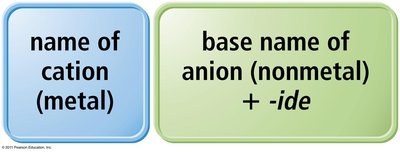
Monatomic anion: Name the nonmetal with an -ide suffix (e.g., chloride, oxide).
Polyatomic ion: Use the name of the polyatomic ion (e.g., sulfate, nitrate).
Compounds Containing Polyatomic Ions
Polyatomic ions are groups of atoms that carry a charge and act as a single unit in ionic compounds.
Common polyatomic ions: Nitrate (NO3-), sulfate (SO42-), phosphate (PO43-), acetate (C2H3O2-).
Naming: Name the cation first, then the polyatomic anion.
Patterns: Polyatomic ions in the same group often have similar formulas and charges.
Hydrates
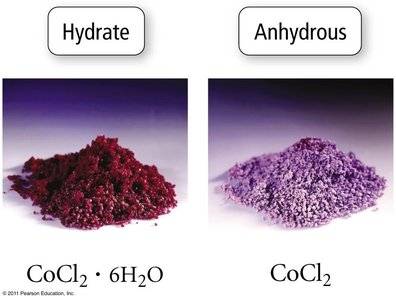
Hydrates are ionic compounds that contain a specific number of water molecules associated with each formula unit.
Formula: Waters of hydration are indicated after a dot (e.g., CoCl2·6H2O).
Naming: Use a prefix to indicate the number of water molecules (e.g., hexahydrate for six).
Naming Binary Molecular Compounds
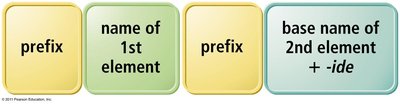
Binary molecular compounds consist of two nonmetals and are named using prefixes to indicate the number of atoms.
First element: Use the full name; never use the prefix mono- for the first element.
Second element: Use the base name with an -ide suffix and appropriate prefix.
Prefixes: mono-, di-, tri-, tetra-, penta-, hexa-, hepta-, octa-, nona-, deca-.
Example: BF3 is named boron trifluoride.
Acids
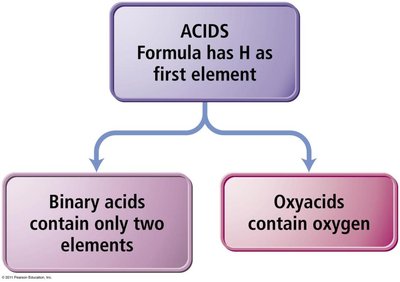
Acids are molecular compounds that release H+ ions when dissolved in water. They are classified as binary acids or oxyacids.
Binary acids: Contain hydrogen and one other nonmetal (e.g., HCl).
Oxyacids: Contain hydrogen, oxygen, and another element (e.g., H2SO4).
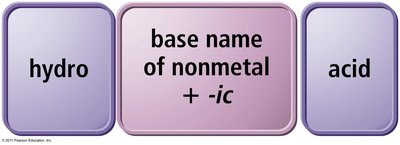
Naming binary acids: Use hydro- prefix, base name of nonmetal with -ic suffix, and the word acid (e.g., hydrochloric acid).
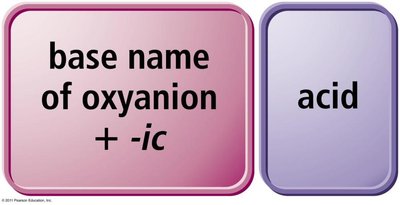
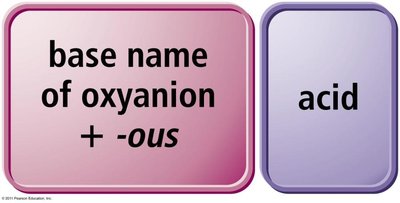
Naming oxyacids: If the polyatomic ion ends in -ate, change to -ic; if it ends in -ite, change to -ous, followed by acid (e.g., sulfuric acid, sulfurous acid).
Carbon Bonding and Hydrocarbons
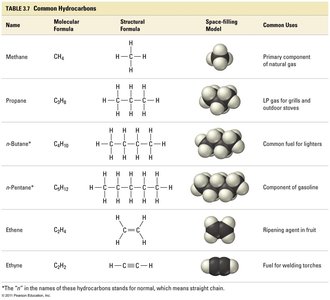
Carbon forms covalent bonds and can create a vast array of compounds, including straight chains, branched chains, and rings. Hydrocarbons are compounds composed solely of carbon and hydrogen.
Bonding: Carbon typically forms four covalent bonds.
Hydrocarbons: Classified as alkanes, alkenes, and alkynes based on the types of bonds present.
Examples: Methane (CH4), ethane (C2H6), ethene (C2H4), ethyne (C2H2).