 뒤로
Chapter 3: Periodic Properties of the Elements – Study Guide
스터디 가이드 - 스마트 노트
 자료에 맞춘 맞춤형 노트, 핵심 정의, 예시, 맥락을 확장해 제공합니다.
Periodic Properties of the Elements
Significance of the Periodic Table Arrangement
The periodic table is structured to reflect recurring (periodic) properties of elements. Elements are arranged in rows (periods) and columns (groups), where each group contains elements with similar chemical properties due to their similar valence electron configurations.
Periods: Horizontal rows; elements increase in atomic number from left to right.
Groups: Vertical columns; elements in the same group have similar properties.
Special Groups: Group 1A (alkali metals), Group 2A (alkaline earth metals), Group 7A (halogens), Group 8A (noble gases).
Classification: Metals, nonmetals, and metalloids are divided by a steplike line.
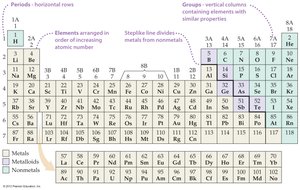
Electron Arrangement and Energy Levels in Multi-Electron Atoms
Multi-electron atoms have complex electron arrangements described by quantum numbers and electron configurations. The energy levels and orbital shapes remain consistent, but electron-electron repulsion causes orbitals with the same principal quantum number (n) to have different energies.
Quantum Numbers: n (principal), l (angular momentum), ml (magnetic), ms (spin).
Degenerate Orbitals: Orbitals with the same energy.
Electron Spin: Each electron has an intrinsic spin, either +1/2 or -1/2.
Pauli Exclusion Principle: No two electrons in an atom can have the same set of four quantum numbers.
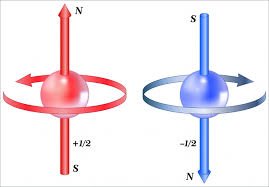
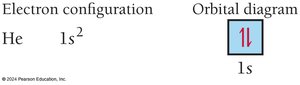
Electron Configurations and Principles
Electron configurations describe the arrangement of electrons in an atom's orbitals. Electrons fill orbitals in order of increasing energy, following specific rules:
Aufbau Principle: Electrons occupy the lowest energy orbitals first.
Hund’s Rule: Electrons fill degenerate orbitals singly before pairing up, maximizing spin.
Ground State: The lowest energy configuration for an atom.
Condensed Configurations: Use noble gas notation to represent core electrons; valence electrons are those available for bonding.
Periodic Table Blocks and Electron Configuration
The periodic table is divided into blocks based on the type of orbitals being filled: s, p, d, and f. The position of an element in the table helps determine its electron configuration.
s-block: Groups 1A and 2A
p-block: Groups 3A to 8A
d-block: Transition metals
f-block: Lanthanides and actinides
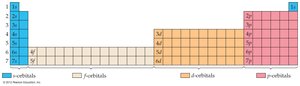
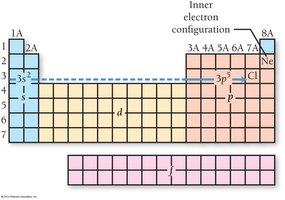
Writing Electron Configurations Based on Periodic Table Position
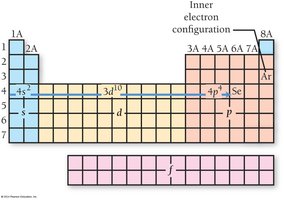
Electron configurations can be written by following the order of filling orbitals as indicated by the periodic table. For elements with higher atomic numbers, d and f electrons are considered core electrons.
Example: Chlorine: Start at 1s and proceed left to right, top to bottom.
Example: Selenium: After filling 4s, fill 3d, then 4p.
Effective Nuclear Charge (Zeff)
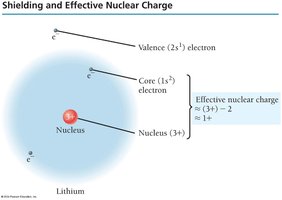
Effective nuclear charge is the net positive charge experienced by an electron in a multi-electron atom. It is less than the actual nuclear charge due to shielding by core electrons.
Formula: (where Z is atomic number, S is shielding constant)
Shielding: Core electrons reduce the pull felt by valence electrons.
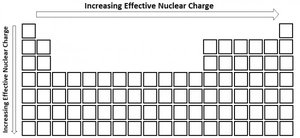
Trend: Zeff increases across a period, remains relatively constant down a group.
Atomic Radii Trends
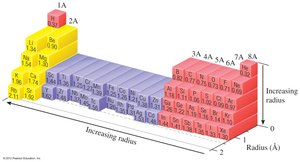
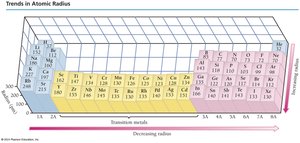
Atomic radius is the distance from the nucleus to the outermost electron shell. It varies predictably across the periodic table.
Across a Period: Atomic radius decreases due to increasing Zeff.
Down a Group: Atomic radius increases as n increases.
Ionic Radii and Formation of Ions
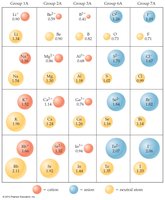
Ionic radius depends on nuclear charge, number of electrons, and the orbitals involved. Cations are smaller than their parent atoms, while anions are larger.
Cations: Electrons removed from outermost orbital; radius decreases.
Anions: Electrons added to outermost orbital; radius increases.
Ionization Energy (IE)
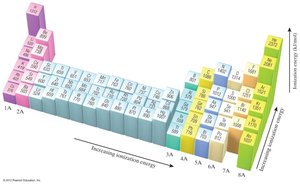
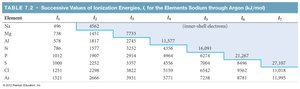
Ionization energy is the minimum energy required to remove an electron from a gaseous atom or ion. Successive ionization energies increase as electrons are removed from increasingly positive ions.
First Ionization Energy:
Second Ionization Energy:
Trend: IE increases across a period, decreases down a group.
Large jumps: When removing core electrons or from filled shells.
Electron Configurations for Ions
When forming cations, electrons are removed from the highest n orbital first. For anions, electrons are added to the lowest available n orbital.
Cations: Remove from largest n, then largest l if needed.
Anions: Add to lowest n, then lowest l if needed.
Example: Mn: [Ar]3d54s2 → Mn2+: [Ar]3d5
Example: Cl: [Ne]3s23p5 → Cl-: [Ne]3s23p6
Electron Affinity (EA)
Electron affinity is the energy change when an electron is added to a gaseous atom. Most electron affinities are negative, indicating energy is released.
Formula:
Trend: EA becomes more negative across a period; noble gases have positive EA.
Example: Cl(g) + e- → Cl-(g), ΔE = -349 kJ/mol
Properties of Metals, Nonmetals, and Metalloids
Elements are classified as metals, nonmetals, or metalloids based on their physical and chemical properties.
Metals | Nonmetals |
|---|---|
Shiny, lustrous surface colors | No luster, various colors |
Good conductors of heat/electricity | Poor conductors |
Form basic oxides | Form acidic oxides |
Form cations in aqueous solution | Form anions in aqueous solution |
Trends in Metallic Character
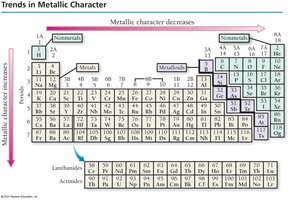
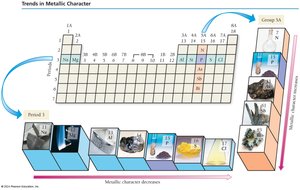
Metallic character increases down a group and decreases across a period. Metals tend to lose electrons, while nonmetals tend to gain electrons.
Historical Development of the Periodic Table
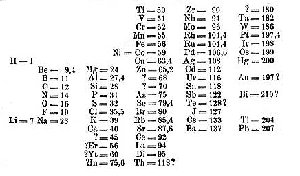
The periodic table was developed by Mendeleev and Meyer, who organized elements by atomic mass and chemical properties, leaving blanks for undiscovered elements.
Penetration and Energy Differences in Orbitals
Penetration refers to how close an electron in a given orbital can get to the nucleus. Orbitals with the same principal quantum number (n) have different energies due to penetration.
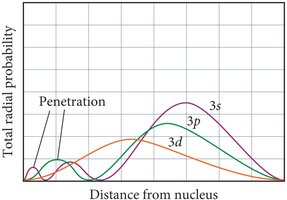
Calculating Effective Nuclear Charge (Slater's Rules)
Slater's rules provide a method to estimate the shielding constant (S) and thus the effective nuclear charge (Zeff).
For electrons with same n: add 0.35/electron
For electrons with n-1: add 0.85/electron
For all smaller n: add 1.00/electron
Example: Na:
Isoelectronic Series
An isoelectronic series consists of ions with the same number of electrons but different nuclear charges. As atomic number increases, ionic radius decreases.
Example: O2-, F-, Na+, Mg2+, Al3+ all have 10 electrons.
Discontinuities in Ionization Energy Trends
There are notable decreases in ionization energy when moving from Group IIA to IIIA and from Group VA to VIA, due to differences in orbital energy and electron pairing.
Group IIA to IIIA: Removing from p orbital, which is higher in energy.
Group VA to VIA: Removing from doubly occupied p orbital, reducing electron-electron repulsion.
Summary Table: Successive Ionization Energies
Successive ionization energies for elements show large jumps when core electrons are removed.
Element | IE1 | IE2 | IE3 | IE4 | IE5 | IE6 | IE7 |
|---|---|---|---|---|---|---|---|
Na | 496 | 4562 | 6913 | 9544 | 13352 | 16613 | 21267 |
Mg | 738 | 1451 | 7733 | 10542 | 13630 | 18020 | 21710 |
Al | 578 | 1817 | 2745 | 11577 | 14842 | 18378 | 23326 |
P | 1012 | 1907 | 2914 | 4952 | 6274 | 8134 | 10443 |
S | 1000 | 2252 | 3357 | 4556 | 7004 | 8495 | 11049 |
Cl | 1251 | 2298 | 3822 | 5158 | 6549 | 9362 | 11018 |
Ar | 1521 | 2665 | 3931 | 5771 | 7238 | 10229 | 12440 |
Additional info: This table is inferred from the context and typical values for successive ionization energies.
