 뒤로
Chapter 4: From Elements to Compounds – Ionic and Covalent Bonding, Periodic Properties, and Compound Formation
스터디 가이드 - 스마트 노트
 자료에 맞춘 맞춤형 노트, 핵심 정의, 예시, 맥락을 확장해 제공합니다.
From Elements to Compounds
How Atoms Combine to Form Compounds
Atoms combine to form compounds by gaining, losing, or sharing valence electrons. The resulting compounds can be classified as ionic or covalent, depending on the nature of the electron transfer or sharing.
Ionic compounds: Formed when atoms gain or lose electrons to become ions. Oppositely charged ions attract each other and form ionic bonds.
Covalent compounds: Formed when atoms share electrons, creating connections known as covalent bonds.
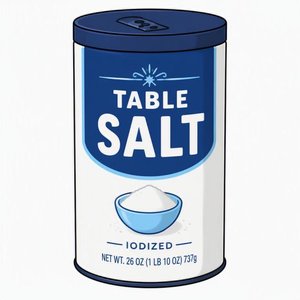
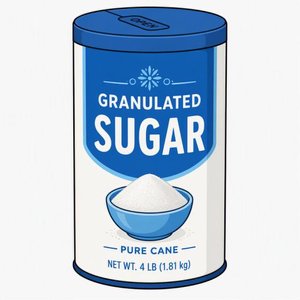
Example: Sodium chloride (NaCl) is an ionic compound, while sucrose (C12H22O11) is a covalent compound.
Periodic Properties of the Elements
Electron Shielding and Effective Nuclear Charge (Zeff)
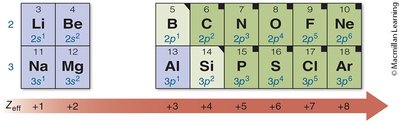
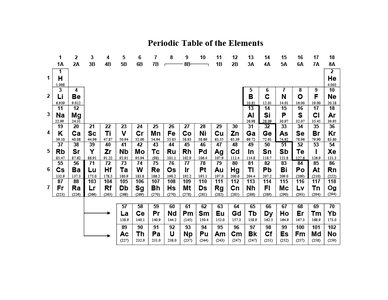
Electron shielding refers to the reduction in attractive force between the nucleus and valence electrons due to the presence of inner (core) electrons. The effective nuclear charge (Zeff) is a measure of how tightly valence electrons are attracted to the nucleus.
Formula: Where Z is the atomic number and S is the number of core electrons.
Trend: Zeff increases across a period (left to right) and remains relatively constant down a group.
Impact: Higher Zeff means valence electrons are more strongly attracted, leading to smaller atomic size.
Trends in Atomic Size
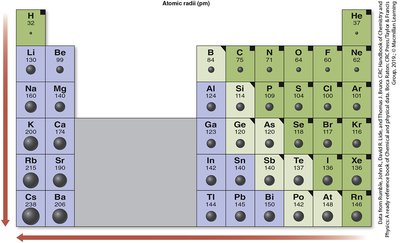
Atomic size decreases across a period due to increasing Zeff, and increases down a group due to additional electron shells.
Across a period: Atoms get smaller as Zeff increases.
Down a group: Atoms get larger due to more electron shells.
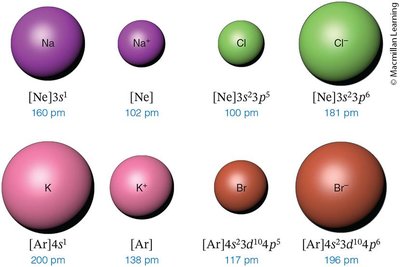
Ion Size Compared to Neutral Atoms
When atoms form ions, their size changes relative to the neutral atom.
Cations: Positive ions formed by losing electrons; always smaller than their neutral parent atom.
Anions: Negative ions formed by gaining electrons; always larger than their neutral parent atom.
Ranking Isoelectronic Ions and Atoms
Isoelectronic species have the same electron configuration but different nuclear charges. Their size depends on Zeff.
Higher Zeff: Smaller size.
Lower Zeff: Larger size.
Example: K+ < Ar < Cl- < S2- (smallest to largest).
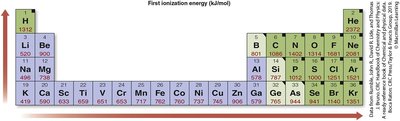
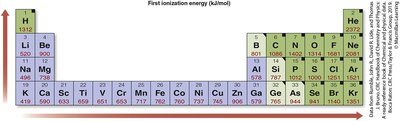
Ionization Energy
Ionization energy is the energy required to remove an electron from an atom to form a cation.
Trend: Increases across a period (left to right) and decreases down a group (top to bottom).
Successive ionizations: Each successive removal of an electron requires more energy.
Equation:
Electron Affinity
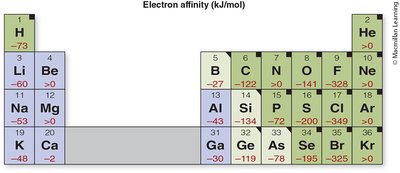
Electron affinity is the energy change when an atom gains an electron to form an anion. Negative values indicate energy is released and the process is favorable.
Trend: Nonmetals generally have higher (more negative) electron affinity, favoring anion formation.
Equation:
Ions and Their Formation
Lewis Dot Symbols and Valence Electrons
Lewis dot symbols visually represent the number of valence electrons in an atom, helping predict whether an atom will form a cation or an anion.
Valence electrons: Electrons in the outermost shell, responsible for chemical bonding.
Octet rule: Atoms tend to gain, lose, or share electrons to achieve a stable octet (eight valence electrons).
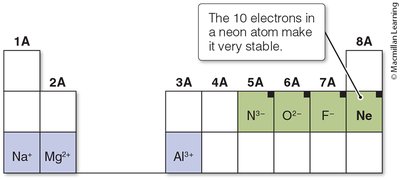
Periodic Table Placement and Ion Formation
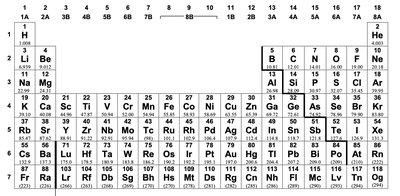
The position of an element on the periodic table indicates its tendency to form cations or anions.
Metals: Tend to lose electrons and form cations.
Nonmetals: Tend to gain electrons and form anions.
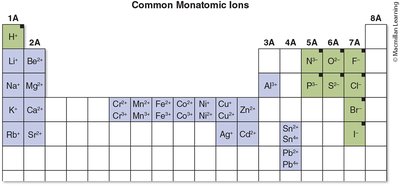
Naming Metal Cations
Metal cations are named based on whether they are main group or transition metals.
Main group cations: Named as "element cation" (e.g., sodium cation).
Transition metal cations: Named using the Stock system, indicating the charge with Roman numerals (e.g., iron(II) cation, iron(III) cation).
Naming Nonmetal Anions
Nonmetal anions are named by changing the ending of the element name to "-ide." Polyatomic ions are groups of atoms with an overall charge.
Examples: Fluoride (F-), oxide (O2-), nitride (N3-).
Polyatomic ions: Groups of atoms bonded together carrying a charge, often following the octet rule.
Common Polyatomic Ions
Polyatomic ions are essential in chemistry and must be memorized. They include both cations and anions.
Formula | Name |
|---|---|
NH4+ | ammonium |
SO42- | sulfate |
NO3- | nitrate |
CO32- | carbonate |
PO43- | phosphate |
OH- | hydroxide |
CN- | cyanide |
ClO4- | perchlorate |
MnO4- | permanganate |
Ionic Bonds and Compounds
Formation and Properties of Ionic Bonds
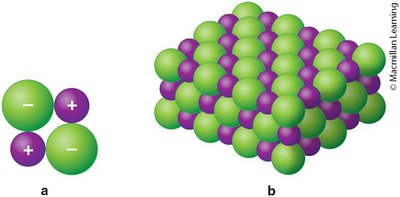
Ionic bonds form when metal cations and nonmetal anions are attracted by electrostatic forces. The strength of the bond is described by Coulomb's law:
Equation:
Impact: Larger charges and smaller distances increase the force of attraction.
Ranking Ionic Compounds by Force of Attraction
The force of attraction between ions in salts depends on the product of their charges and the distance between them.
Salt | |q1q2| | Relative Force |
|---|---|---|
NaCl | 1 | Weakest |
LiCl | 1 (Li smaller than Na) | Stronger than NaCl |
MgCl2 | 2 | Stronger |
MgO | 4 | Strongest |
Predicting Formulas and Naming Salts
Ionic compounds are neutral, so the positive and negative charges must balance. The empirical formula reflects this balance.
Cation | Anion | Empirical Formula | Name |
|---|---|---|---|
Ca2+ | Br- | CaBr2 | calcium bromide |
Mg2+ | NO3- | Mg(NO3)2 | magnesium nitrate |
NH4+ | S2- | (NH4)2S | ammonium sulfide |
Fe3+ | O2- | Fe2O3 | iron(III) oxide |
Fe2+ | Cl- | FeCl2 | iron(II) chloride |
Writing Formulas from Compound Names
To write the formula, identify the cation and anion and balance their charges.
Name | Cation | Anion | Formula |
|---|---|---|---|
sodium phosphide | Na+ | P3- | Na3P |
chromium(III) chloride | Cr3+ | Cl- | CrCl3 |
ammonium phosphate | NH4+ | PO43- | (NH4)3PO4 |
Hydrates: Ionic Compounds with Water
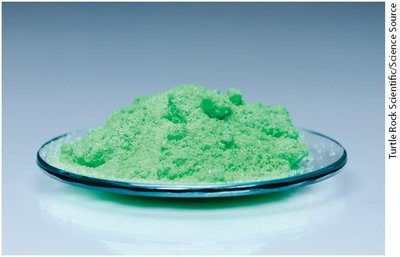
Many ionic compounds trap water molecules within their crystal lattice, forming hydrates. The number of water molecules is indicated by prefixes.
Formula | Name |
|---|---|
NiCl2·6H2O | nickel(II) chloride hexahydrate |
CuSO4·5H2O | copper(II) sulfate pentahydrate |
MgSO4·7H2O | magnesium sulfate heptahydrate |
Prefixes: mono-, di-, tri-, tetra-, penta-, hexa-, hepta-, octa-, nona-, deca-
Covalent Bonding
Formation of Covalent Bonds
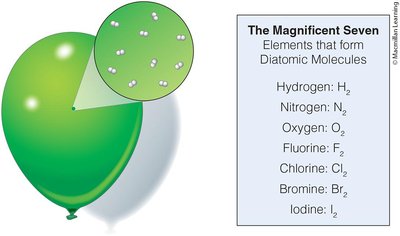
Covalent compounds form when two or more nonmetal atoms share valence electrons, creating stable molecules.
Covalent bond: A shared pair of electrons between atoms.
Lewis Structures for Covalent Compounds
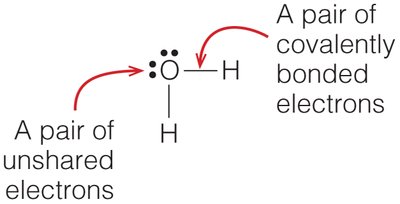
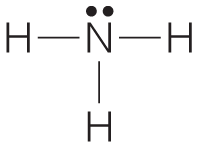
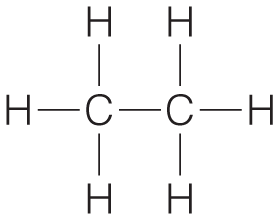
Lewis structures show the arrangement of valence electrons in molecules, including bonding pairs and lone pairs.
Single bond: 2 shared electrons
Double bond: 4 shared electrons
Triple bond: 6 shared electrons
Octet Rule in Covalent Compounds
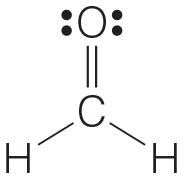
Most covalent compounds obey the octet rule, with atoms bonded to achieve eight valence electrons. Hydrogen is an exception, preferring two electrons.
Examples: Formaldehyde (CH2O), ammonia (NH3), ethane (C2H6).
Naming Covalent Compounds
Covalent compounds use numerical prefixes to indicate the number of atoms present. The prefix "mono-" is only used for the second element if it appears once.
Prefixes: mono-, di-, tri-, tetra-, penta-, hexa-, hepta-, octa-, nona-, deca-
Example: CO is carbon monoxide; CO2 is carbon dioxide.
Order of Naming Elements in Covalent Compounds
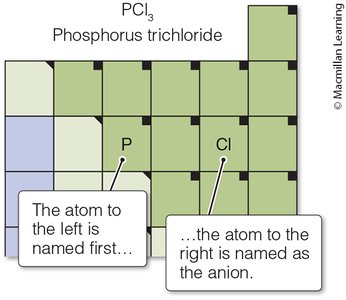
The first element is usually the one furthest to the left on the periodic table. The second element is named as the anion.
Example: PCl3 is phosphorus trichloride, not chlorine triphosphide.
How Ionic and Covalent Compounds Differ
Comparison of Ionic and Covalent Compounds
Ionic compounds are formed by electron transfer, resulting in ions held together by electrostatic forces. Covalent compounds are formed by electron sharing, resulting in molecules held together by shared electrons.
Ionic compounds: Usually solids, high melting points, conduct electricity when dissolved.
Covalent compounds: Can be solids, liquids, or gases; lower melting points; do not conduct electricity in solution.
Compounds in Aqueous Solution
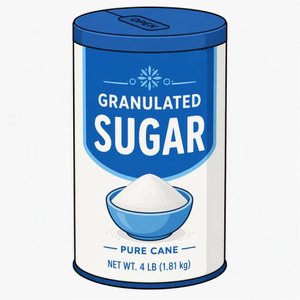
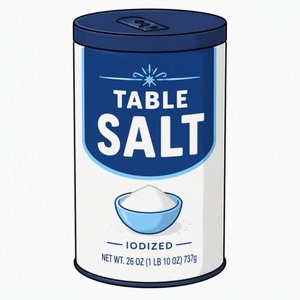
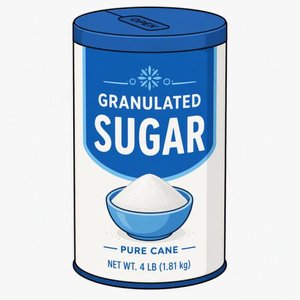
When ionic compounds (like table salt) dissolve in water, they dissociate into ions. Covalent compounds (like sugar) dissolve but do not break into ions.
Ionic compound: NaCl(s) → Na+(aq) + Cl-(aq)
Covalent compound: Sugar dissolves, but the molecule remains intact.
 Additional info: Some explanations and examples were expanded for clarity and completeness, including tables and formula lists for polyatomic ions and compound naming conventions.
