 뒤로
Chapter 6: Ionic Compounds – Electron Configurations, Ionization Energies, and Lattice Energies
스터디 가이드 - 스마트 노트
 자료에 맞춘 맞춤형 노트, 핵심 정의, 예시, 맥락을 확장해 제공합니다.
Electron Configurations of Ions
Formation of Cations and Anions
Atoms can gain or lose electrons to form ions, which are charged particles. The loss of electrons results in cations (positively charged ions), while the gain of electrons results in anions (negatively charged ions). The electron configuration of the resulting ion is closely related to the stability and chemical properties of the element.
Cations: Formed by loss of electrons; typically metals.
Anions: Formed by gain of electrons; typically nonmetals.
Valence Orbitals: The highest energy orbitals (usually s and p) are filled or emptied during ion formation.
Example: Na: Na+:
Example: Cl: Cl-:

Reoccurring Themes for Representative Elements
Noble Gas Configurations and Ion Formation
Noble gases are chemically stable due to filled valence s and p orbitals. Many representative elements (Groups 1A, 2A, 3A, 6A, 7A) form ions that achieve a noble gas-like electron configuration, which is a key factor in their stability.
Group 1A: Lose 1 electron to form 1+ ions (e.g., Na+).
Group 2A: Lose 2 electrons to form 2+ ions (e.g., Mg2+).
Group 6A: Gain 2 electrons to form 2- ions (e.g., S2-).
Group 7A: Gain 1 electron to form 1- ions (e.g., Cl-).
Common Main-Group Ions and Their Noble-Gas Electron Configurations
The table below summarizes the main-group ions and their corresponding noble-gas electron configurations.
Group 1A | Group 2A | Group 3A | Group 6A | Group 7A | Electron Configuration |
|---|---|---|---|---|---|
H+ | Be2+ | Al3+ | O2- | F- | [He] |
Li+ | Mg2+ | Ga3+ | S2- | Cl- | [Ne] |
Na+ | Ca2+ | In3+ | Se2- | Br- | [Ar] |
K+ | Sr2+ | Tl3+ | Te2- | I- | [Kr] |
Rb+ | Ba2+ | [Xe] |
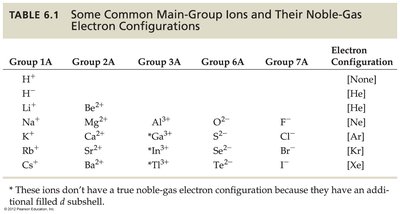
Additional info: Some ions (e.g., Ga3+, In3+, Tl3+) do not have a true noble-gas configuration due to filled d subshells.
Multivalent Elements and Transition Metals
Formation of Transition Metal Ions
Transition metals can form multiple ions by losing valence s electrons first, followed by d electrons. The order of electron removal differs from the order of filling.
Example: Fe: Fe2+:
Example: Fe: Fe3+:
Key Point: s electrons are removed before d electrons during ion formation.
Ionic Radii
Cations
When a cation forms, the removal of valence electrons reduces the ionic radius compared to the neutral atom. The trend down a group remains: ionic radius increases as you move down the group.

Anions
When an anion forms, the addition of valence electrons increases the ionic radius compared to the neutral atom. The trend down the group is similar: ionic radius increases as you move down the group.
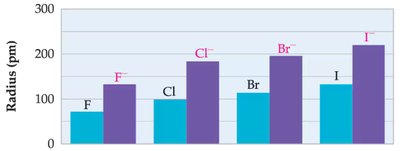
Across a period: Ionic radius contracts for cations, then expands for anions.
Ionization Energy
Definition and Trends
Ionization energy (Ei) is the energy required to remove the highest-energy electron from a neutral atom in the gaseous state. Ionization energy is closely related to atomic radius and periodic trends.
Metallic elements: Lower ionization energies.
Nonmetal elements: Higher ionization energies.
Across a period: Ionization energy increases.
Down a group: Ionization energy decreases.
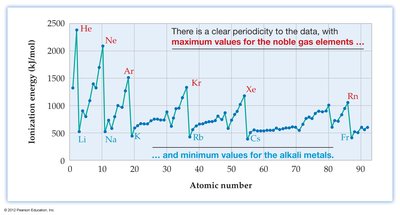
Irregularities in Ionization Energy Trends
Some elements show irregularities in ionization energy due to their electron configurations. For example, Be, Mg, N, and P have higher ionization energies than their neighbors, while O and S have slightly lower values.
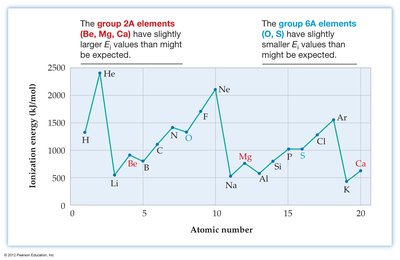
Additional info: These irregularities are explained by the stability of filled and half-filled subshells.
Higher Ionization Energies
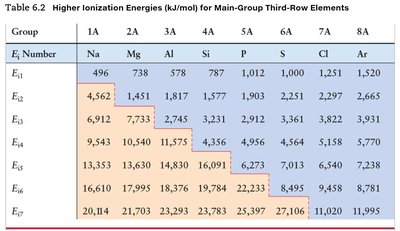
Atoms can have multiple ionization energies, corresponding to the removal of successive electrons. The values increase dramatically after removing all valence electrons.
Ei Number | Na | Mg | Al | Si | P | S | Cl | Ar |
|---|---|---|---|---|---|---|---|---|
Ei1 | 496 | 738 | 578 | 787 | 1,012 | 1,000 | 1,251 | 1,520 |
Ei2 | 4,562 | 1,451 | 1,817 | 1,577 | 1,903 | 2,251 | 2,296 | 2,669 |
Ei3 | 6,912 | 7,733 | 2,745 | 3,231 | 2,900 | 3,366 | 3,815 | 3,937 |
Ei4 | 9,454 | 10,540 | 11,575 | 4,356 | 4,564 | 4,585 | 5,158 | 5,770 |
Ei5 | 13,363 | 10,830 | 16,091 | 6,273 | 6,703 | 6,540 | 7,238 | 7,938 |
Ei6 | 16,101 | 12,713 | 18,782 | 22,833 | 8,495 | 7,378 | 8,499 | 9,730 |
Ei7 | 20,114 | 21,703 | 23,293 | 23,788 | 27,106 | 11,020 | 11,915 | 11,020 |
Electron Affinity
Definition and Trends
Electron affinity (Eea) is the energy change when an electron is added to a neutral atom in the gaseous state. Most electron affinities are negative, indicating energy is released when an atom gains an electron. The greater the negative value, the more stable the resulting anion.
Halogens: Have large negative electron affinities.
Noble gases: Have positive or zero electron affinities (do not readily accept electrons).
Group 2A: Also have near-zero electron affinities.
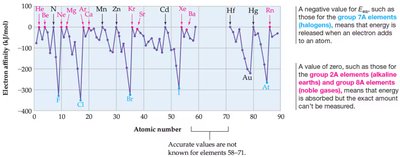
Additional info: Electron affinity values are influenced by nuclear attraction and electron-electron repulsion.
The Octet Rule
Valence Electrons and Covalent Bond Formation
The octet rule states that main group elements tend to gain, lose, or share electrons to fill their valence s and p orbitals, achieving eight electrons in their outer shell. This rule predicts the number of covalent bonds formed by elements, especially period 2 nonmetals (C, N, O, F).
Carbon: 4 valence electrons; forms 4 covalent bonds.
Hydrogen: Exception; forms 1 bond to fill its n=1 shell.
Transition metals, lanthanides, actinides: Often do not follow the octet rule.
Examples : Using group numbers (valence e⁻): F and Br are group 17 (7 valence e⁻) → typically 1 bond. N is group 15 (5 valence e⁻) → typically 3 bonds. S is group 16 (6 valence e⁻) → typically 2 bonds (but S can also form expanded-octet structures like 4 or 6 bonds in some compounds). Ar is a noble gas (8 valence e⁻) → 0 bonds in typical gen-chem contexts (it’s very unreactive).
Ionic Bonds and Formation of Ionic Solids
Electrostatic Attraction and Ionic Compounds
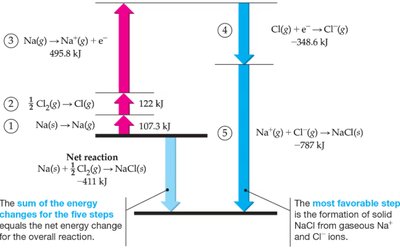
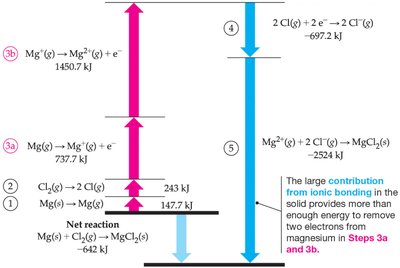
Ionic bonding occurs when electrons are transferred from one atom to another, resulting in electrostatic attraction between cations and anions. This is the basis for the formation of ionic solids.

Energy Changes in Ionic Compound Formation
The formation of ionic compounds like NaCl involves both ionization energy and electron affinity. However, the overall stability is achieved through the electrostatic attraction in the solid, which releases additional energy.
Lattice Energy
Definition and Factors Affecting Lattice Energy
Lattice energy (ΔUlattice) is the energy released when ions in the gas phase form an ionic solid. It is given by:
C: Constant depending on crystal structure.
Z+, Z-: Charges on the ions.
Ro: Interionic distance.
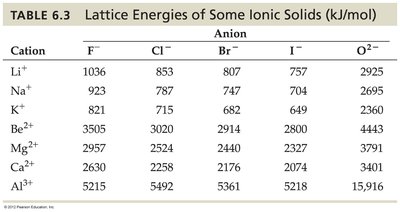
Key Point: Lattice energy increases with higher ion charges and smaller ion sizes.
Lattice Energy Reference Table
The table below shows lattice energies for various ionic solids.
Cation | F- | Cl- | Br- | I- | O2- |
|---|---|---|---|---|---|
Li+ | 1036 | 853 | 807 | 757 | 2925 |
Na+ | 923 | 787 | 747 | 704 | 2695 |
K+ | 821 | 715 | 682 | 649 | 2360 |
Be2+ | 3505 | 3020 | 2914 | 2800 | 4443 |
Mg2+ | 2957 | 2524 | 2440 | 2327 | 3791 |
Ca2+ | 2630 | 2258 | 2176 | 2074 | 3401 |
Al3+ | 5215 | 5492 | 5361 | 5218 | 15,916 |
Comparing Ionic Solids
Visual representations of ionic solids help distinguish between compounds like NaCl and MgO, which differ in lattice energy due to ion charges and sizes.
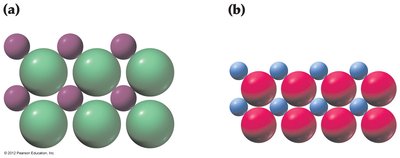
Additional info: MgO has a larger lattice energy than NaCl due to higher ion charges.
