 뒤로
Chapter 7: Thermochemistry – Energy and Chemical Reactions
스터디 가이드 - 스마트 노트
 자료에 맞춘 맞춤형 노트, 핵심 정의, 예시, 맥락을 확장해 제공합니다.
Thermochemistry
Introduction to Thermochemistry
Thermochemistry is the branch of chemistry that studies the energy and heat associated with chemical reactions and physical transformations. It is essential for understanding how energy is transferred and conserved in chemical processes.
Energy is the capacity to do work or produce heat.
Work is a force acting over a distance.
Heat is the flow of energy caused by a difference in temperature.
Energy can be exchanged between objects through contact, such as collisions.
Classification and Manifestations of Energy
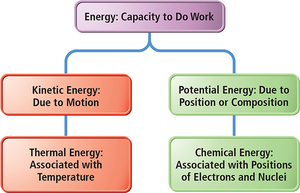
Energy exists in various forms and can be classified as kinetic or potential energy. Understanding these forms is crucial for analyzing chemical reactions.
Kinetic Energy: Energy of motion; includes thermal energy associated with temperature.
Potential Energy: Energy stored due to position or composition; includes chemical energy stored in molecular structures.
Other forms: Electrical (flow of charge), Light/Radiant (energy transitions in atoms), Nuclear (energy in atomic nuclei).
Energy Transformation Examples
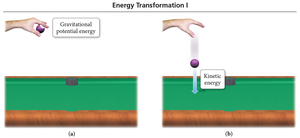
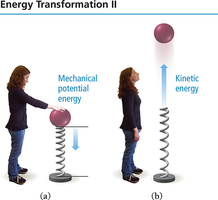
Energy can be transformed from one form to another, such as potential energy converting to kinetic energy.
Conservation of Energy
The law of conservation of energy states that energy cannot be created or destroyed, only transferred or converted. The total energy before and after a process remains constant.
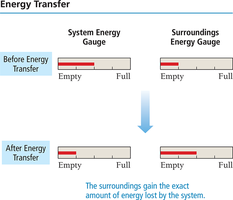
Energy transfer between system and surroundings must be equal and opposite.
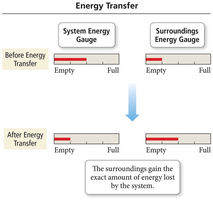
System and Surroundings
In thermochemistry, the system is the part of the universe being studied, while the surroundings are everything else. Energy exchanges occur between these two.
Energy gained by the system is lost by the surroundings, and vice versa.
Units of Energy
Energy is measured in joules (J) and calories (cal).
1 joule (J) = energy needed to move a 1 kg mass by 1 meter.
1 calorie (cal) = energy needed to raise 1 g of water by 1°C.
1 kcal = 1000 cal; food Calories are kcals.
The First Law of Thermodynamics
Law of Conservation of Energy
The first law of thermodynamics states that the total energy of the universe is constant. Energy can be transferred or converted, but not created or destroyed.
Δ (delta) denotes change: ΔE = Efinal - Einitial
Internal Energy and State Functions
Internal energy (E) is the sum of all kinetic and potential energies of the particles in a system. It is a state function, meaning it depends only on the initial and final states, not the path taken.
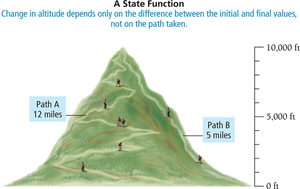
Energy Flow in Chemical Reactions
Energy changes in chemical reactions can be visualized using energy diagrams. The direction of energy flow determines whether energy is released or absorbed.
If reactants have higher internal energy than products, energy is released (exothermic).
If reactants have lower internal energy than products, energy is absorbed (endothermic).
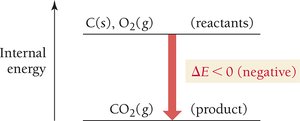
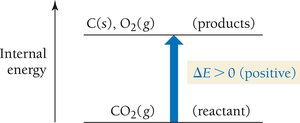
Energy Flow: System and Surroundings
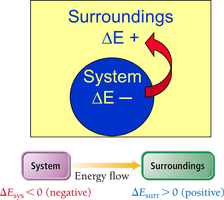
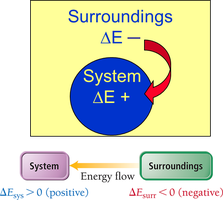
Energy flow is tracked by changes in internal energy (ΔE) for both system and surroundings.
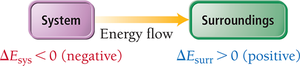
When energy flows out of the system: ΔEsystem is negative, ΔEsurroundings is positive.
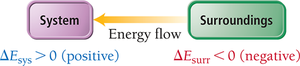
When energy flows into the system: ΔEsystem is positive, ΔEsurroundings is negative.
Energy Diagrams
Energy diagrams graphically show the direction and magnitude of energy flow during a process.
ΔEsys < 0: Energy flows out of the system.
ΔEsys > 0: Energy flows into the system.
Summary Table: Energy Flow in Chemical Reactions
Condition | ΔEsys | Energy Flow |
|---|---|---|
Reactants higher energy than products | Negative | Out of system |
Reactants lower energy than products | Positive | Into system |
Key Equations
Energy, Work, and Heat:
Additional info:
These notes cover the fundamental concepts of thermochemistry, including energy classification, conservation, system-surroundings interactions, and energy flow in chemical reactions. The included images reinforce the understanding of energy transformations, state functions, and energy exchange between system and surroundings.
