 뒤로
CHEM 118 Exam 1A Study Guidance – General Chemistry Concepts
스터디 가이드 - 스마트 노트
 자료에 맞춘 맞춤형 노트, 핵심 정의, 예시, 맥락을 확장해 제공합니다.
Q1. The observation that hydrogen and oxygen can react to form two compounds with different chemical and physical properties, one having an O:H mass ratio = 8:1 and the other having an O:H mass ratio = 16:1 is consistent with the law of:
Background
Topic: Laws of Chemical Combination
This question tests your understanding of the fundamental laws that govern how elements combine to form compounds, specifically the law of multiple proportions.
Key Terms:
Law of Multiple Proportions: When two elements form more than one compound, the ratios of the masses of the second element that combine with a fixed mass of the first element are simple whole numbers.
Law of Definite Proportions: A chemical compound always contains the same elements in the same proportion by mass.
Step-by-Step Guidance
Identify the two compounds formed by hydrogen and oxygen (likely water and hydrogen peroxide).
Compare the O:H mass ratios given (8:1 and 16:1) and note that they are simple multiples.
Recall which law explains the formation of compounds with simple whole-number ratios of elements.
Try solving on your own before revealing the answer!
Final Answer: Law of Multiple Proportions
The law of multiple proportions explains how two elements can form more than one compound with mass ratios that are simple multiples of each other.
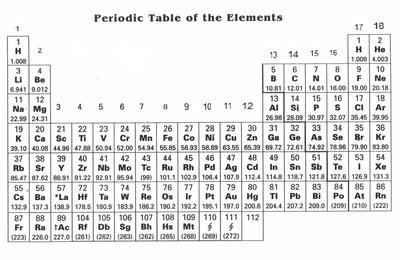
Q2. Place the following in order of increasing metallic character: Rb, Cs, K, Na
Background
Topic: Periodic Trends
This question tests your understanding of how metallic character changes across and down the periodic table.
Key Terms:
Metallic Character: The tendency of an element to lose electrons and form positive ions (cations).
Periodic Table: Metallic character increases down a group and decreases across a period.
Step-by-Step Guidance
Locate Rb, Cs, K, and Na on the periodic table (all are alkali metals in Group 1).
Recall that metallic character increases as you move down the group.
Arrange the elements from least to most metallic based on their position in the group.
Try solving on your own before revealing the answer!
Final Answer: Na < K < Rb < Cs
Metallic character increases as you move down Group 1: Na, K, Rb, Cs.
Q3. The Bohr model of the atom is an example of a(n):
Background
Topic: Scientific Method and Models
This question tests your understanding of scientific terminology: hypothesis, law, theory, and experiment.
Key Terms:
Hypothesis: A tentative explanation or prediction.
Theory: A well-substantiated explanation of some aspect of the natural world.
Law: A statement based on repeated experimental observations.
Experiment: A procedure to test a hypothesis.
Step-by-Step Guidance
Recall what the Bohr model represents (a conceptual explanation of atomic structure).
Determine whether it is a hypothesis, law, theory, or experiment based on its scientific role.
Try solving on your own before revealing the answer!
Final Answer: Theory
The Bohr model is considered a scientific theory because it explains atomic structure and behavior.
Q4. Which of the following quantum numbers describes the shape of an orbital?
Background
Topic: Quantum Numbers and Atomic Structure
This question tests your knowledge of the four quantum numbers and their physical meaning.
Key Terms:
Principal Quantum Number ($n$): Energy level.
Angular Momentum Quantum Number ($l$): Shape of the orbital.
Magnetic Quantum Number ($m_l$): Orientation of the orbital.
Spin Quantum Number ($m_s$): Spin direction of the electron.
Step-by-Step Guidance
Recall the four quantum numbers and their meanings.
Identify which quantum number is associated with the shape of the orbital.
Try solving on your own before revealing the answer!
Final Answer: Angular Momentum Quantum Number ($l$)
The angular momentum quantum number determines the shape of the orbital (s, p, d, f).
Q5. When waves of equal amplitude from two sources are out of phase and interact, it is called:
Background
Topic: Wave Interference
This question tests your understanding of constructive and destructive interference in wave phenomena.
Key Terms:
Constructive Interference: Waves add together, increasing amplitude.
Destructive Interference: Waves cancel each other, reducing amplitude.
Out of Phase: Peaks and troughs do not align.
Step-by-Step Guidance
Recall what happens when two waves are out of phase.
Determine whether the interaction increases or decreases the amplitude.
Try solving on your own before revealing the answer!
Final Answer: Destructive Interference
Out-of-phase waves of equal amplitude cancel each other, resulting in destructive interference.
Q6. The Pauli Exclusion Principle states that:
Background
Topic: Quantum Mechanics and Electron Configuration
This question tests your understanding of the Pauli Exclusion Principle and its implications for electron arrangement.
Key Terms:
Pauli Exclusion Principle: No two electrons in the same atom can have the same set of four quantum numbers.
Quantum Numbers: $n$, $l$, $m_l$, $m_s$.
Step-by-Step Guidance
Recall the four quantum numbers for electrons.
Understand how the Pauli Exclusion Principle restricts electron configurations.
Try solving on your own before revealing the answer!
Final Answer: No two electrons in the same atom can have the same four quantum numbers.
This principle explains why each orbital can hold only two electrons with opposite spins.
Q7. Which of the following two pairs of atoms are isotopes?
Background
Topic: Isotopes and Atomic Structure
This question tests your ability to identify isotopes based on atomic number and mass number.
Key Terms:
Isotopes: Atoms of the same element (same atomic number) with different mass numbers.
Atomic Number ($Z$): Number of protons.
Mass Number ($A$): Number of protons + neutrons.
Step-by-Step Guidance
Compare the atomic numbers of each pair to see if they are the same element.
Check if the mass numbers are different for the same element.
Try solving on your own before revealing the answer!
Final Answer: $^{12}_{6}C$ and $^{13}_{6}C$
These are isotopes of carbon, differing only in their mass number.
Q8. In which of the following sets do all the species have the same number of electrons?
Background
Topic: Ions and Electron Counting
This question tests your ability to count electrons in neutral atoms and ions.
Key Terms:
Isoelectronic: Species with the same number of electrons.
Electron Counting: Consider atomic number and charge.
Step-by-Step Guidance
Calculate the number of electrons for each species in the sets.
Identify which set has all species with the same electron count.
Try solving on your own before revealing the answer!
Final Answer: Cl-, Ar, Ca2+
All three have 18 electrons, making them isoelectronic.
Q9. Place the following elements in order of increasing atomic radius: O, Si, Al
Background
Topic: Periodic Trends – Atomic Radius
This question tests your understanding of how atomic radius changes across periods and down groups.
Key Terms:
Atomic Radius: The size of an atom, typically measured from the nucleus to the outermost electron shell.
Periodic Trend: Atomic radius increases down a group and decreases across a period.
Step-by-Step Guidance
Locate O, Si, and Al on the periodic table.
Recall the trend: atomic radius increases down a group and decreases across a period.
Arrange the elements based on their positions and the trend.
Try solving on your own before revealing the answer!
Final Answer: O < Si < Al
Atomic radius increases from oxygen to silicon to aluminum.
Q10. Which of the following occurs as the energy of a photon increases?
Background
Topic: Electromagnetic Radiation
This question tests your understanding of the relationship between energy, frequency, and wavelength of photons.
Key Terms and Formulas:
Photon Energy: $E = h\nu$
Speed of Light: $c = \lambda \nu$
As energy increases, frequency increases and wavelength decreases.
Step-by-Step Guidance
Recall the formulas relating energy, frequency, and wavelength.
Determine how increasing energy affects frequency and wavelength.
Try solving on your own before revealing the answer!
Final Answer: The wavelength gets shorter
As photon energy increases, wavelength decreases (gets shorter).
Q11. In which orbital would an electron (on average) be closest to the nucleus?
Background
Topic: Atomic Orbitals and Electron Distribution
This question tests your understanding of orbital types and their proximity to the nucleus.
Key Terms:
s, p, d, f Orbitals: s orbitals are spherical and closest to the nucleus.
Principal Quantum Number ($n$): Lower $n$ means closer to the nucleus.
Step-by-Step Guidance
Compare the types of orbitals (s, p, d, f) and their average distance from the nucleus.
Recall that s orbitals are closest, and lower $n$ means closer.
Try solving on your own before revealing the answer!
Final Answer: 3s
The 3s orbital is closest to the nucleus compared to 3p, 3d, 6d, and 6f.
Q12. Which of the following contains an ionic bond?
Background
Topic: Chemical Bonding
This question tests your ability to identify ionic versus covalent bonds.
Key Terms:
Ionic Bond: Formed between a metal and a nonmetal, involving electron transfer.
Covalent Bond: Formed between nonmetals, involving electron sharing.
Step-by-Step Guidance
Identify which compounds are formed from a metal and a nonmetal.
Recall that ionic bonds are typically found in compounds like NaCl.
Try solving on your own before revealing the answer!
Final Answer: NaCl
NaCl is an ionic compound formed from sodium (metal) and chlorine (nonmetal).
Q13. A 24.0 g amount of which of the following contains the greatest number of atoms? N, B, C, O
Background
Topic: Moles and Avogadro's Number
This question tests your ability to use molar mass to determine the number of atoms in a given mass.
Key Terms and Formulas:
Molar Mass: Mass of one mole of an element.
Avogadro's Number: $6.02 \times 10^{23}$ atoms/mol.
Number of atoms: $\text{Number of atoms} = \frac{\text{mass}}{\text{molar mass}} \times \text{Avogadro's number}$
Step-by-Step Guidance
Find the molar mass of each element (N, B, C, O) using the periodic table.
Calculate the number of moles in 24.0 g for each element.
Multiply the number of moles by Avogadro's number to find the number of atoms.
Try solving on your own before revealing the answer!
Final Answer: Boron (B)
Boron has the lowest molar mass, so 24.0 g contains the greatest number of atoms.
Q14. Which statement about electromagnetic radiation is correct?
Background
Topic: Electromagnetic Radiation Properties
This question tests your understanding of the relationships between energy, frequency, and wavelength.
Key Terms and Formulas:
Energy and Frequency: $E = h\nu$
Wavelength and Frequency: $c = \lambda \nu$
Step-by-Step Guidance
Recall the relationships between energy, frequency, and wavelength.
Evaluate each statement for correctness based on these relationships.
Try solving on your own before revealing the answer!
Final Answer: As the energy decreases the frequency decreases.
Energy and frequency are directly proportional.
Q15. Calculate the frequency of the light emitted for a photon with a wavelength of 120 nm.
Background
Topic: Electromagnetic Radiation Calculations
This question tests your ability to use the speed of light equation to calculate frequency from wavelength.
Key Formula:
$c = \lambda \nu$
Where $c$ is the speed of light ($3.00 \times 10^8$ m/s), $\lambda$ is wavelength (in meters), and $\nu$ is frequency (in s-1).
Step-by-Step Guidance
Convert the wavelength from nm to meters: $120 \text{ nm} = 1.20 \times 10^{-7}$ m.
Use the formula $\nu = \frac{c}{\lambda}$ to set up the calculation.
Plug in the values for $c$ and $\lambda$ to solve for $\nu$.
Try solving on your own before revealing the answer!
Final Answer: $2.50 \times 10^{15}$ s-1
Using $\nu = \frac{3.00 \times 10^8}{1.20 \times 10^{-7}}$, the frequency is $2.50 \times 10^{15}$ s-1.
Q16. Which atom’s valence electrons experience the greatest effective nuclear charge?
Background
Topic: Effective Nuclear Charge (Zeff)
This question tests your understanding of how effective nuclear charge varies across the periodic table.
Key Terms:
Effective Nuclear Charge ($Z_{eff}$): The net positive charge experienced by valence electrons.
Trend: $Z_{eff}$ increases across a period.
Step-by-Step Guidance
Locate Na, Cl, P, and Mg on the periodic table.
Recall that $Z_{eff}$ increases from left to right across a period.
Identify which atom is furthest to the right in the period.
Try solving on your own before revealing the answer!
Final Answer: Cl
Chlorine's valence electrons experience the greatest effective nuclear charge among the options.
Q17. Which of the following elements is a halogen?
Background
Topic: Periodic Table Groups
This question tests your ability to identify halogens based on their group in the periodic table.
Key Terms:
Halogens: Group 17 elements (F, Cl, Br, I, At).
Step-by-Step Guidance
Locate the elements in Group 17 on the periodic table.
Identify which of the given options is a halogen.
Try solving on your own before revealing the answer!
Final Answer: Br
Bromine is a halogen, found in Group 17.
Q18. The charge-to-mass ratio of an electron was established by:
Background
Topic: History of Atomic Structure
This question tests your knowledge of key experiments in atomic physics.
Key Terms:
Thomson's Cathode Ray Tube Experiment: Determined the charge-to-mass ratio of the electron.
Millikan's Oil Drop Experiment: Measured the charge of the electron.
Rutherford's Gold Foil Experiment: Discovered the nucleus.
Step-by-Step Guidance
Recall which experiment measured the charge-to-mass ratio.
Match the experiment to the scientist.
Try solving on your own before revealing the answer!
Final Answer: Thomson's Cathode Ray Tube Experiment
Thomson's experiment established the charge-to-mass ratio of the electron.
Q19. Choose the orbital diagram that represents the ground state of O.
Background
Topic: Electron Configuration and Orbital Diagrams
This question tests your ability to draw and interpret orbital diagrams for elements.
Key Terms:
Ground State: Lowest energy configuration.
Orbital Diagram: Shows electron arrangement in orbitals.
Hund's Rule: Electrons fill degenerate orbitals singly before pairing.
Step-by-Step Guidance
Write the electron configuration for oxygen (O): $1s^2 2s^2 2p^4$.
Draw the orbital diagram, applying Hund's Rule.
Try solving on your own before revealing the answer!
Final Answer: The diagram with two paired electrons in each of 1s and 2s, and four electrons in 2p (two paired, two unpaired).
Oxygen's ground state orbital diagram follows Hund's Rule for the 2p orbitals.
Q20. Which subatomic particle has the smallest mass?
Background
Topic: Subatomic Particles
This question tests your knowledge of the relative masses of electrons, protons, neutrons, and alpha particles.
Key Terms:
Electron: Smallest mass among subatomic particles.
Proton and Neutron: Much larger mass than electron.
Alpha Particle: Composed of two protons and two neutrons.
Step-by-Step Guidance
Recall the relative masses of each subatomic particle.
Identify which has the smallest mass.
Try solving on your own before revealing the answer!
Final Answer: Electron
The electron has the smallest mass among the listed particles.
Q21. An element has two stable isotopes with masses of 62.929601 amu and 64.927794 amu with isotopic abundances of 69.17% and 30.83%, respectively. Calculate the average atomic mass and determine the identity of the element.
Background
Topic: Isotopic Abundance and Average Atomic Mass
This question tests your ability to calculate average atomic mass using isotopic masses and abundances.
Key Formula:
$\text{Average atomic mass} = (\text{mass}_1 \times \text{fraction}_1) + (\text{mass}_2 \times \text{fraction}_2)$
Step-by-Step Guidance
Convert the percent abundances to decimal fractions (e.g., 69.17% = 0.6917).
Multiply each isotope's mass by its fractional abundance.
Add the results to get the average atomic mass.
Compare the calculated average atomic mass to values on the periodic table to identify the element.
Try solving on your own before revealing the answer!
Final Answer: Average Atomic Mass = 63.55 amu; Identity = Copper (Cu)
The calculated average atomic mass matches copper's atomic mass on the periodic table.
Q22. What is the mass (in grams) of 12.0 moles of CaO?
Background
Topic: Moles and Molar Mass
This question tests your ability to use molar mass to convert moles to grams.
Key Formula:
$\text{Mass} = \text{moles} \times \text{molar mass}$
Step-by-Step Guidance
Find the molar mass of CaO (Ca: 40.08 g/mol, O: 16.00 g/mol).
Add the atomic masses to get the molar mass of CaO.
Multiply the number of moles (12.0) by the molar mass to find the mass in grams.
Try solving on your own before revealing the answer!
Final Answer: 672 g
12.0 moles × 56.08 g/mol = 672 g of CaO.
Q23. Calculate the change in energy (J) associated with the transition of an electron from n = 2 to n = 5 in the hydrogen atom. Be sure to include the correct mathematical sign on your answer.
Background
Topic: Atomic Transitions and Energy Calculations
This question tests your ability to use the energy level equation for hydrogen atom transitions.
Key Formula:
$\Delta E = -2.18 \times 10^{-18} \left( \frac{1}{n_f^2} - \frac{1}{n_i^2} \right)$ J
Step-by-Step Guidance
Identify the initial ($n_i = 2$) and final ($n_f = 5$) energy levels.
Plug the values into the formula, being careful with the sign and order.
Calculate the terms $\frac{1}{n_f^2}$ and $\frac{1}{n_i^2}$.
Set up the subtraction and multiplication, but stop before the final calculation.
Try solving on your own before revealing the answer!
Final Answer: $\Delta E = +4.58 \times 10^{-19}$ J
The positive sign indicates absorption of energy as the electron moves to a higher energy level.
Q24. Calculate the change in energy in kJ/mol for the transition in Problem 23.
Background
Topic: Energy Conversion and Moles
This question tests your ability to convert energy per atom to energy per mole.
Key Formula:
$\text{Energy (kJ/mol)} = \Delta E \times \text{Avogadro's number} \div 1000$
Step-by-Step Guidance
Take the energy change from Problem 23 ($\Delta E$ in J).
Multiply by Avogadro's number ($6.02 \times 10^{23}$).
Divide by 1000 to convert J to kJ.
Set up the calculation, but stop before the final multiplication.
Try solving on your own before revealing the answer!
Final Answer: $+275$ kJ/mol
The energy change for the transition is $+275$ kJ/mol, indicating absorption.
Q25. What frequency of light (s-1) corresponds to the transition in Problem 23?
Background
Topic: Energy and Frequency Relationship
This question tests your ability to relate energy change to photon frequency.
Key Formula:
$E = h\nu$
Where $E$ is energy (J), $h$ is Planck's constant ($6.626 \times 10^{-34}$ J·s), and $\nu$ is frequency (s-1).
Step-by-Step Guidance
Take the energy change from Problem 23 ($\Delta E$ in J).
Use the formula $\nu = \frac{E}{h}$ to set up the calculation.
Plug in the values for $E$ and $h$, but stop before the final division.
Try solving on your own before revealing the answer!
Final Answer: $6.91 \times 10^{14}$ s-1
Using $\nu = \frac{4.58 \times 10^{-19}}{6.626 \times 10^{-34}}$, the frequency is $6.91 \times 10^{14}$ s-1.
Q26. Does this transition in Problem 23 represent the absorption or emission of a photon?
Background
Topic: Atomic Transitions
This question tests your understanding of whether energy is absorbed or emitted during electron transitions.
Key Terms:
Absorption: Electron moves to a higher energy level (positive $\Delta E$).
Emission: Electron moves to a lower energy level (negative $\Delta E$).
Step-by-Step Guidance
Recall the direction of the transition (n = 2 to n = 5).
Determine if energy is absorbed or emitted based on the sign of $\Delta E$.
Try solving on your own before revealing the answer!
Final Answer: Absorption
The electron absorbs energy to move from n = 2 to n = 5.
Q27. What is the maximum number of electrons that can fit in a d subshell?
Background
Topic: Electron Configuration
This question tests your knowledge of subshell capacities.
Key Terms:
d Subshell: Contains 5 orbitals, each can hold 2 electrons.
Step-by-Step Guidance
Recall the number of orbitals in a d subshell (5).
Multiply by 2 to find the maximum number of electrons.
Try solving on your own before revealing the answer!
Final Answer: 10
A d subshell can hold a maximum of 10 electrons.
Q28. What element has the electron configuration: 1s22s22p63s23p64s23d104p2?
Background
Topic: Electron Configuration and Periodic Table
This question tests your ability to identify elements based on their electron configuration.
Key Terms:
Electron Configuration: Distribution of electrons among orbitals.
Step-by-Step Guidance
Add up the total number of electrons in the configuration.
Match the total to the atomic number on the periodic table.
Try solving on your own before revealing the answer!
Final Answer: Germanium (Ge)
The configuration corresponds to atomic number 32, which is germanium.
Q29. Draw the noble gas shorthand electron orbital filling diagram for copper.
Background
Topic: Electron Configuration and Orbital Diagrams
This question tests your ability to use noble gas shorthand and draw orbital diagrams for transition metals.
Key Terms:
Noble Gas Shorthand: Use the previous noble gas to simplify electron configuration.
Orbital Filling Diagram: Visual representation of electron arrangement.
Step-by-Step Guidance
Write the noble gas shorthand for copper ([Ar] 4s1 3d10).
Draw the orbital diagram, showing the filling of 4s and 3d orbitals.
Try solving on your own before revealing the answer!
Final Answer: [Ar] 4s1 3d10
Copper's orbital diagram shows one electron in 4s and ten in 3d.
Q30. Based on the diagram you drew in Problem 29, is copper paramagnetic or diamagnetic?
Background
Topic: Magnetism and Electron Configuration
This question tests your understanding of paramagnetism and diamagnetism.
Key Terms:
Paramagnetic: At least one unpaired electron.
Diamagnetic: All electrons are paired.
Step-by-Step Guidance
Examine the orbital diagram for unpaired electrons.
Determine if all electrons are paired or if any are unpaired.
Try solving on your own before revealing the answer!
Final Answer: Diamagnetic
Copper has all electrons paired in its ground state configuration.
Q31. Draw the noble gas shorthand electron orbital filling diagram for the copper (I) ion (Cu+).
Background
Topic: Electron Configuration of Ions
This question tests your ability to adjust electron configurations for ions.
Key Terms:
Cu+: Remove one electron from copper's configuration.
Step-by-Step Guidance
Start with copper's configuration ([Ar] 4s1 3d10).
Remove one electron, typically from the 4s orbital.
Draw the resulting orbital diagram.
Try solving on your own before revealing the answer!
Final Answer: [Ar] 3d10
Cu+ has a filled 3d subshell and no electrons in 4s.
Q32. Based on the diagram you drew in Problem 31, is the copper (I) ion paramagnetic or diamagnetic?
Background
Topic: Magnetism and Electron Configuration
This question tests your understanding of paramagnetism and diamagnetism for ions.
Key Terms:
Diamagnetic: All electrons paired.
Paramagnetic: At least one unpaired electron.
Step-by-Step Guidance
Examine the orbital diagram for unpaired electrons.
Determine if all electrons are paired.
Try solving on your own before revealing the answer!
Final Answer: Diamagnetic
Cu+ has all electrons paired in its configuration.
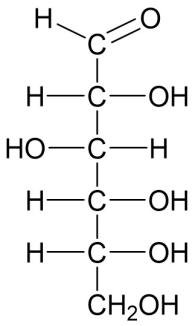
Q33. What are the chemical and empirical formulas of the glucose molecule shown below?
Background
Topic: Chemical and Empirical Formulas
This question tests your ability to interpret structural formulas and determine chemical and empirical formulas.
Key Terms:
Chemical Formula: Shows the exact number of atoms of each element.
Empirical Formula: Shows the simplest whole-number ratio of atoms.
Step-by-Step Guidance
Count the number of C, H, and O atoms in the glucose structure.
Write the chemical formula based on the atom counts.
Determine the simplest ratio for the empirical formula.
Try solving on your own before revealing the answer!
Final Answer: Chemical formula = C6H12O6; Empirical formula = CH2O
Glucose has 6 C, 12 H, and 6 O atoms; the simplest ratio is 1:2:1.
Q34. Complete the missing information in the table below.
Background
Topic: Ionic Compounds and Nomenclature
This question tests your ability to write chemical formulas and names for ionic compounds.
Key Terms:
Cation: Positively charged ion.
Anion: Negatively charged ion.
Chemical Formula: Combination of cation and anion.
Name: Systematic name of the compound.
Step-by-Step Guidance
Identify the cation and anion for each entry.
Write the chemical formula by combining the ions in the correct ratio.
Name the compound using standard nomenclature rules.
Try solving on your own before revealing the answer!
Final Answer:
K+ + F- → KF (Potassium fluoride)
Cu(NO3)2 → Copper(II) nitrate
Sodium acetate → NaC2H3O2
