 뒤로
CHEM135 Exam 1 Study Guidance – Atomic Structure, Quantum Numbers, Solar Cells, and More
스터디 가이드 - 스마트 노트
 자료에 맞춘 맞춤형 노트, 핵심 정의, 예시, 맥락을 확장해 제공합니다.
Q1. Consider the orbital diagram below:
Background
Topic: Atomic Structure and Quantum Numbers
This question tests your understanding of electron configurations, quantum numbers, and electron transitions in atoms.
Key Terms and Formulas:
Electron configuration: The arrangement of electrons in an atom's orbitals.
Quantum numbers: Set of numbers that describe the properties of atomic orbitals and the electrons in them.
Aufbau principle, Pauli exclusion principle, Hund's rule.
Step-by-Step Guidance
Analyze the orbital diagram and count the total number of electrons represented.
Match the electron configuration to a neutral atom on the periodic table.
For the quantum numbers, identify the principal quantum number (), angular momentum quantum number (), magnetic quantum number (), and spin quantum number () for the specified electron.
To add an electron in the ground state, determine the next available orbital following the Aufbau principle.
For excitation, consider which electron would require the lowest energy (longest wavelength/lowest frequency photon) to be promoted to a higher orbital.
Try solving on your own before revealing the answer!
Final Answer:
a. The atom is phosphorus (P).
b. Example quantum numbers: , , , .
c. The next electron would be added to the 3p orbital.
d. The 3s electron would require the lowest frequency photon to be excited to 3p.
Q2. Which of the following sets of quantum numbers does not represent an electron in its ground state?
Background
Topic: Quantum Numbers and Electron Configuration
This question tests your ability to recognize valid quantum number sets for electrons in their ground state.
Key Terms and Formulas:
Quantum numbers: (principal), (angular momentum), (magnetic), (spin)
Allowed values: to , to ,
Step-by-Step Guidance
Check each set for valid combinations of quantum numbers.
Remember that for the ground state, electrons fill the lowest energy orbitals first.
Look for any set where is not less than , or is outside the allowed range for $l$.
Try solving on your own before revealing the answer!
Final Answer:
The set 1,1,-1,+1/2 is not valid because for , must be 0.
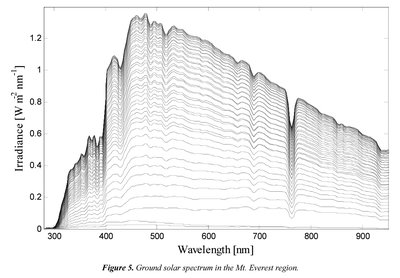
Q3. Solar spectrum and band gap calculation for solar cells
Background
Topic: Photoelectric Effect and Band Gap Energy
This question tests your understanding of the relationship between photon energy, wavelength, and the suitability of materials for solar cells.
Key Terms and Formulas:
Photon energy:
Band gap: Minimum energy required to excite an electron from the valence to the conduction band.
1 eV = J
J·s, m/s
Step-by-Step Guidance
Convert the given wavelength (476.6 nm) to meters.
Plug the values into the photon energy equation to find the energy in joules.
Convert the energy from joules to electron volts (eV).
Compare the calculated band gap to the band gaps of the given materials to determine which can be excited by this wavelength.
Use the solar spectrum to decide which material would capture the most light and which would release electrons with the lowest kinetic energy.
Try solving on your own before revealing the answer!
Final Answer:
a. Maximum band gap: 2.60 eV (to 4 SF)
b. Gallium arsenide (1.42 eV) would capture most of the solar spectrum; Gallium nitride (3.44 eV) would release electrons with the lowest kinetic energy.
c. Choice depends on application, but GaAs is often chosen for broad spectrum capture.
Q4. If you dope tellurium (Te, Z=52) with antimony (Sb, Z=51), what do you make?
Background
Topic: Semiconductors and Doping
This question tests your understanding of n-type and p-type semiconductors and how doping affects conductivity.
Key Terms and Formulas:
Doping: Adding impurities to a semiconductor to change its electrical properties.
n-type: Extra electrons (donor), p-type: Extra holes (acceptor).
Step-by-Step Guidance
Compare the group numbers of Te and Sb to determine if Sb acts as a donor or acceptor in Te.
Decide if the result is n-type or p-type based on the electron count.
Try solving on your own before revealing the answer!
Final Answer:
n-type semiconductor (Sb donates electrons to Te).
Q5. T/F - An electron in conduction band has a higher energy than an electron in the valence band.
Background
Topic: Band Theory of Solids
This question tests your understanding of energy bands in solids.
Key Terms and Formulas:
Conduction band: Higher energy band where electrons are free to move.
Valence band: Lower energy band filled with electrons.
Step-by-Step Guidance
Recall the definitions of conduction and valence bands.
Compare the relative energies of electrons in each band.
Try solving on your own before revealing the answer!
Final Answer:
True. Electrons in the conduction band have higher energy than those in the valence band.
Q6. T/F – In a solar cell with a n type and p type layer, photoelectrons flow toward the p-type layer to generate current.
Background
Topic: Solar Cells and p-n Junctions
This question tests your understanding of charge carrier movement in solar cells.
Key Terms and Formulas:
p-n junction: Interface between p-type and n-type semiconductors.
Photoelectrons: Electrons excited by light.
Step-by-Step Guidance
Recall the direction of electron flow in a p-n junction under illumination.
Determine whether electrons move toward the p-type or n-type layer.
Try solving on your own before revealing the answer!
Final Answer:
True. Photoelectrons flow toward the p-type layer, generating current.
Q7. Which of the following species would have the largest band gap?
Background
Topic: Band Gaps and Periodic Trends
This question tests your understanding of how band gaps change across the periodic table.
Key Terms and Formulas:
Band gap: Energy difference between valence and conduction bands.
Trend: Band gap generally increases across a period (left to right).
Step-by-Step Guidance
Locate Ga, As, and Br on the periodic table.
Recall that nonmetals typically have larger band gaps than metals or metalloids.
Compare their positions to predict which has the largest band gap.
Try solving on your own before revealing the answer!
Final Answer:
Bromine (Br) has the largest band gap among the options.
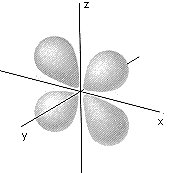
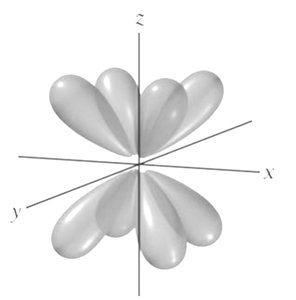
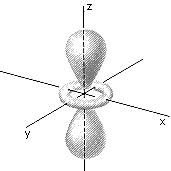
Q8. Which of the following represent a d orbital? Select all that apply.
Background
Topic: Atomic Orbitals
This question tests your ability to recognize the shapes of d orbitals.
Key Terms and Formulas:
d orbitals: Have cloverleaf or donut shapes, .
Step-by-Step Guidance
Recall the typical shapes of d orbitals (four-lobed or donut with two lobes).
Identify which images match these descriptions.
Try solving on your own before revealing the answer!
Final Answer:
The images with four-lobed and donut shapes (images 2, 3, and 4) represent d orbitals.
Q9. How many orientations of d orbital exist?
Background
Topic: Quantum Numbers and Orbital Orientations
This question tests your understanding of the magnetic quantum number and orbital orientations.
Key Terms and Formulas:
For d orbitals, .
Number of orientations:
Step-by-Step Guidance
Plug into the formula to find the number of orientations.
Try solving on your own before revealing the answer!
Final Answer:
There are 5 orientations of d orbitals.
Q10. Provide the condensed electron configuration for Pb (Z=82).
Background
Topic: Electron Configuration
This question tests your ability to write condensed electron configurations for heavy elements.
Key Terms and Formulas:
Condensed electron configuration: Uses the previous noble gas in brackets.
Order of filling: 6s, 4f, 5d, 6p, etc.
Step-by-Step Guidance
Find the noble gas preceding Pb (Z=82).
Write the configuration from that noble gas onward, filling orbitals in the correct order.
Try solving on your own before revealing the answer!
Final Answer:
[Xe] 4f14 5d10 6s2 6p2
Q11. X-rays and lead aprons: photon energy and number of atoms calculation
Background
Topic: Photoelectric Effect and Stoichiometry
This question tests your understanding of photon energy, the photoelectric effect, and calculations involving density and Avogadro's number.
Key Terms and Formulas:
Photon energy:
Density:
Number of atoms:
Step-by-Step Guidance
Calculate the energy of a photon with wavelength 292 nm and compare it to the energy of x-ray photons.
For the lead apron, calculate the volume using area and thickness (convert units as needed).
Find the mass using density and volume.
Convert mass to moles using the molar mass of Pb.
Multiply by Avogadro's number to find the number of atoms.
Try solving on your own before revealing the answer!
Final Answer:
a. Yes, x-rays have enough energy to eject electrons from Pb.
b. The apron contains approximately atoms of Pb (to proper SF).
Q12. Electron configuration for Ge and its +3 cation
Background
Topic: Electron Configuration and Ions
This question tests your ability to write electron configurations for neutral atoms and their cations.
Key Terms and Formulas:
Electron configuration: Order of filling orbitals.
Cation: Remove electrons from the highest energy orbitals first.
Step-by-Step Guidance
Identify the element with the given configuration (atomic number 32: Ge).
For the +3 cation, remove three electrons from the highest energy orbitals (4p, then 4s, then 3d if needed).
Try solving on your own before revealing the answer!
Final Answer:
a. Ge (germanium)
b. 1s2 2s2 2p6 3s2 3p6 4s2 3d10
Q13. Metal exposed to UV photons: frequency and photoelectric effect
Background
Topic: Photoelectric Effect
This question tests your ability to use the photoelectric equation to relate photon energy, binding energy, and kinetic energy.
Key Terms and Formulas:
Photoelectric equation:
1 mol = particles
Step-by-Step Guidance
Convert the binding energy from kJ/mol to J per electron.
Add the kinetic energy to the binding energy to get the total photon energy.
Use to solve for frequency .
Try solving on your own before revealing the answer!
Final Answer:
a. Frequency: s-1 (3 SF)
b. Increasing amplitude increases the number of electrons ejected; increasing frequency increases the kinetic energy of ejected electrons.
Q14. Phosphorus-32 (-2 charge): subatomic particles and isotopes
Background
Topic: Isotopes and Atomic Structure
This question tests your understanding of atomic number, mass number, and the effect of charge and isotopes.
Key Terms and Formulas:
Protons = atomic number
Neutrons = mass number - atomic number
Electrons = protons - charge
Isotopes: Same protons, different neutrons
Step-by-Step Guidance
Find the atomic number of phosphorus (15).
Calculate the number of neutrons: 32 - 15.
Calculate the number of electrons for a -2 charge.
Determine core and valence electrons based on electron configuration.
For isotopes, recall which subatomic particle changes.
Try solving on your own before revealing the answer!
Final Answer:
a. Symbol: P, mass no.: 32, protons: 15, core e-: 10, valence e-: 7, neutrons: 17, charge: -2
b. Number of neutrons changes for isotopes.
Q15. Calcium and bromine: effective nuclear charge, ionization energy, metallic character, and ions
Background
Topic: Periodic Trends
This question tests your understanding of effective nuclear charge, ionization energy, metallic character, and common ions formed by elements.
Key Terms and Formulas:
Effective nuclear charge (): (S = shielding electrons)
Ionization energy: Energy required to remove an electron
Metallic character: Tendency to lose electrons
Step-by-Step Guidance
Calculate for Ca using the atomic number and core electrons.
Compare ionization energies and metallic character for Ca and Br.
Determine the most likely ions formed by Ca and Br.
Try solving on your own before revealing the answer!
Final Answer:
a.i. for Ca is approximately 2.
a.ii. Br has the more positive ionization energy.
a.iii. Ca has greater metallic character.
b. Ca forms Ca2+, Br forms Br-.
BONUS: Heisenberg joke explanation
Background
Topic: Heisenberg Uncertainty Principle
This joke refers to the quantum mechanical principle that you cannot simultaneously know both the exact position and exact momentum (speed) of a particle.
Try solving on your own before revealing the answer!
Final Answer:
Heisenberg's uncertainty principle states that the more precisely you know a particle's position, the less precisely you can know its momentum (and vice versa). The joke is that Heisenberg knew his position but not his speed, playing on this principle.
