 뒤로
뒤로Chemical Bonding I: Bond Types, Polarity, and Electronegativity
스터디 가이드 - 스마트 노트
 자료에 맞춘 맞춤형 노트, 핵심 정의, 예시, 맥락을 확장해 제공합니다.
Chemical Bonding I
Types of Chemical Bonds
Chemical bonds are the forces that hold atoms together in compounds. The type of bond formed depends on the nature of the atoms involved and their interactions.
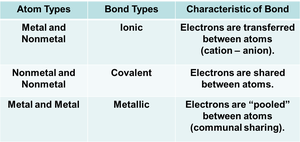
Ionic Bonds: Formed between metals and nonmetals. Electrons are transferred from the metal to the nonmetal, resulting in the formation of cations and anions.
Covalent Bonds: Formed between nonmetals. Electrons are shared between atoms.
Metallic Bonds: Formed between metals. Electrons are pooled and shared communally among all atoms.
Atom Types | Bond Types | Characteristic of Bond |
|---|---|---|
Metal and Nonmetal | Ionic | Electrons are transferred between atoms (cation – anion). |
Nonmetal and Nonmetal | Covalent | Electrons are shared between atoms. |
Metal and Metal | Metallic | Electrons are “pooled” between atoms (communal sharing). |
Bond Polarity and Dipole Moments
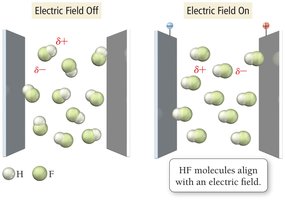
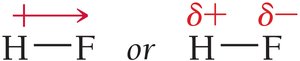
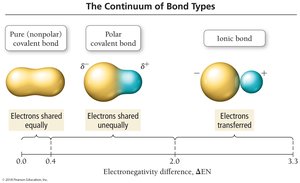
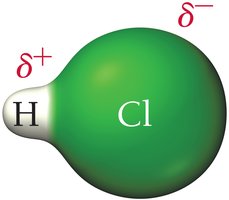
Bond polarity arises when electrons are shared unequally between two atoms due to differences in electronegativity. This creates a dipole moment, with one end of the bond being partially negative (δ–) and the other partially positive (δ+).
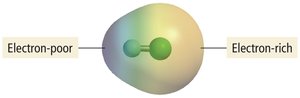
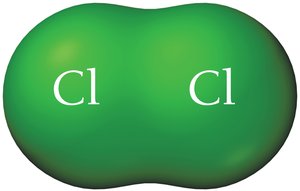
Nonpolar Covalent Bond: Electrons are shared equally (e.g., Cl2).
Polar Covalent Bond: Electrons are shared unequally, resulting in partial charges (e.g., H–F).
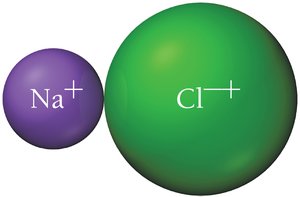
Ionic Bond: Electrons are transferred, resulting in full charges (e.g., Na+Cl–).
Dipole moments can be visualized by the alignment of molecules in an electric field, where polar molecules orient themselves according to the field direction.
Electronegativity
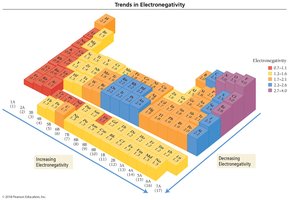
Electronegativity (EN) is the ability of an atom to attract bonding electrons to itself. The greater the difference in electronegativity between two atoms, the more polar the bond.
Electronegativity increases across a period (left to right) and decreases down a group (top to bottom).
Fluorine is the most electronegative element; francium is the least.
The Continuum of Bond Types
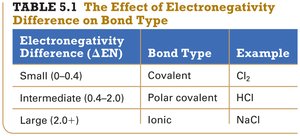
Bonds are classified based on the difference in electronegativity (ΔEN) between the bonded atoms:
Pure (Nonpolar) Covalent: ΔEN = 0–0.4 (e.g., Cl2)
Polar Covalent: ΔEN = 0.4–2.0 (e.g., HCl)
Ionic: ΔEN > 2.0 (e.g., NaCl)
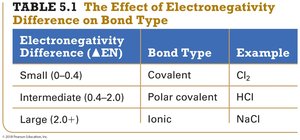
Electronegativity Difference (ΔEN) | Bond Type | Example |
|---|---|---|
Small (0–0.4) | Covalent | Cl2 |
Intermediate (0.4–2.0) | Polar covalent | HCl |
Large (2.0+) | Ionic | NaCl |
Visualizing Bond Polarity
Electron density maps and molecular models help visualize the distribution of electron density in molecules, highlighting regions that are electron-rich or electron-poor.
Dipole Moments of Molecules
The dipole moment (μ) is a quantitative measure of bond polarity. It is calculated as:
Measured in Debye units (D).
Greater ΔEN and bond length lead to larger dipole moments.
Molecule | ΔEN | Dipole Moment (D) |
|---|---|---|
Cl2 | 0 | 0 |
ClF | 1.0 | 0.88 |
HF | 1.9 | 1.82 |
LiF | 3.0 | 6.33 |
Percent Ionic Character
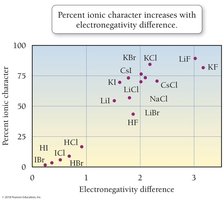
The percent ionic character of a bond is the ratio of the measured dipole moment to the dipole moment if the electron were completely transferred. It increases with increasing electronegativity difference.
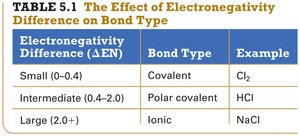
Summary Table: Effect of Electronegativity Difference on Bond Type
Electronegativity Difference (ΔEN) | Bond Type | Example |
|---|---|---|
Small (0–0.4) | Covalent | Cl2 |
Intermediate (0.4–2.0) | Polar covalent | HCl |
Large (2.0+) | Ionic | NaCl |
Key Examples
Cl2: Nonpolar covalent bond, electrons shared equally.
HCl: Polar covalent bond, electrons shared unequally, partial charges develop.
NaCl: Ionic bond, electrons transferred, full charges on ions.
Additional info: The images and tables included reinforce the concepts of bond types, polarity, electronegativity trends, and the relationship between electronegativity difference and bond character, which are foundational for understanding chemical bonding in General Chemistry.
