 뒤로
Chemical Bonding II: Valence Bond Theory, Hybridization, and Molecular Orbital Theory
스터디 가이드 - 스마트 노트
 자료에 맞춘 맞춤형 노트, 핵심 정의, 예시, 맥락을 확장해 제공합니다.
CHAPTER 6: CHEMICAL BONDING II
The Problem with Lewis Theory
Lewis theory provides a foundational understanding of chemical bonding, predicting trends in properties and offering first approximations of bond angles. However, it fails to accurately predict numerical values and certain molecular behaviors, such as magnetism.
Limitations: Lewis theory cannot predict actual bond angles or magnetic properties (e.g., oxygen is paramagnetic, which Lewis theory does not explain).
Need for Advanced Theories: More sophisticated bonding theories are required to address these shortcomings.
A Return to Quantum Theory
Quantum theory describes electrons as occupying atomic orbitals (s, p, d, f). Chemical bonds form when these orbitals interact, and the nature of the interaction depends on their alignment relative to the axis between nuclei.
Bond Length: The distance between atoms at which potential energy is minimized is called the bond length.
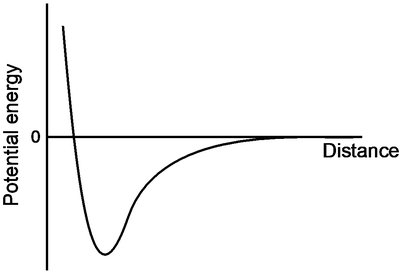
Valence Bond Theory
Valence bond (VB) theory builds on quantum mechanics, proposing that valence electrons reside in atomic or hybrid orbitals. Chemical bonds result from the overlap of half-filled orbitals and spin-pairing of electrons.
Bond Formation: Overlap of two half-filled orbitals leads to a bond; geometry of overlap determines molecular shape.
Hybrid Orbitals: Standard orbitals (s, p, d, f) can combine to form hybrid orbitals.
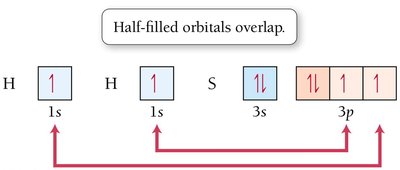
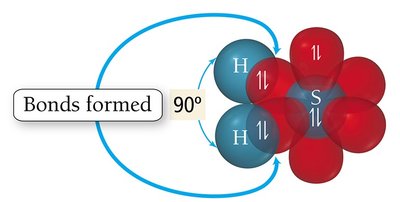
Bonds in Valence Bond Theory
Bonding occurs when atomic or hybrid orbitals interact. The interaction can be direct (along the axis) or parallel (perpendicular to the axis).
Direct Overlap: Orbitals aligned along the axis form sigma (σ) bonds.
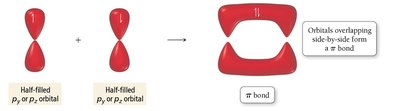
Parallel Overlap: Orbitals parallel and perpendicular to the axis form pi (π) bonds.
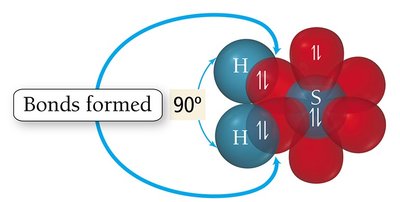
Sigma and Pi Bonds
Sigma (σ) bonds are formed by head-on overlap of orbitals, while pi (π) bonds are formed by side-by-side overlap.
Single Bonds: Always sigma bonds.
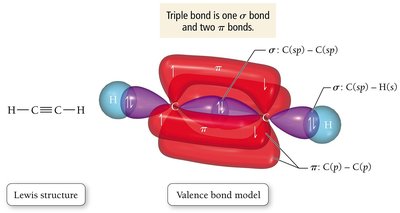
Double/Triple Bonds: Consist of one sigma bond and one or two pi bonds.






Hybridization
Hybridization is the mixing of atomic orbitals to form new hybrid orbitals, maximizing bonding and stability. The type of hybridization depends on the number of electron groups around the atom.
Types: sp, sp2, sp3, sp3d, sp3d2
Example: Carbon can exhibit sp, sp2, or sp3 hybridization.
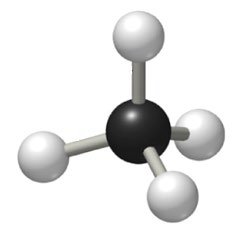
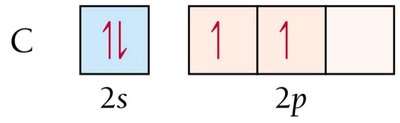
Hybrid Orbitals
The number of hybrid orbitals formed equals the number of atomic orbitals combined. The shape and energy of hybrid orbitals depend on the types of atomic orbitals mixed.
Lowest Energy: The hybridization that yields the lowest energy is favored.
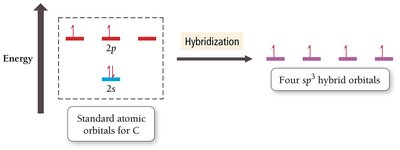
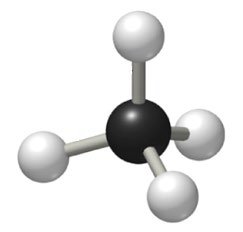
Hybridization: sp3 Orbitals
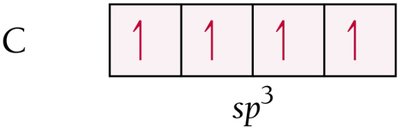
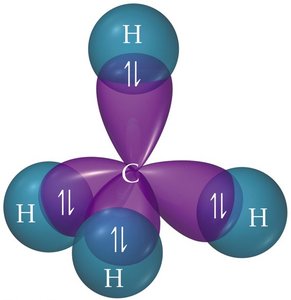
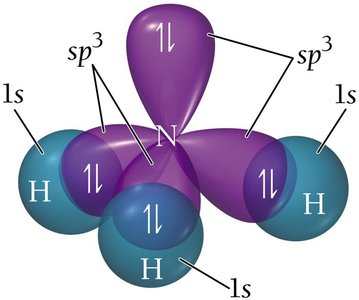
Atoms with four electron groups adopt sp3 hybridization, resulting in tetrahedral geometry and bond angles of 109.5°.
Example: Methane (CH4)
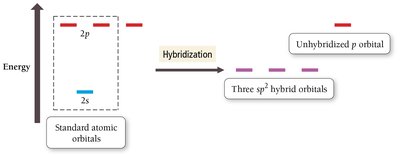
Hybridization: sp2 Orbitals
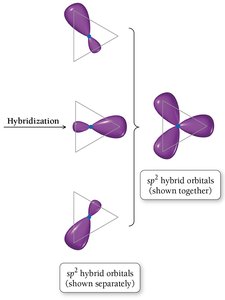
Atoms with three electron groups use sp2 hybridization, resulting in trigonal planar geometry and 120° bond angles.
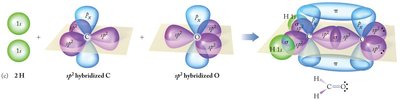
Example: Formaldehyde (CH2O)
Hybridization: Sigma and Pi Bonding
Sigma bonds form when orbitals point along the axis connecting nuclei; pi bonds form when orbitals are parallel and perpendicular to the axis.

Hybridization: Orbital Overlap
Overlap between hybrid orbitals on different atoms forms sigma bonds, while overlap between unhybridized p orbitals forms pi bonds.
Hybridization: sp Orbitals
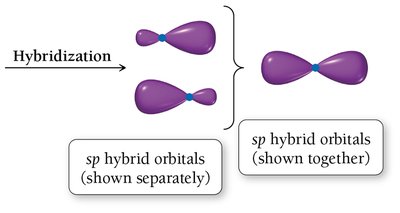
Atoms with two electron groups use sp hybridization, resulting in linear geometry and 180° bond angles.
Example: Acetylene (C2H2)
Bond Rotation
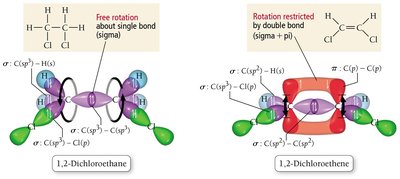
Sigma bonds allow free rotation around the bond axis, while pi bonds restrict rotation due to their side-by-side overlap.
Single Bonds: Free rotation (sigma bond)
Double/Triple Bonds: Restricted rotation (pi bond)
Cis and Trans Isomers
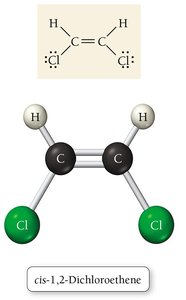
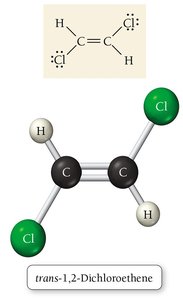
Double bonds cannot rotate, leading to cis and trans isomers, which differ in the spatial arrangement of substituents.
Cis Isomer: Substituents on the same side
Trans Isomer: Substituents on opposite sides
Hybridization: sp3d and sp3d2 Orbitals
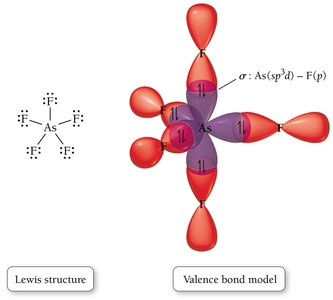
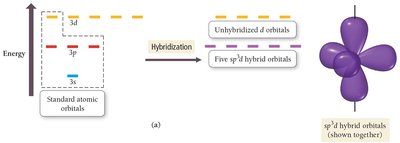
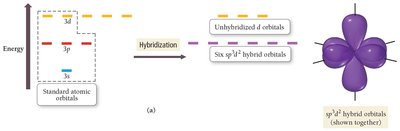
Atoms with five or six electron groups use sp3d or sp3d2 hybridization, resulting in trigonal bipyramidal or octahedral geometries, respectively.
sp3d: Trigonal bipyramidal, 120° and 90° angles
sp3d2: Octahedral, 90° angles
Hybrid Orbitals and Steric Number: Summary Table
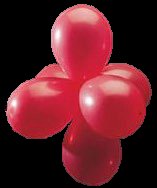
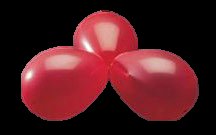
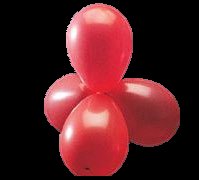
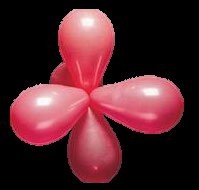
The steric number (number of electron groups) determines the hybridization and geometry of the central atom.
Electron Groups | Electron Pair Geometry | # of Hybrid Orbitals | Hybrid Orbitals |
|---|---|---|---|
2 | Linear | 2 | sp |
3 | Trigonal planar | 3 | sp2 |
4 | Tetrahedral | 4 | sp3 |
5 | Trigonal bipyramidal | 5 | sp3d |
6 | Octahedral | 6 | sp3d2 |
Molecular Orbital (MO) Theory
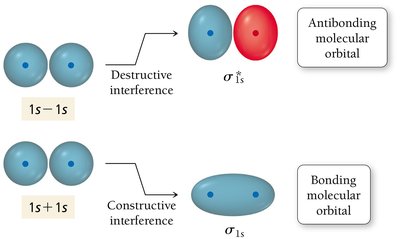
MO theory constructs molecular orbitals from atomic orbitals using quantum mechanics. Constructive combination forms bonding orbitals (lower energy), while destructive combination forms antibonding orbitals (higher energy).
Bonding MO: Electron density between nuclei, designated σ or π
Antibonding MO: Electron density outside nuclei, designated σ* or π*
MO Theory and Properties
Bond order is calculated as half the difference between the number of electrons in bonding and antibonding orbitals. Higher bond order indicates stronger bonds.
Bond Order Formula:
Magnetism: Unpaired electrons in MO diagrams indicate paramagnetism; all paired electrons indicate diamagnetism.
Molecular Orbitals of H2
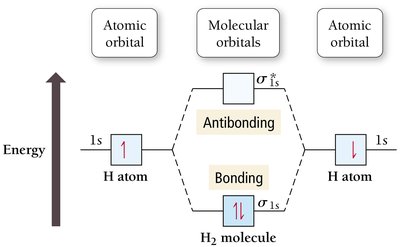
In H2, two 1s atomic orbitals combine to form one bonding (σ1s) and one antibonding (σ1s*) molecular orbital.
MO Theory: He2 and He2+
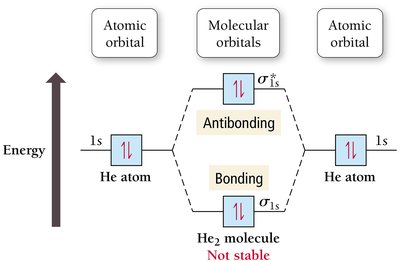
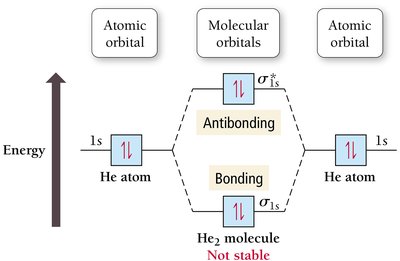
He2 does not exist because its bond order is zero (equal numbers of electrons in bonding and antibonding orbitals). He2+ can exist with a bond order of 0.5.
Summarizing MO Theory
MOs are linear combinations of AOs. The number of MOs equals the number of AOs. Electrons fill the lowest energy MOs first, following Hund's rule for degenerate orbitals. Stable bonds require positive bond order.
Second Row Homonuclear Diatomic Molecules
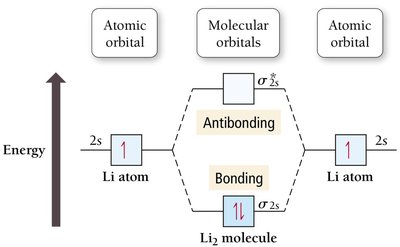
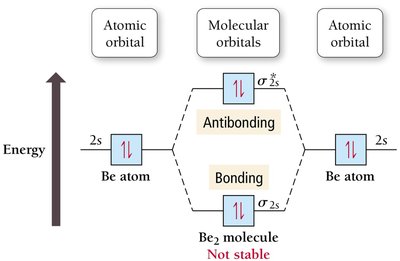
MO diagrams for Li2 and Be2 show differences in stability based on bond order.
P Orbital Interactions
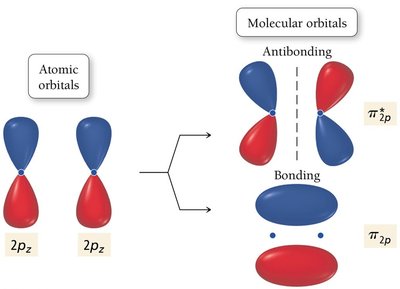
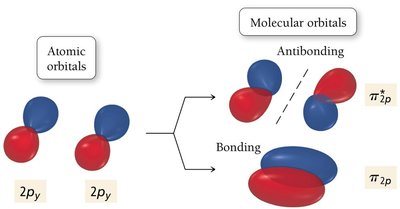
2p orbitals interact to form π and π* molecular orbitals, with electron density distributed above and below the internuclear axis.
MO Diagrams with P Orbitals
MO diagrams for diatomic molecules with p orbitals show the arrangement of bonding and antibonding orbitals.
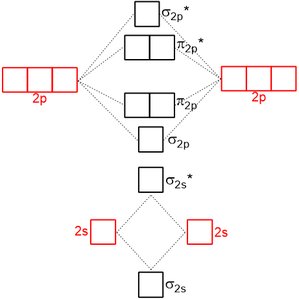
MO Diagram of O2
O2 has unpaired electrons in its MO diagram, explaining its paramagnetic behavior.
Homonuclear Diatomic Molecules: 2s-2p Mixing
For B2, C2, and N2, 2s and 2p orbitals are close in energy, causing mixing and affecting the energy ordering of molecular orbitals.
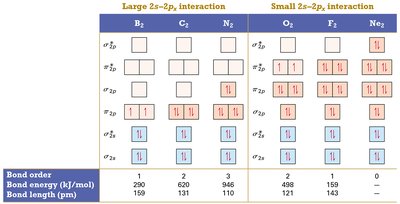
Practice: MO Diagram for N2–
Draw an MO energy diagram and determine the bond order for N2–. Compare its bond strength and magnetic properties to N2.
Additional info: Academic context and explanations have been expanded for clarity and completeness. Tables and diagrams have been recreated and described for study purposes.
