뒤로
Chemical Equilibrium, Acid-Base Equilibria, and Aqueous Equilibria: Exam 2 Study Guide
스터디 가이드 - 스마트 노트
 자료에 맞춘 맞춤형 노트, 핵심 정의, 예시, 맥락을 확장해 제공합니다.
Chapter 15 – Chemical Equilibrium
15.1 The Concept of Chemical Equilibrium
Chemical equilibrium occurs when the rates of the forward and reverse reactions are equal, resulting in constant concentrations of reactants and products over time. This does not mean the reactions stop, but rather that they proceed at equal rates.
Equilibrium: The state in which the concentrations of reactants and products remain unchanged because the forward and reverse reaction rates are equal.
Dynamic Process: Both forward and reverse reactions continue to occur.
Concentration Stability: The concentrations of all species involved remain constant at equilibrium.
15.2 The Equilibrium Constant
The equilibrium constant (Kc) quantifies the ratio of product to reactant concentrations at equilibrium for a given reaction. It can also be expressed in terms of partial pressures (Kp).
Kc: The equilibrium constant in terms of concentration (mol/L).
Kp: The equilibrium constant in terms of partial pressures (atm).
Conversion: , where is the change in moles of gas.
Units: Depend on the reaction stoichiometry.
Expression: For a reaction ,
15.3 Using Equilibrium Constants
The magnitude of Kc indicates whether a reaction favors products or reactants. Manipulating equilibrium equations affects the value of Kc.
Large Kc: Reaction favors products ("leans right").
Small Kc: Reaction favors reactants ("leans left").
Reversing Reaction: becomes .
Multiplying Equation: is raised to the power of the coefficient.
Combining Equations: Multiply individual values.
15.4 Heterogeneous Equilibria
Heterogeneous equilibrium involves reactants and products in different phases. Only concentrations of gases and aqueous species are included in equilibrium expressions; pure solids and liquids are omitted.
Rule: Exclude pure solids and liquids from equilibrium constant expressions.
15.5 Calculating Equilibrium Constants
Equilibrium constants can be calculated using equilibrium concentrations or by setting up ICE tables when concentrations are not given.
ICE Table: Stands for Initial, Change, Equilibrium; used to organize and solve equilibrium problems.
Quadratic Equation: Sometimes required to solve for unknown concentrations.
Formula: ,
15.6 Some Applications of Equilibrium Constants
The reaction quotient (Q) is calculated similarly to Kc but uses initial concentrations. Comparing Q to Kc predicts the direction of the reaction.
Q < Kc: Reaction proceeds forward.
Q > Kc: Reaction proceeds in reverse.
Q = Kc: System is at equilibrium.
15.7 Le Chatelier’s Principle
Le Chatelier’s Principle states that a system at equilibrium will adjust to counteract any imposed change.
Concentration: Adding/removing reactants or products shifts equilibrium.
Pressure/Volume: Changes affect gaseous equilibria; equilibrium shifts toward the side with fewer moles of gas when pressure increases.
Temperature: Exothermic reactions shift left when heated; endothermic shift right.
Catalyst: Speeds up attainment of equilibrium but does not affect position.
Chapter 16 – Acid-Base Equilibria
16.1 Classification of Acids and Bases
Acids and bases are classified by their behavior in water and their ability to donate or accept protons or electron pairs.
Arrhenius: Acids produce H+, bases produce OH- in water.
Brønsted–Lowry: Acids donate protons (H+), bases accept protons.
Lewis: Acids accept electron pairs, bases donate electron pairs.
Amphiprotic: Water can act as both an acid and a base.
16.2 Conjugate Acid-Base Pairs
Conjugate pairs differ by one proton. The strength of an acid is inversely related to the strength of its conjugate base.
Conjugate Acid: Formed when a base gains a proton.
Conjugate Base: Formed when an acid loses a proton.
Ka/Kb: Larger values indicate stronger acids/bases.
16.3 The Autoionization of Water
Water autoionizes to form H+ and OH-. The equilibrium constant for this process is Kw.
Equation:
Kw:
pH/pOH: ,
Relationship:
16.4 The pH Scale
The pH scale measures the acidity or basicity of a solution. Neutral solutions have pH 7, acidic <7, basic >7.
Calculation:
Interconversion:
Logarithmic Functions: Used to relate concentrations and pH.
16.5 Strong Acids and Bases
Strong acids and bases dissociate completely in water. There are 7 strong acids and 8 strong bases to memorize.
Strong Acid: Complete ionization; e.g., HCl, HNO3.
Strong Base: Complete ionization; e.g., NaOH, KOH.
pH Calculation: Directly from concentration.
16.6 Weak Acids
Weak acids only partially dissociate. Their strength is quantified by the acid-dissociation constant (Ka).
Ka Expression:
ICE Table: Used to solve equilibrium problems.
Quadratic Equation: Sometimes required for calculations.
"Cheat" Method: For very weak acids,
16.7 Weak Bases
Weak bases partially accept protons. Their strength is quantified by the base-dissociation constant (Kb).
Kb Expression:
ICE Table: Used for calculations.
Relationship:
16.8 The Relationship Between Ka and Kb
Ka and Kb are related for conjugate acid-base pairs. Their product equals Kw.
Equation:
pKa + pKb = pKw = 14$
Chapter 17 – Aqueous Equilibria: Buffers, Titrations, and Solubility
17.1 The Common-Ion Effect
The common-ion effect occurs when a solution contains two substances that share a common ion, affecting equilibrium and properties like pH and solubility.
Effect: Addition of a common ion suppresses ionization.
Calculation: Requires ICE table analysis.
17.2 Buffers
Buffers are solutions that resist changes in pH when small amounts of acid or base are added. They consist of a weak acid and its conjugate base, or a weak base and its conjugate acid.
Henderson-Hasselbalch Equation:
Buffer Formation: Requires both components present.
17.3 Acid-Base Titrations
Titrations involve the gradual addition of one solution to another to determine concentration or pH. The equivalence point is where stoichiometric amounts react.
Equivalence Point: Moles of acid equal moles of base.
Endpoint: Indicator changes color; may not coincide with equivalence point.
Types: Strong/strong, strong/weak titrations.
Calculations: May involve ICE tables, pH, volume, concentration.
17.4 Solubility Equilibria
Solubility equilibria describe the dissolution of salts in water. The solubility product constant (Ksp) quantifies this equilibrium.
Ksp Expression: For ,
Calculations: Find Ksp from ion concentrations or vice versa.
Molar Solubility: Amount dissolved per liter.
17.5 Factors that Affect Solubility
Solubility can be affected by the presence of a common ion, acidity, or formation of complex ions.
Common Ion: Decreases solubility.
Acidic Solution: Can increase solubility of salts containing basic anions.
Complex Ion Formation: Increases solubility.
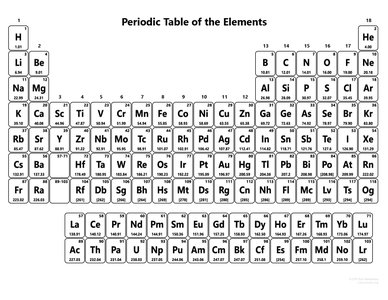
Periodic Table of the Elements
The periodic table is a fundamental reference for understanding element properties, atomic numbers, and relationships in chemical reactions, including those discussed in equilibrium and acid-base chemistry.