 뒤로
Chemical Equilibrium: Principles, Expressions, and Applications
스터디 가이드 - 스마트 노트
 자료에 맞춘 맞춤형 노트, 핵심 정의, 예시, 맥락을 확장해 제공합니다.
Chemical Equilibrium
Dynamic Equilibrium
Chemical equilibrium is a dynamic state in which the rates of the forward and reverse reactions are equal, resulting in constant concentrations of reactants and products in a closed system. This concept is fundamental to understanding how chemical reactions behave under various conditions.
Dynamic equilibrium means that both the forward and reverse reactions continue to occur, but there is no net change in the concentrations of reactants and products.
Equilibrium can be observed in various physical and chemical systems, such as saturated solutions, vapor pressure equilibrium, and gas-phase reactions.
Equilibrium is only achieved in closed systems where no substances can enter or leave.
Visualizing Chemical Equilibrium: The N2O4/NO2 System
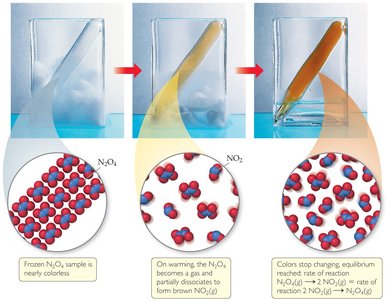
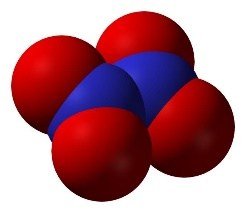
The equilibrium between dinitrogen tetroxide (N2O4) and nitrogen dioxide (NO2) is a classic example used to illustrate dynamic equilibrium. N2O4 is colorless, while NO2 is brown, making the equilibrium visually apparent.
The reaction: N2O4(g) ↔ 2 NO2(g)
At equilibrium, the rate of N2O4 dissociation equals the rate of NO2 recombination.
The color intensity in the reaction vessel stabilizes, indicating equilibrium has been reached.
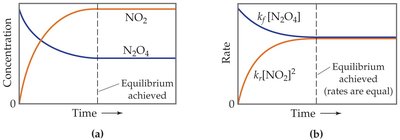
Concentration and Rate Changes at Equilibrium
As a reaction approaches equilibrium, the concentrations of reactants and products change until they reach constant values. The rates of the forward and reverse reactions also become equal at equilibrium.
Before equilibrium, the forward reaction rate is higher; as products accumulate, the reverse rate increases.
At equilibrium, both rates are equal, and concentrations remain constant.
The Equilibrium Constant
Definition and Expression
The equilibrium constant (K) quantifies the ratio of product and reactant concentrations at equilibrium for a given reaction. It is derived from the law of mass action and is specific to a particular reaction at a given temperature.
For a general reaction: aA + bB ↔ dD + eE
The equilibrium constant expression is:
K is dimensionless and depends only on temperature, not on initial concentrations.
Example: The Haber Process
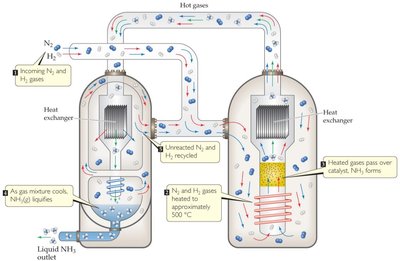
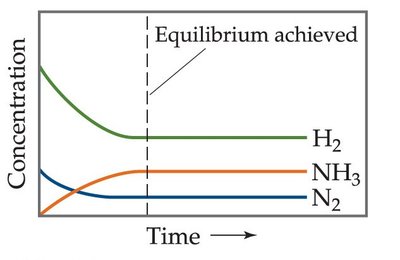
The Haber process synthesizes ammonia from nitrogen and hydrogen gases and is a key industrial reaction. The equilibrium constant expression for this reaction is essential for optimizing ammonia production.
Reaction: N2(g) + 3 H2(g) ↔ 2 NH3(g)
Equilibrium constant expression:
High temperature and pressure are required to achieve a practical yield of ammonia.
Calculating the Equilibrium Constant
To determine the equilibrium constant, measure the concentrations of all species at equilibrium and substitute them into the equilibrium constant expression.
Example: For N2O4(g) ↔ 2 NO2(g), if [N2O4] = 0.0045 M and [NO2] = 0.0310 M at equilibrium:
Relationship Between Kc and Kp
Equilibrium Constants for Gaseous Reactions
For reactions involving gases, the equilibrium constant can be expressed in terms of concentrations (Kc) or partial pressures (Kp). The two are related by the equation:
Where is the change in moles of gas: (moles of gaseous products) (moles of gaseous reactants)
R is the gas constant (0.08206 L·atm·mol−1·K−1), and T is temperature in Kelvin.
Activities and Units in Equilibrium Calculations
Activities and Approximations
Strictly, equilibrium constants are calculated using activities, which are dimensionless. In practice, concentrations (in molarity) and partial pressures (in atm) are used as approximations for activities in ideal solutions and gases.
Substance | Activity | Simplified Form |
|---|---|---|
Ideal gas | P/(1 atm) | P (in atmospheres) |
Solute in ideal solution | [C]/(1 M) | [C] (in molarity) |
Pure solid or liquid | 1 | 1 |
Solids and liquids do not appear in the equilibrium constant expression because their activities are defined as 1.
As systems deviate from ideality, these approximations become less accurate.
