 뒤로
Chemical Equilibrium: The Extent of Chemical Reactions
스터디 가이드 - 스마트 노트
 자료에 맞춘 맞춤형 노트, 핵심 정의, 예시, 맥락을 확장해 제공합니다.
Equilibrium: The Extent of Chemical Reactions
The Equilibrium State and the Equilibrium Constant
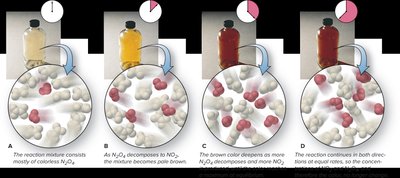
Chemical equilibrium is a dynamic state in which the rates of the forward and reverse reactions are equal, resulting in no net change in the concentrations of reactants and products. All reactions are reversible and, under suitable conditions, will reach equilibrium. At equilibrium, the system appears static macroscopically, but molecular changes continue to occur.
Dynamic Equilibrium: The forward and reverse reactions continue at equal rates.
Equilibrium Constant (K): The ratio of product concentrations to reactant concentrations at equilibrium, each raised to the power of their coefficients in the balanced equation.
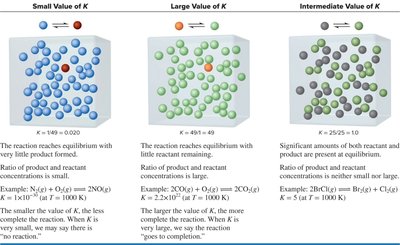
Extent of Reaction: The value of K indicates how far a reaction proceeds toward products at a given temperature.
Small K: Reaction favors reactants; little product is formed.
Large K: Reaction favors products; little reactant remains.
The Reaction Quotient (Q) and the Equilibrium Constant (K)
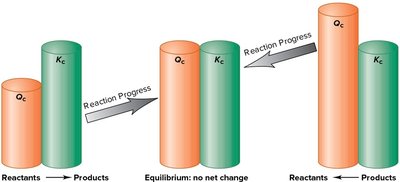
The reaction quotient, Q, is calculated using the same expression as K but with current (not necessarily equilibrium) concentrations. Comparing Q to K determines the direction in which a reaction will proceed to reach equilibrium.
If Q < K: The reaction proceeds toward products (right).
If Q > K: The reaction proceeds toward reactants (left).
If Q = K: The system is at equilibrium; no net change occurs.
Heterogeneous Equilibria
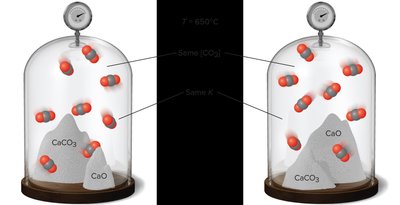
Heterogeneous equilibria involve reactants and/or products in different phases. The concentrations of pure solids and liquids are constant and are omitted from the expressions for Q and K. Only species whose concentrations change are included.
Example: For the reaction CaCO3(s) ⇌ CaO(s) + CO2(g), Q = [CO2].
Forms of K and Q
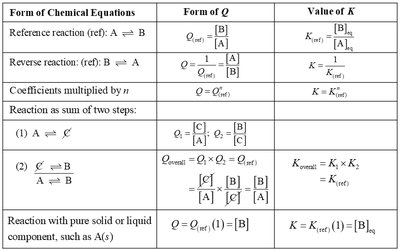
The form of Q and K depends on how the balanced equation is written:
Reversing the reaction inverts K (Kreverse = 1/Kforward).
Multiplying the equation by n raises K to the nth power.
Adding reactions multiplies their K values.
Form of Chemical Equations | Form of Q | Value of K |
|---|---|---|
Reference reaction: A ⇌ B | Q = [B]/[A] | K = [B]eq/[A]eq |
Reverse reaction: B ⇌ A | Q = [A]/[B] | K = 1/Kref |
Coefficients multiplied by n | Q = ([B]/[A])n | K = (Kref)n |
Sum of two steps | Qoverall = Q1 × Q2 | Koverall = K1 × K2 |
Pure solid or liquid component | Q = [B] | K = [B]eq |
Expressing Equilibria with Pressure Terms: Kc and Kp
For gaseous reactions, equilibrium can be expressed in terms of partial pressures (Kp) or concentrations (Kc). The two are related by the equation:
Where Δn is the change in moles of gas (moles of gaseous products minus moles of gaseous reactants).
Solving Equilibrium Problems
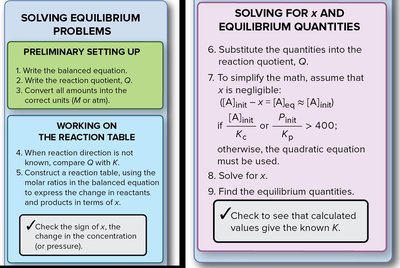
To solve equilibrium problems, a reaction table (ICE table: Initial, Change, Equilibrium) is used to organize data and solve for unknowns. The quadratic formula may be required if the simplifying assumption (that x is negligible) is not justified.
Write the balanced equation and the expression for Q or K.
Set up the reaction table with initial, change, and equilibrium values.
Substitute equilibrium values into the K expression and solve for x.
Check if the simplifying assumption is valid: if the change is less than 5% of the initial concentration, it is justified.
Le Châtelier’s Principle
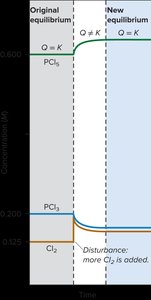
Le Châtelier’s Principle states that if a system at equilibrium is disturbed, it will shift to counteract the disturbance and re-establish equilibrium. Common disturbances include changes in concentration, pressure (volume), and temperature.
Change in Concentration: Adding reactant shifts equilibrium toward products; adding product shifts toward reactants.
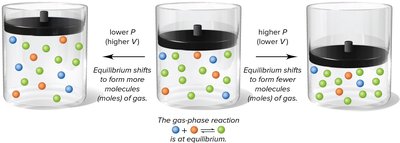
Change in Pressure/Volume: Increasing pressure (decreasing volume) shifts equilibrium toward the side with fewer moles of gas; decreasing pressure (increasing volume) shifts toward more moles of gas.
Change in Temperature: For endothermic reactions, increasing temperature shifts equilibrium toward products (K increases); for exothermic reactions, increasing temperature shifts toward reactants (K decreases).
Catalysts: Speed up the attainment of equilibrium but do not affect the equilibrium position or K.
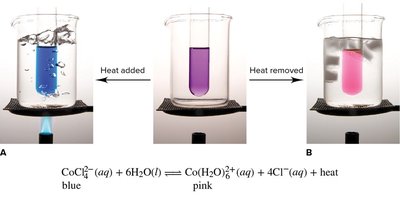
Summary Table: Effects of Disturbances on Equilibrium
Disturbance | Effect on Equilibrium Position | Effect on Value of K |
|---|---|---|
Increase [reactant] | Toward formation of product | None |
Decrease [reactant] | Toward formation of reactant | None |
Increase [product] | Toward formation of reactant | None |
Decrease [product] | Toward formation of product | None |
Increase P (decrease V) | Toward fewer moles of gas | None |
Decrease P (increase V) | Toward more moles of gas | None |
Increase P (add inert gas, no ΔV) | None | None |
Increase T (ΔH > 0) | Toward absorption of heat | Increases |
Increase T (ΔH < 0) | Toward absorption of heat | Decreases |
Decrease T (ΔH > 0) | Toward release of heat | Decreases |
Decrease T (ΔH < 0) | Toward release of heat | Increases |
Catalyst added | None; equilibrium reached sooner | None |
Using Molecular Scenes to Analyze Equilibrium
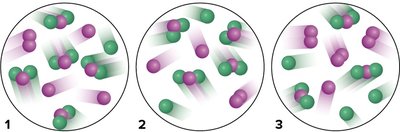
Molecular diagrams can be used to visualize the relative amounts of reactants and products at equilibrium and to predict the direction of reaction when the system is not at equilibrium. By counting particles and calculating Q, one can determine whether the reaction will proceed toward products or reactants to reach equilibrium.

Key Equations
General equilibrium constant (Kc): for the reaction aA + bB ⇌ cC + dD
Relationship between Kp and Kc:
van’t Hoff equation (effect of temperature on K):
Additional info: These notes cover the core concepts of chemical equilibrium, including the equilibrium constant, the reaction quotient, Le Châtelier’s Principle, and the mathematical and conceptual tools needed to analyze equilibrium systems. They are suitable for college-level General Chemistry students preparing for exams or seeking a concise, structured summary of the topic.
