 뒤로
Chemical Kinetics: Reaction Rates, Mechanisms, and Catalysis
스터디 가이드 - 스마트 노트
 자료에 맞춘 맞춤형 노트, 핵심 정의, 예시, 맥락을 확장해 제공합니다.
Chemical Kinetics
Introduction to Kinetics
Chemical kinetics is the study of the rates at which chemical reactions occur and the factors that affect these rates. Understanding kinetics allows chemists to control reactions and optimize conditions for industrial and laboratory processes.
Defining Reaction Rate
Rate of Reaction
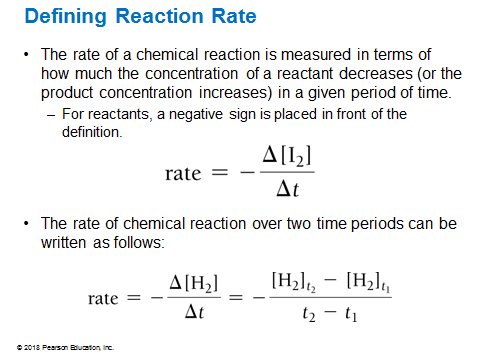
The rate of a chemical reaction is defined as the change in concentration of a reactant or product per unit time. For reactants, the rate is negative because their concentration decreases over time; for products, it is positive.
General formula for rate (for a reactant):
For products:
The rate over a time interval to can be written as:
Stoichiometry and Rate Expressions
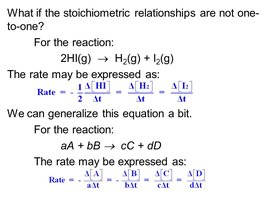
When reactions do not have a 1:1 stoichiometric ratio, the rate expression must account for the coefficients:
For :
Types of Reaction Rates
Initial, Average, and Instantaneous Rates
Reaction rates can be measured in different ways:
Initial rate: The rate at the very start of the reaction (t = 0).
Average rate: The rate over a finite time interval.
Instantaneous rate: The rate at a specific moment, found by the slope of the tangent to the concentration vs. time curve.
Arrhenius Equation and Temperature Dependence
The Arrhenius Equation
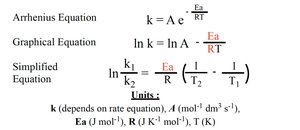
The Arrhenius equation describes how the rate constant () depends on temperature and activation energy ():
= frequency factor (s-1)
= activation energy (J/mol)
= gas constant (8.314 J/(mol·K))
= temperature (K)
The equation can be rearranged for graphical analysis:
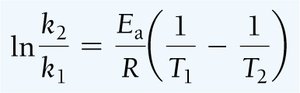
Or, for two temperatures:
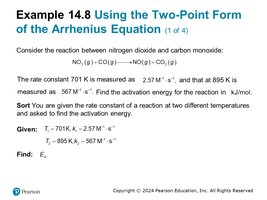
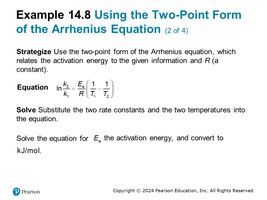
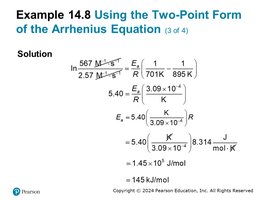
Example: Using the Two-Point Form of the Arrhenius Equation
Given two rate constants at different temperatures, the activation energy can be calculated using the two-point form of the Arrhenius equation.
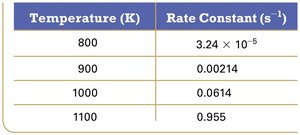
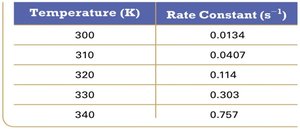
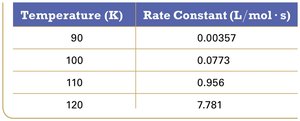
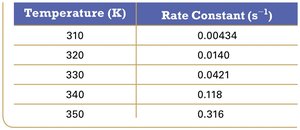
Experimental Data: Rate Constants at Different Temperatures
Tables of rate constants at various temperatures are used to construct Arrhenius plots and determine activation energies.
Temperature (K) | Rate Constant (s-1) |
|---|---|
800 | 3.24 × 10⁻⁵ |
900 | 0.00214 |
1000 | 0.0614 |
1100 | 0.955 |
Temperature (K) | Rate Constant (s-1) |
|---|---|
300 | 0.0134 |
310 | 0.0407 |
320 | 0.114 |
330 | 0.303 |
340 | 0.757 |
Temperature (K) | Rate Constant (L/mol·s) |
|---|---|
90 | 0.00357 |
100 | 0.0773 |
110 | 0.956 |
120 | 7.781 |
Temperature (K) | Rate Constant (s-1) |
|---|---|
310 | 0.00434 |
320 | 0.0140 |
330 | 0.0421 |
340 | 0.118 |
350 | 0.316 |
Reaction Mechanisms
Elementary Steps and Rate-Determining Step
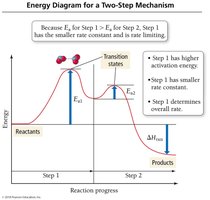
Many reactions occur in a series of steps called elementary steps. The slowest step is the rate-determining step, which controls the overall reaction rate.
The rate law for the overall reaction is determined by the rate-determining step.
Intermediates are species produced and consumed within the mechanism but do not appear in the overall reaction.
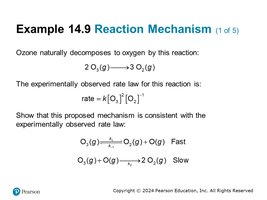
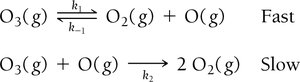
Example: Ozone Decomposition Mechanism
For the reaction , the experimentally observed rate law is , which can be explained by a two-step mechanism involving a fast equilibrium and a slow step.
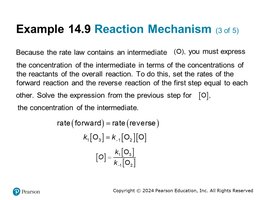
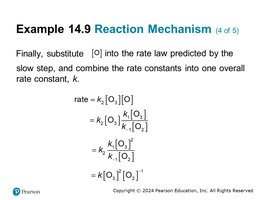
Fast Equilibrium Steps
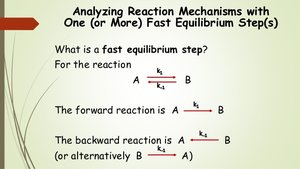
When a mechanism contains a fast equilibrium step, the concentration of intermediates can be related to the concentrations of reactants using equilibrium expressions.
Catalysis
Role of Catalysts
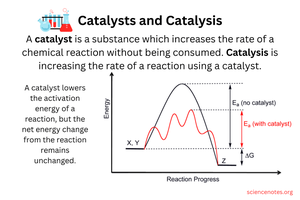
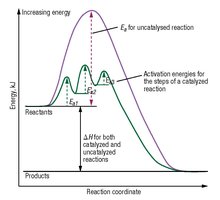
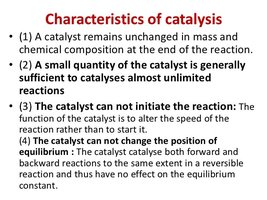
A catalyst is a substance that increases the rate of a chemical reaction without being consumed. Catalysts work by lowering the activation energy, providing an alternative pathway for the reaction.
Homogeneous catalysts: Present in the same phase as the reactants.
Heterogeneous catalysts: Present in a different phase than the reactants.
Summary Table: Key Equations in Kinetics
Equation | Description |
|---|---|
General rate for a reactant | |
Arrhenius equation | |
Linearized Arrhenius equation | |
Two-point Arrhenius equation | |
General rate law (m, n = reaction orders) |
Additional info: This guide covers the foundational concepts of chemical kinetics, including reaction rates, the Arrhenius equation, reaction mechanisms, and catalysis, with relevant equations and graphical representations for General Chemistry students.
