 뒤로
Chemical Reactions and Chemical Quantities: Core Concepts and Applications
스터디 가이드 - 스마트 노트
 자료에 맞춘 맞춤형 노트, 핵심 정의, 예시, 맥락을 확장해 제공합니다.
Chapter 4: Chemical Reactions and Chemical Quantities
Outline of Key Topics
Balancing Chemical Equations
Stoichiometry
Limiting Reactant, Theoretical Yield, and Percent Yield
Global Warming: Greenhouse Gases
Combustion, Alkali Metal, and Halogen Reactions
Chemical Reactions
Definition and Types
A chemical reaction is a process in which one or more substances (reactants) are converted into one or more different substances (products). Chemical reactions involve changes in the arrangement of atoms and result in the formation of new chemical substances.
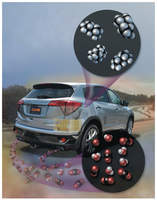
Combustion reaction: A type of chemical reaction where a substance combines with oxygen to form one or more oxygen-containing compounds, often releasing heat.
Example: The reaction of methane with oxygen to produce carbon dioxide and water is a classic combustion reaction.
Chemical Equations
Representation and Information
Chemical equations are shorthand notations that describe chemical reactions. They provide:
Formulas of reactants and products
States of reactants and products (solid, liquid, gas, aqueous)
Relative numbers of molecules or moles involved
Balancing chemical equations ensures the Law of Conservation of Mass is obeyed—there must be equal numbers of each type of atom on both sides of the equation.
States of Reactants and Products
States are indicated in parentheses after each formula:
(s): solid
(l): liquid
(g): gas
(aq): aqueous (dissolved in water)
Balancing Chemical Equations
Principles and Practice
To balance a chemical equation, adjust the coefficients (numbers in front of formulas) so that the number of atoms of each element is the same on both sides. Never change the subscripts in chemical formulas.
Example: The combustion of methane must be balanced to reflect the conservation of mass.
Stoichiometry
Quantitative Relationships in Reactions
Stoichiometry is the study of the numerical relationships between the amounts of reactants and products in a chemical reaction. The coefficients in a balanced equation specify the relative amounts in moles of each substance involved.
Example: In the combustion of octane, 2 moles of octane react with 25 moles of oxygen to form 16 moles of carbon dioxide and 18 moles of water.
Mole-to-Mole Conversions
Use the coefficients from the balanced equation to convert between moles of different substances.
Example: Burning 22.0 moles of octane produces 176 moles of carbon dioxide, using the stoichiometric ratio from the balanced equation.
Mass-to-Mass Conversions
To convert between masses of reactants and products:
Convert mass of reactant to moles using molar mass.
Use the stoichiometric ratio from the balanced equation to find moles of product.
Convert moles of product to mass using molar mass.
Limiting Reactant, Theoretical Yield, and Percent Yield
Concepts and Calculations
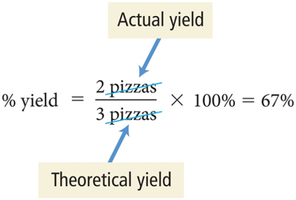
In a chemical reaction, the limiting reactant is the reactant that is completely consumed first, thus limiting the amount of product formed. The theoretical yield is the maximum amount of product that can be made based on the limiting reactant. The actual yield is the amount of product actually obtained from the reaction. Percent yield is calculated as:
Example: Pizza Analogy
If you have enough crusts for 4 pizzas, cheese for 5, and sauce for 3, you can only make 3 pizzas—the sauce is the limiting reactant. The theoretical yield is 3 pizzas; if you actually make 2, the percent yield is 67%.
Global Warming and Greenhouse Gases
Role of Chemical Reactions
Combustion of fossil fuels produces carbon dioxide (CO2), a major greenhouse gas. Greenhouse gases trap heat in the atmosphere, contributing to global warming.
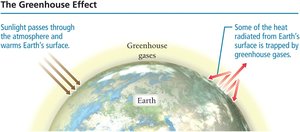
Trends in Atmospheric CO2 and Temperature
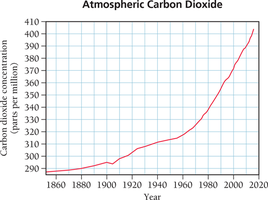
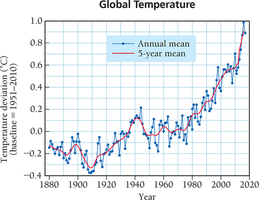
Since 1880, atmospheric CO2 levels have risen by 38%, and Earth's average temperature has increased by about 1.0°C. These trends are closely linked to human activities, especially the burning of fossil fuels.
Combustion Reactions
Characteristics and Examples
Combustion reactions involve a substance reacting with oxygen to form one or more oxygen-containing compounds, often including water, and releasing heat. For example, natural gas (methane) reacts with oxygen to form carbon dioxide and water.
Alkali Metal and Halogen Reactions
Alkali Metal Reactions
Alkali metals react vigorously with nonmetals, such as sodium reacting with chlorine to form sodium chloride. They also react with water to produce dissolved alkali metal ions, hydroxide ions, and hydrogen gas. The reactivity increases down the group.
Halogen Reactions
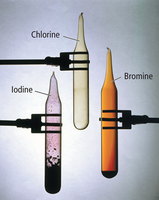
Halogens react with many metals to form metal halides, with hydrogen to form hydrogen halides, and with each other to form interhalogen compounds.
Summary Table: States of Reactants and Products in Chemical Equations
Symbol | State |
|---|---|
(s) | Solid |
(l) | Liquid |
(g) | Gas |
(aq) | Aqueous (dissolved in water) |
Additional info: The above table is a standard classification used in chemical equations to indicate the physical state of each substance involved.
